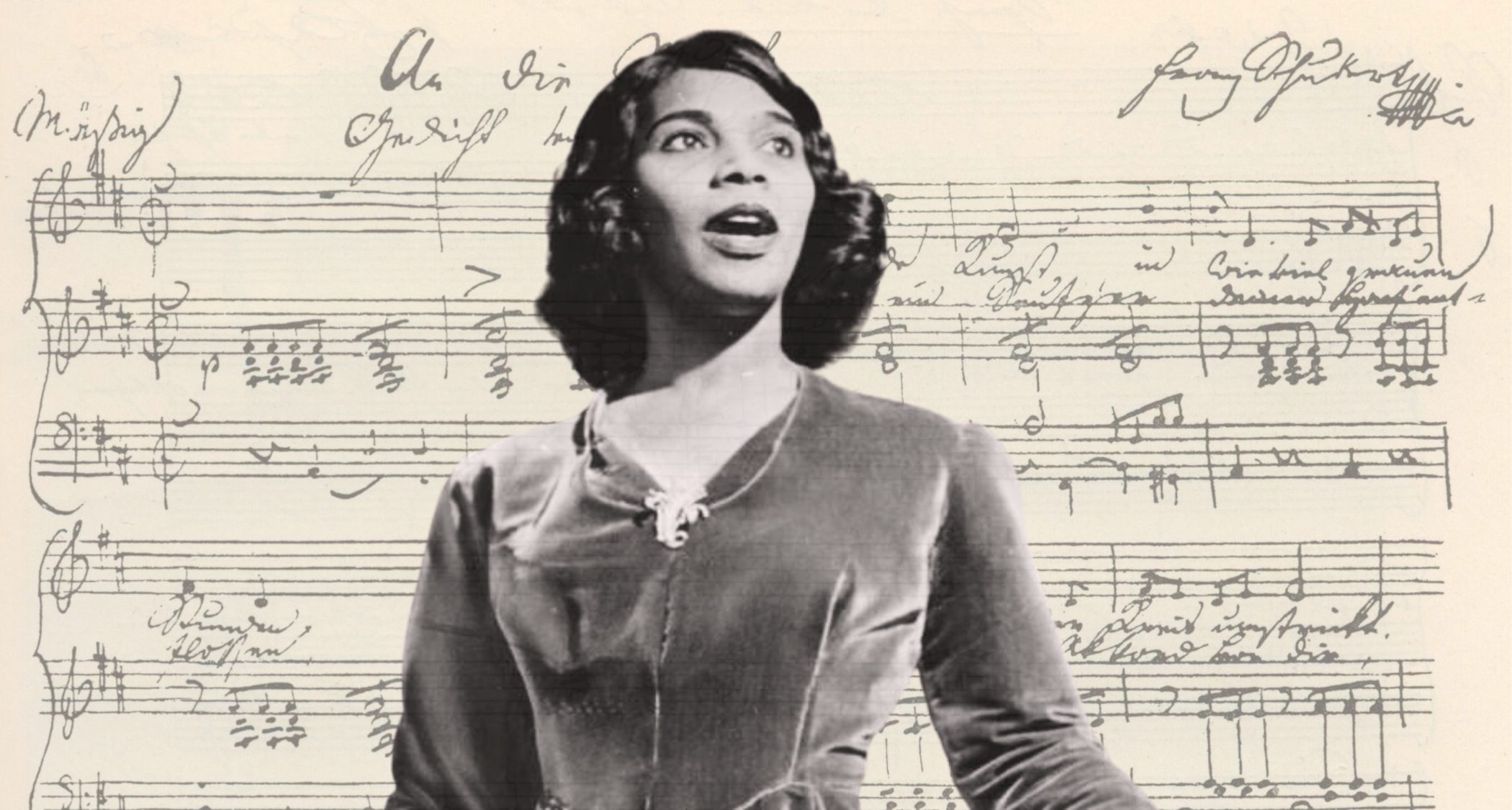
Beauty in Ambiguity: On Marian Anderson’s Lifelong Love For Schubert
Anthony Tommasini Explores the Singer’s Relationship With Music From Both Sides of the Atlantic
When you’re young, or not so young, and strongly drawn to a genre of music, a certain composer, a particular piece, it’s often hard to explain why, even to yourself. This may be especially true of music unfamiliar to you. Music works powerfully on a subliminal level. Sometimes we prefer to keep it that way and not try to account for how it speaks to us.
So it was with Marian Anderson’s lifelong love of Schubert’s songs. She was never very clear about what gripped her, starting from the epiphany she had as a young teenager when she heard Roland Hayes sing Schubert songs in a recital at her church; though she understood not a word of the German texts, she was transfixed. Some fifteen years later, her determination to study Schubert lieder with expert teachers was in large part what impelled her to go to Europe.
During the prime years of her career, while widely acknowledged as an exceptional Schubert singer with impeccable German diction, Anderson still avoided expounding on the music. When selecting songs for a recital program, she later explained, she always looked first to Schubert, “the composer I love best,” who wrote “hundreds of them,” each “more beautiful than the last.” But she left it at that and seldom said more. Schubert’s songs, she noted, “were rewarding for pianist and singer.” How so?
Beyond Schubert, Marian Anderson from early on was captivated by classical music altogether, which set her apart from family members with limited exposure to it. This was also true for me. Though I grew up in a comfortable Long Island suburb, nobody in my family had any real appreciation of classical music until I came along and discovered it on my own, especially after I started taking piano lessons at eight years old, not through my parents’ suggestion, but at my own insistence. I had no idea what drew me. But it was immediate and powerful.
Anderson affirms something she demonstrated in practice throughout her career—that no songs by Schubert or Brahms are more sublime and profound than Negro spirituals.
During childhood days as a member of her church choir, Anderson was deeply affected by the music they sang, mostly familiar hymns and spirituals, but also, on occasion, classical choral works, including selections from Handel’s Messiah, and a showpiece movement from Rossini’s Stabat Mater for which Marian was sometimes tapped to sing the solo. Her response, like mine, seems to have been immediate and powerful.
A centuries-long apparatus within the field has enveloped classical music in a mystique of superiority, presenting it as universal and timeless, the highest music, transcending nationality, race, and belief systems. And in later years, when Anderson tried to describe the genre to which she had devoted herself, which was not often, she could come off like someone who had bought into this mystique.
During her first trips to Europe, it struck her that audiences there were more musically educated than those at home and took music “more seriously,” she said in a 1945 interview. “When one is serious by nature, one is moved by serious things,” she explained; in a way “light songs are a form of flattery” that “serve to put one in a pleasant frame of mind.” But, Anderson noted, there had been a great change in the musical taste of American audiences during the last twenty years. “This was evident to anyone who sang for our boys in the Army or for the war workers in factories,” she said. “It would have seemed perfectly natural had they demanded the lighter songs. Instead, it was not unusual to find them requesting Brahms and Schubert.”
We should not read too much into Anderson’s characterization of certain songs as “lighter.” She was thinking of very popular fare and songs that appealed to the “bobbysoxer” crowd, as she put it. Anderson came to know and admire Duke Ellington and found a friend in Alberta Hunter when they overlapped in London. She was no classical music snob. Still, she used some questionable terms during this interview. “Many radio programs could provide music of a higher type and find more listeners,” Anderson said, but “too often those in charge feel that the programs must be brought ‘down’ rather than ‘up’ to the public.”
To be fair, in using words like “higher” and “up” she probably just meant that art songs and classical music might initially strike many listeners as more challenging and “serious.” Yet, if programming were directed “up,” the public would respond and come to love this music too. And, she added: “I do not have to tell you that I dearly love the Negro spirituals. They are the unburdenings of the sorrows of an entire race which, finding scant happiness on earth, turns to the future for its joys.” Once again with these words Anderson affirms something she demonstrated in practice throughout her career—that no songs by Schubert or Brahms are more sublime and profound than Negro spirituals.
I cannot imagine that Anderson experienced Schubert songs and other “higher” German lieder as superior or transcendent. More likely she was hooked by the subliminal stirrings and emotional undertow of the music. Somehow, beneath the surface of some cheerful Schubert song, anxiety and sadness seem to be churning. That dichotomy surely reflected, consciously or not on Schubert’s part, the circumstances of his life and contradictions of his character.
Short, bespectacled, a little chubby, and craving fellowship, Schubert was beloved by a circle of male friends who thought they had an unheralded genius in their midst. But he struggled with his career, harbored doubts and torments, and died miserably at thirty-one. Young Marian Anderson may have been responding to these tensions in the music. Rather than deterring her, the ambiguities made her want to hear and know more.
Anderson had been steeped in musical ambiguity through the Negro spirituals she grew up with. Ambiguity, subtext, double meanings, and metaphor course through all of them. “Deep River, Lord, I want to cross over into campground,” Anderson sang when she made her very first studio recording, expressing a longing for and certainty that a “gospel feast” awaits in the “promised land” where “all is peace.” The aching reality of life for oppressed Black people is never explicitly referred to. But it was no gospel feast.
“Sometimes I Feel Like a Motherless Child,” a spiritual Anderson sang throughout her life, has ambiguity written into the rising two-note motif that begins the melody, with the syllable “some” coming on the downbeat, and “times” slightly drawn out. In Anderson’s 1951 recording, she emphasizes this crucial detail, singing “SOME-times.”
This inflection suggests that there are times when she doesn’t feel like a motherless child. Though, sadly, Anderson became a fatherless child, she had a mother who adored her. But any singer of this spiritual must metaphorically convey what it feels like to be motherless, rootless, unprotected, vulnerable. The teenage Anderson must have felt this way when she was peremptorily denied an application form to a music school in Philadelphia, or, many years later, when the Daughters of the American Revolution barred her from its stage in Washington, D.C., a Black artist who had performed before presidents and kings in world capitals.
Looking back, similarly vague perceptions of ambiguity and pain were probably what captivated me about Schubert’s songs when I was a teenager. I think it was the summer before my senior year in high school when, at the urging of my piano teacher, I bought a two-disc recording of Schubert’s song cycle Die schöne Müllerin (The Beautiful Maid of the Mill), performed by the German baritone Dietrich Fischer-Dieskau and the English pianist Gerald Moore. At the time I was a burgeoning pianist who intended to major in music in college, so I was familiar with lots of classical repertory. But not this seminal Schubert work. Nor, really, with German lieder.
Was hearing Roland Hayes and, in time, other inspiring artists sing Schubert, Brahms, and Schumann songs like being beckoned by a musical brook to trust her instincts and follow its unlikely path?
Of course, many classical pieces I loved at the time were rich with ambiguities, like Beethoven’s searching, majestic, and sometimes impish Fourth Piano Concerto, and Stravinsky’s austerely spiritual Symphony of Psalms. But that summer, listening to the recording of this Schubert song cycle alone in the finished basement of our home, I was utterly hooked and couldn’t understand why. I had taken a year of badly taught high school German and, of course, the album included the German texts—a set of twenty poems by Wilhelm Müller—with English translations. So, I got the gist of the story the poems related, each one the first-person words and reflections of a restless young man, though crucial details are purposely vague.
A journeyman miller is wandering the countryside looking to pick up work. He hears a gurgling brook, which seems to be beckoning him, and heads to it. Like some nature boy, he speaks to the brook, which directs him, or so he thinks, to a beguiling mill amid a forest grove, where he secures a job from the head miller. The young man promptly develops a crush on the miller’s lovely daughter, though he fears she is beyond him, a mere journeyman. He begins to think that his feelings are reciprocated, which sends him into bursts of delirious joy. But his doubts linger, and he soon realizes that she is infatuated with a dashing hunter dressed in green, the very color of a ribbon he had given to the maiden. His fury devolves into despair and depression. In the last song, he asks his friendly brook to give him rest beneath its waters and sing a lullaby as he dies. Does he act on this? It’s left unclear.
Though I found the miller’s sorry tale richly romantic, it was Schubert’s music, and the way it melded with the words, that pulled me in, right from the seemingly high-spirited opening song, “Das Wandern.” “To wander is the miller’s delight,” the young man sings, adding that it’s a poor miller who doesn’t know the rewards of wandering. He likens himself to the brook, always on the move, day and night. This strophic song in five verses conveys the journeyman’s joyfulness through a jaunty, tuneful vocal line over a steadily striding piano accompaniment. The music is bustling and hearty, though too much so. The heartiness verges on bluster. Does the miller really thrive on wandering? What’s he wandering from?
Sure enough, ambiguity permeates the second song, which is titled with a question: “Wohin?” (Where To?) These subtle ambiguities are realized beautifully by Marian Anderson in a splendid 1945 recording of “Wohin?” with the pianist Franz Rupp. Die schöne Müllerin was conceived for a male voice and the protagonist is a young man, so Anderson would not have contemplated performing the complete cycle. But two of its songs became staples of her repertory, especially this one.
Though he doesn’t know what overcame him, as the miller relates in “Wohin?,” he heard a babbling brook and felt compelled to go to it. The piano part gurgles like the waters with a rippling right-hand figure in sextuplets. The vocal line is tender, yet insistent and questioning. Anderson draws upon the lighter, luminous components of her voice to suggest this young man’s intrigued yet confused state. Her singing is melting and vulnerable yet charged with expectation. In crucial moments the music fleetingly becomes mysterious, even ominous, with minor-key harmonies and a twisting vocal turn doubled by the bass line of the piano part. Only in these passages does Anderson summon her deep, rich contralto tones, though just a touch—at the moment when the miller confides his befuddlement to the brook and asks, “Is this, then, my path?” He wonders if it may not be babbling waters speaking to him, but river nymphs (or darker natural forces?) singing and dancing below the surface. Well, “let them sing,” he says, and he will follow cheerfully (“fröhlich nach”), he claims. But he doesn’t seem too cheerful in Anderson’s account, as the piano part trails off while the vocal line lingers quizzically with a soft sustained tone on the word “nach.”
Though the recording was made during Anderson’s mature prime, it’s easy to imagine that this song spoke to the adolescent Marian. Was hearing Roland Hayes and, in time, other inspiring artists sing Schubert, Brahms, and Schumann songs like being beckoned by a musical brook to trust her instincts and follow its unlikely path?
The other song from Die schöne Müllerin that Anderson made her own, the seventh from the cycle, was “Ungeduld” (Impatience). Our protagonist has been crippled with doubts about the miller’s daughter and prone to emotional highs and lows. But in this song he is riding an exuberant, manic high, burning with passion, convinced he has found the love of his life. He wants to carve the news upon every tree, sow it in every flower bed, whisper it in every field. The vocal line unfolds in breathless bursts of sputtered words and clipped melodic phrases, backed up by a piano part with unceasing rhythmic triplets and bouncing chords. Each of the four verses ends with a full-voiced declaration, “Dein ist mein Herz” (“My heart is yours”), with emphatic high notes on the word “Dein.”
Yet it’s clear, not just from the text but from Schubert’s music, that the miller has yet to speak these words directly to his beloved. Instead, he calls upon intermediaries, like a starling he wants to train to sing his words at her window. Is he flushed with love or becoming delusional?
_______________________________

From Voice of a Century: The Life and Artistry of Marian Anderson by Anthony Tommasini. Published by Penguin Press, an imprint of Penguin Random House LLC. Copyright © 2026 by Anthony Tommasini.

Anthony Tommasini
Anthony Tommasini was the chief classical music critic for the New York Times from 2000-2021. He graduated from Yale University, and later earned a Doctorate of Musical Arts from Boston University. He is the author of four books, including The Indispensable Composers, a guide to the greatest works of classical music in the canon. As a pianist, he made two recordings of Thomson’s music on the Northeastern label which were supported by the National Endowment for the Arts.