It’s been seven hours and thirty-five days since he took his love away. Josephine knows the world is crowded with people like her, that hers is a fundamentally ordinary predicament, but she feels a grueling, novel loneliness even so. Nothing compares to him. On Saturday, she goes to a café in her neighborhood to drink black coffee and pick at a crumbly scone. The café is called the Grind House. There are bad paintings for sale on its walls. You’d need a brain injury to buy one of these, Josephine thinks, disdain being the form her grief takes, at least so far, a new meanness. Also not eating. She has lost ten pounds. Can’t sleep, can’t eat, can’t speak his name.
According to her coworker at the legal justice foundation, Maria Prince—who’s two decades older—Josephine needs to get laid. Sex will make Josephine nicer, to herself and the world at large. Getting laid is such an ugly phrase, Josephine thinks. Is she at the Grind House to find someone to sleep with? Surely not. There are better places to go for that. The Grind House is full of college students, hipsters, retirees, parents wearing babies in batik slings. Except there is one man. Josephine saw him last Saturday, and the one before. He looks about fifty. Today he is typing on a laptop, his jaw set. He wears Carhartt pants and a red fleece jacket. He’s white, big but not overweight, barrel-chested. He has a gun. She sees it when he gets up to refill his coffee, in a holster at his side, hidden by red fleece. The gun has been there on the previous Saturdays as well.
Maria Prince would dislike the gun. She’d want Josephine to get laid, but not by a pig.
Today Josephine accepts his eye contact. The man comes to her table to introduce himself. “Oliver Key,” and they shake, firmly, as if for business. He has a wide face, blue eyes. His head is fiercely bald and gleaming. Bald by choice, in control, one of those men.
“Josephine Pratt.”
She points to the chair across from her. He sits. “Bad art, huh?” and he gestures to the wall, the blue man, neon pink dandelions, knock-off Van Gogh hallucinations.
She says, “I was just thinking the same.”
“Terrible,” he whispers, in case the artist is near, “abysmal.” He’s read her well. He looks like a cop, he’s telling her, but she can trust his aesthetic sensibilities. It reassures her that he knows the word abysmal. Maria calls her a snob, and maybe she is.
“I thought the artist might be brain injured,” she says. “I thought proceeds might go to a charity.”
“You’re mean.” He nods, a smile. “Cool.”
“Not always.”
“Me neither.”
He explains he’s newish to the area. Moved here for work. He’s divorced and has two sons in their twenties, and gives her a look that means she’s allowed to show surprise at how young he looks.
“I was nineteen when Jimmy was born.”
“Just a babe.”
Babes with a babe, that’s right. The next baby at twenty-two. Rough years but he has no regrets. Raised the kids in New Hampshire but they were scattered now, Jimmy in Oregon, Jake in Virginia. His ex, their mother, recently moved to Florida. “She’s reasonable enough,” he says, but his jaw tightens. “What about you? You got any kids?”
“I had a beta fish once.”
“You’re young still.”
Thirty-one. Sometimes, entangled in bed, she and her ex discussed a future in which they had a baby, though usually he’d been drinking when he talked this way, dreamy and turned on, and his memory would be spotty in the morning.
Oliver’s phone pings and he lifts a finger, makes an apologetic face. He speaks softly. She recognizes Arabic; many of her clients speak it. He goes on for half a minute, mostly listening.
“Sorry,” he says when he hangs up. “My work never stops.”
“What kind?”
“Security.” He smiles mysteriously. “You?”
She points to her leather binder, her legal pad. “I’m a lawyer.”
He tilts his head. “That so? What kind?”
She tries to remember how to be funny.
“Ambulance chaser.”
There’s a long commotion from the espresso machine.
“You have plans, Josephine? You want to go for a ride?”
Another espresso commotion while he waits for the answer. It’s been three and a half years since she’s tried to flirt with a stranger. He has a gun, likely a badge, which doesn’t make him less dangerous. She’s white but has never been with a white guy. That’s not saying much; she’s only been with three men.
“I was planning to go home and thaw some dumplings,” she says. “Maybe watch a show about hoarders or middle-aged virgins.”
“We can do better than that.” He puts his big hands before him on the table.
“You think so?”
“Easy.”
A lawyer who isn’t rich, a lawyer in debt—a “non-profiteer,” her father calls her—working on behalf of poor people and refugees. People on the margins. Are you allergic to money, Josephine? her father jokes, and maybe she is. She’s allergic to shrimp, to cats. She’s been left. Left for another woman. None of these are right to say now. Oliver wants to know more about her. She’s gotten into his truck, a dark blue pickup with tinted windows. Its cab smells like Christmas tree. What does she do for fun? Does she have any hobbies?
“I’m taking guitar lessons,” she tells him.
His phone keeps pinging. He’s in the middle of something but trying to act like he’s not.
“I don’t know,” he is saying. “Tomorrow? Tuesday latest. No. Ask Golden. Yes. No.” A long pause. “Roger that.” He slips the phone into the center console. They’re heading north out of the city. The sky is white-gray, an old bedsheet. The blasting heater bakes the piney smell into something more chemical.
“Work,” he says again, apologetically. “Never stops. Guitar, you were saying. Acoustic guitar.”
“I’m terrible at it. I might quit.”
“I’ve seen you at the café before. In your yellow hat. I noticed that hat. The earflaps.”
“I’ve seen you too.” The thing she noticed of course was the gun, but she doesn’t say that.
“And how big your eyes are. My kids had eyes like that when they were young. Yours are beautiful.”
She takes off the hat.
“My ex gave it to me.”
“A bad breakup?”
She feels pitiful, says, “Not for him.”
Her ex was a diabetes researcher at MIT. Brilliant, driven. When he wasn’t in the lab, he was the drummer in a band called Four O’clock Shadow that did upbeat covers of sad songs. Her ex had given her the guitar. She was taking lessons so that, one day, she could play in the band too.
“There was someone else,” Josephine says. “A girl in his band. Younger.”
“Than you?”
“Twenty-two.”
“Oof.”
“I was supposed to be in the band.”
“Salt in the wound. Oh man.”
The man who gives her guitar lessons lives two houses down, an old guy with two ferrets, Cheech and Chong. He’s depressed, her teacher. Cheech is sick. He’s going to die.
“Ferrets are repulsive,” Oliver replies. “But I’m sorry for Cheech. Chong, too.”
It’s her teacher, Diego, Josephine is worried about. He’s lonesome and awkward. The ferrets mean everything to him.
“It would be unkind to quit my lessons now.”
“No one should rely on a ferret that much,” Oliver says, matter of fact.
“Now you’re being mean.”
They are several miles out of the city. His phone pings again. He picks up, listens, says, “Damn. Got it.” He hangs up. “I have to go back for a minute.”
He’s pulling off the highway now, changing direction.
“Just one more thing, then I’m off the clock. Then we can head to Hallowell, if you’re game, to my place up there. I’ve got a place. Piles of DVDs. A vat of ancient whiskey. Two-thousand-years-old whiskey.”
“Jesus whiskey, OK.”
“It’ll give you religion. I’ve got the new Mars movie, Chloe What’s-Her-Name. You’ve seen that? You game?”
She’s game, sure. She’s seen the movie but who cares. She has the urge to throw her yellow hat out the window. Then she does, rolls down the window and throws it out, and he laughs.
“Whoever he is, he didn’t deserve you.”
“DuPont.”
“That’s the bozo?”
“The actress. Chloe DuPont. Red Storm Rising.”
“Oh right, I heard she made some kind of home movie,” which is a joke; her sex tape has recently gone viral.
Does she sense a new charge between them now that he’s alluded to the sex tape? Maybe. In the sun visor Josephine checks her hair without the hat, smooths some staticky pieces. She’s wan, angular, looks like a person with a fever, like her throat hurts. She’d put on eyeliner this morning. She knows now why she put on eyeliner. She’s not been thinking of the gun but it’s been thinking about her.
Soon they’re back where they started from. His truck idling near a bus stop makes a low, efficient hum. “This’ll just be a second.” She expects him to jump out but he sits there, scanning the street. There’s a white guy in a plaid jacket, fixing his fence, a woman pulling a toddler along by the arm. Down the block, a Middle Eastern kid sits on the stoop of a brick apartment building, talking on a phone, gesticulating with his free hand. He wears jeans and a dark jacket. He has a narrow face and thick eyebrows, is talking animatedly. Oliver leans across her and pops opens the glove compartment, retrieves something small and black. He holds it up near his face, and for a second she thinks—a gun! another one!—but there’s a soft click and she understands it’s a camera. Click click click. That’s it. Then he pulls away, drives back to the interstate.
While he drives, he makes another phone call. Arabic again, but his voice is lower, relaxed. He hangs up.
“All set,” he says. “Sorry about that.”
“Arabic, right?” She wants him to confirm it.
He only says, “It never ends.”
“Is he guilty?” She doesn’t know what she means. “That kid?”
“Yes.”
“Yes?”
“It’s Arabic. Picked it up in Kuwait, way back. I have a real ear, turned out. Never knew how good an ear until Kuwait. I ended up tutoring my buddies. Now I speak six languages.”
“Kuwait,” she says. “You’re in the military?”
“I was. Not anymore.”
They’re passing through Brunswick, the sky darkening.
Josephine’s ex is Indian, Bengali. Even in his progressive university town, he has heard slurs, been followed into a bathroom. Brown people and immigrants suffer such indignities all the time. They are monitored by default. Pulled over on the highways. Visited by agents, cops, scammers. She takes on cases like these at the foundation.
“What did he do, that kid?”
“What kid?”
“Or is he just guilty of being brown?”
“Slow down, sister.”
“Am I off track?”
“You’re jumping to conclusions.”
“I might be.”
At once she doubts herself.
“I operate within the law,” he says. “All my guys, we operate with the utmost integrity. Look, Josephine . . .” He takes a deep breath, and she thinks he’s going to say more about his work, explain himself, but he says, “My wife left me for a guy in a band. I know the road you’re on, I do. It’s a rough road.”
She exhales.
“What’d he play?”
“Violin.” He sniffs, she hears the hurt. “First violin. It was the symphony. Maybe that’s not quite the same thing. Would it be better or worse if she’d left me for a rock star?”
“She’s no rock star,” Josephine says, picturing his ex’s new girlfriend, the sexy, tiny bassist, an art school student with earrings like antennae that reminded Josephine of the Jetsons’ robot maid, Rosey.
Off the highway now, onto dark roads. Pines sway in the winter sky. She’s not nervous but memorizes the turns.
“Are you in a band? I need warning if you are.”
“I look like I am?”
“You look like a bruiser, to be honest.”
He laughs. “Rule of law, baby. Only lawful bruising—I work for the government,” as if this will put her at ease.
His place is immaculate and spare, an army barrack but with sheepskin rugs and lamps from IKEA, a glossy concrete floor, brushed steel lamps and fixtures. His bathroom soap has rough flecks of something in it. The walls are pale blue. Simple flax-colored panels cover the windows and can be controlled by remote. It’s neither masculine nor feminine. She says she loves it and she does. It’s clean as a spaceship.
“My ex didn’t even have a hand in it. She was gone by then. It was all me. There’s a cot, too.” He shows her a panel where a clever bed is hidden. “If one of my boys comes. Or a guest,” he adds, “who prefers a separate bed,” and, for the first time, blushes. She’s glad he blushed.
Their shoes sit neatly together by the door. He serves her crackers and cheese. Olives. A bag of original Lay’s. She maneuvers herself into one of those round chairs on a wicker stalk, her legs tucked beneath her. He’s poured the whiskey from some ancient-looking clay container but it tastes to her like Jim Beam. He admits he might have overstated the quality of the whiskey. No religion, but at least bristling heat. She feels more comfortable now that she’s drinking it, now that she’s seen the place.
“This house is more than meets the eye,” he says, points to a hatch that goes underground. He tells her about high-tech solar panels, a self-monitoring compost bin. He opens a metal cabinet to show her the flat-screen TV that slides out on a drawer. The most comfortable place to watch is the bed, king-sized, so that’s where they go, whiskey on the side table.
She saw the movie in the theater with Maria back when it came out. It’s gloriously awful, opens with a montage of horror, nuclear plumes and acid hail and gas-line ruptures, Lady Liberty toppled, covered in red graffiti to foreshadow the place they’re going, Randy Cox and Chloe DuPont, the two prettiest astronauts on the ship who can’t stand each other at first but will end up for the good of mankind in a space hotel, creating the last human fetus. In the middle, around the point at which the actors first kiss, Oliver kisses Josephine. After a while, he stands up and removes his clothes. She watches him do this. He drops his fleece jacket on the floor, then his white undershirt. Then he removes the gun, keeping his eyes on it the whole time. He puts it in a bedside cabinet of some sort, below her line of sight. He takes his pants off but returns to bed still in his underwear, which seems polite. On the TV someone is screaming.
“Let’s split this planet.”
“You got it, brother.”
Bullets.
He says, hot in her ear, “Oreedo an araki fii kolli makaan”
“What does it mean?”
“I want to see you every place.”
She agrees to these terms.
Rockets. Battles. Solar storms. Finally, a long string of credits, eerie triumphant music to prepare viewers for the sequel. They lie on their backs. It’s quiet back on earth. She tells him what her coworker Maria said about sex after a breakup. It’s one piece of the cure, not the whole thing. The trouble comes when you make it the whole strategy. You can’t fuck your way to freedom, was how Maria put it.
He strokes her arm. “Poor kid. It’ll get better.” Then: “You’re quite open with your coworkers about your love life.”
“Only Maria.”
It arouses her, being called kid. No one’s done that before. Everyone has been her own age.
“When did your ex leave?” she asks, assuming from the way he spoke of her that their split was fairly recent, but he says, “Twenty years ago, give or take.” He senses her surprise. “We had kids together, so it’s never really over.”
Condoms are in the drawer above the gun, which—she sees now, as he goes for another one—he keeps in a safe under the bedside table, a black metal box with a digital panel. She sees the safe when he flips her over, when she’s on her hands and knees, and she likes that all his protection is within reach, that the gun is locked away. Despite herself, she feels secure.
For the first time in thirty-six days, Josephine wakes with someone other than her ex in her mind. The brown boy on the phone—the sad-eyed kid on the stoop who looked like her ex. Oliver is still sleeping, snoring lightly. She’s ready to go home. She dresses quietly, brushes her teeth with her finger, washes her face and armpits with his exfoliating soap. On the back of the toilet, a book: The Poems of Hafiz. She hadn’t noticed it the night before. She’s slept with a white guy in security who reads Persian poetry, who speaks six languages. How strange. How unexpected. She sits on the toilet, opens to a random page. Don’t surrender your loneliness so quickly. Her temples pulse, prelude to a headache.
When she emerges from the bathroom he’s standing there, white T-shirt and Carhartt pants, holding that sly little camera up to his face.
“Smile,” he says.
She freezes before the lens. He takes a picture of her clean, surprised face.
Click click click. He’s solemn, focused, like it’s his job.
“Stop,” Josephine says. “Please.”
He drops the camera to his side.
“Are you putting together a file on me?”
He laughs. “Maybe I am,” he says.
She doesn’t like being surprised by a camera.
“I should go home.”
“We’ll get breakfast on the way, yeah? Hash browns. I know a place. Best hash browns this side of the Mississippi.”
“I couldn’t possibly,” she says, but he’s right, the hash browns annihilate the hangover, the headache. It’s her first full meal in ages. Grease, eggs, potato, coffee. Eat, he instructs. Shock and awe.
No car is waiting at her curb, no ex-lover has driven up the coast to decry his error. Disappointment is a bomb in her body, goes off every time she returns home and he’s not on her stoop. One night with another person can’t change that. Why did she think it could? How long can this go on? How many more weeks?
“It was fun,” Oliver says, pulling up to the curb.
“It was.”
Goodbye, they say. He lifts a hand and she does the same. She watches his blue truck going down the hill toward the highway.
I did it, Maria! she’ll announce on Monday. But if she tells Maria with whom she did it—a cop. A fed, a contractor, whatever. She won’t tell her who, just that it happened. She won’t do it again. She can’t fuck a cop twice.
Later that afternoon, she does what she knew she’d do from the moment she woke. Walks Beckett to Congress, passes the Grind House, closed on Sundays, walks several more blocks north to the corner of Dyer and Washington. She scans the street, quieter on Sunday. No one is at the bus stop. The apartment is brick, three stories, with green shutters, a green door, three doorbells set in a tin plate. She presses the first bell. When there’s no response, she knocks. She’s going to ring the next bell when the door opens.
He’s wearing a black, long-sleeved shirt with a Nike swoosh on the breast. He is older than she thought. Her own age, perhaps. His eyes are so much like her ex’s, and the furrowed eyebrows too, that her breath catches. The resemblance, really, is uncanny. She says her name, the name of the foundation where she works. She puts her card in his hand. He looks at it, seems to recognize the name or logo, a green flower, and his expression relaxes.
“I’m a lawyer. If you need anything, you can call me. I can help, if you ever run into issues.”
“Issues,” he repeats, and recites several sentences: “I am learning. I am doing everything correctly. All of my papers are in order.”
“You haven’t done anything wrong,” she says, and only then does he look worried. “Nothing at all,” she says, and he closes the door before she can confuse him with more reassurance.
Back at home she takes a shower and puts on old sweatpants and submits to exhaustion. It’s strange to be queasy with fatigue from fucking a new person. She feels the day settling, the episode ending, feels quiet and spent, and so when Oliver calls her while she’s folding laundry, she almost lets it go to voicemail. What is to be gained? Her phone, pinging.
She stops folding laundry and sits.
“I’ll be in Germany for two weeks. We should get coffee when I get back.”
“I need to be single for a while.”
“Sure, sure.” He coughs. “No strings. We can be casual.”
Casual? There’s a pause. She doesn’t know what he’s after. No harm being nice, she decides. No harm keeping a file on him, if he’s going to do the same. She asks what he’s doing in Germany. It’s boring, a security conference, lonely men showing off their gadgets and gizmos. She tells him she’s quitting the guitar. She’s decided, once and for all. She’s getting her teacher a ferret to soften the blow. A surprise ferret. Oliver can think of no worse surprise. A ferret is the blow. What if the teacher doesn’t want it?
He’ll want it, she knows he will.
“You’re a good egg, Josephine Pratt,” he says, full of authority, as if he knows exactly who she is. It’s late now, she should go. She has a pile of laundry to fold, a big week ahead chasing ambulances. “It never stops,” she says. He understands, naturally. He’ll call her when he’s back. They’ll have coffee at the Grind House. Maybe we will, she tells him, and they breathe together on the line, comfortable as spies in the silence.
__________________________________
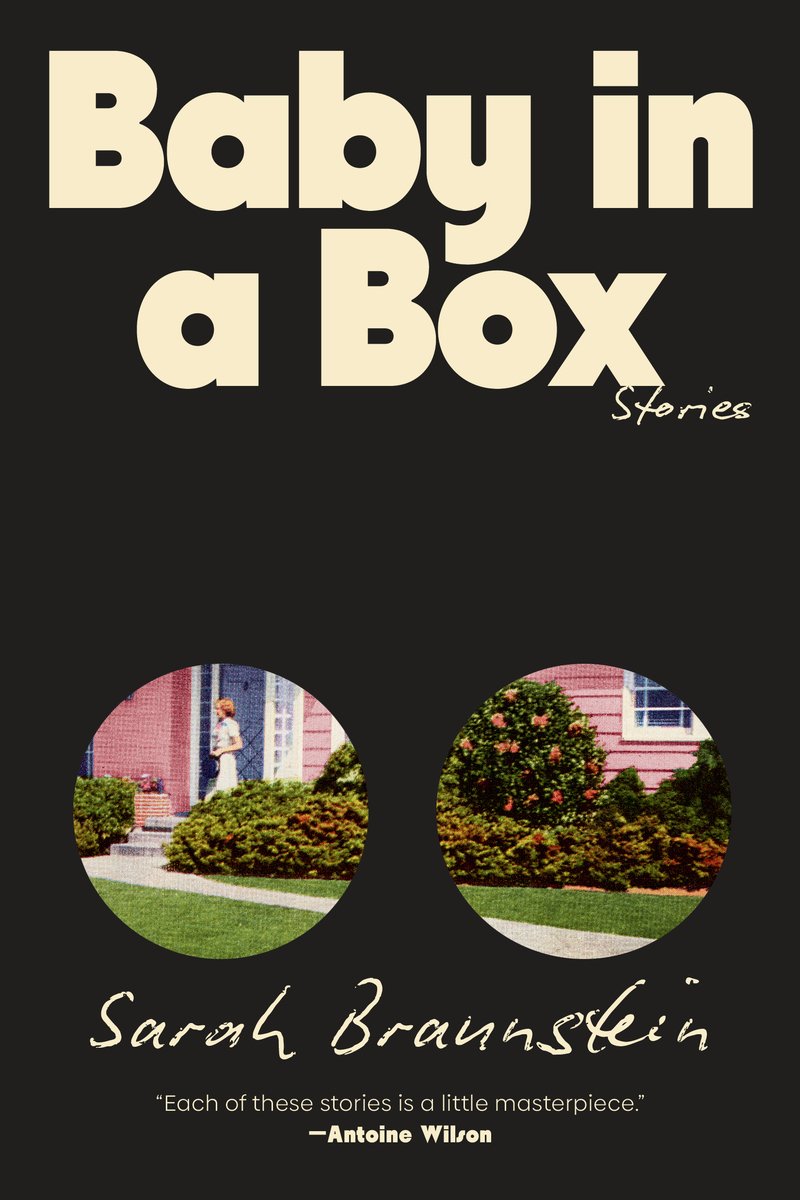
From Baby in a Box: Stories by Sarah Braunstein. Copyright © 2026 by Sarah Braunstein. Used with permission of the publisher, W. W. Norton & Company, Inc. All rights reserved.