Anna Holmes on Why “No” Is the Most Powerful Word a Woman Can Say Today
“For women ‘no’ can be a declaration of war, a call to arms, a rejection of the very traits that society deems most valuable.”
“No.”
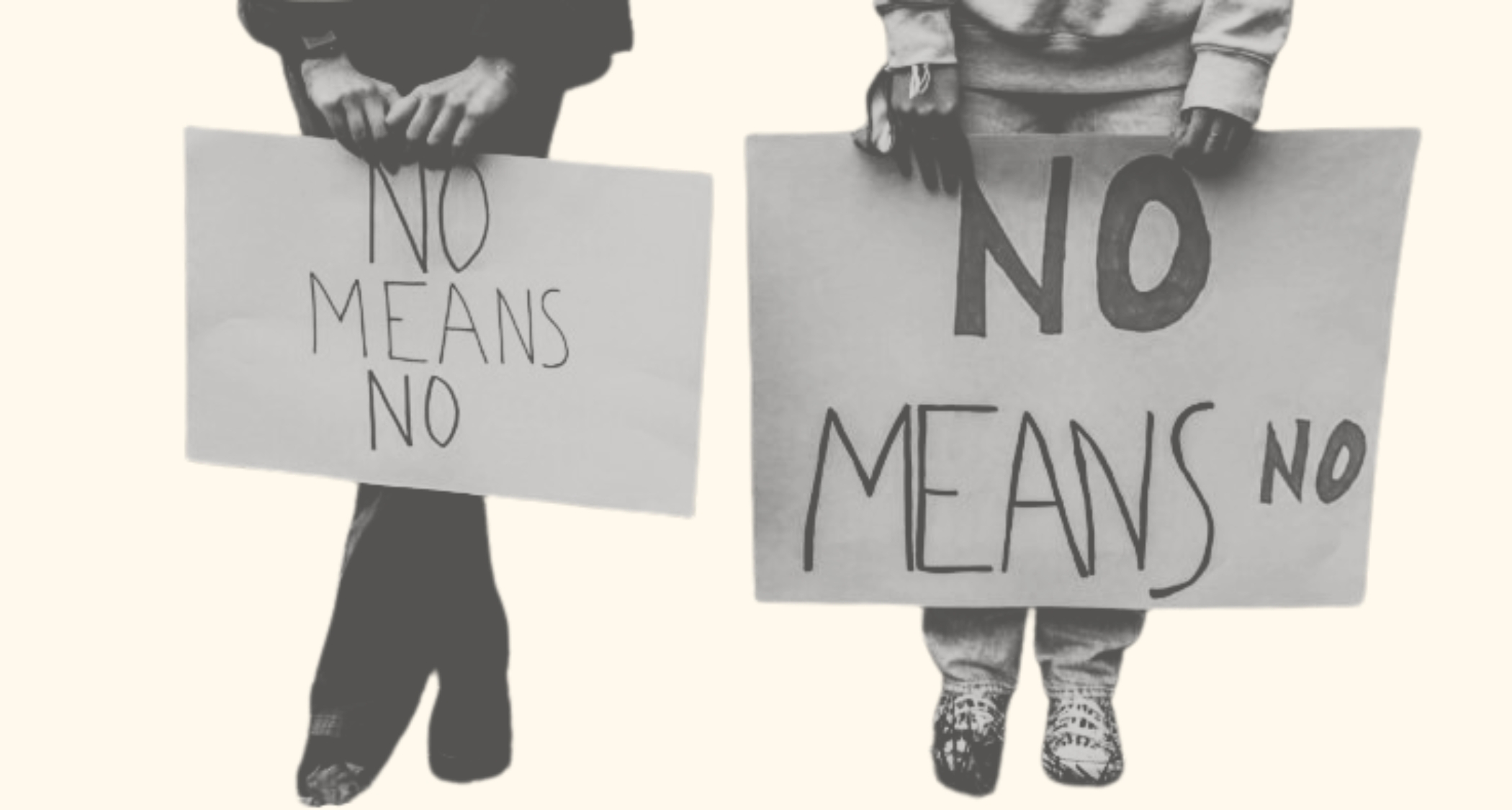
Two little letters with enormous impact. One might contextualize them with punctuation—a comma here, an exclamation point there, a period over there—but the meaning remains about the same: a rejection of the affirmative; a refusal; an expression of resistance, even defiance. “No.” One syllable with which to order and define the world…wants and needs, likes and dislikes. One of the first words that many babies utter, one that will punctuate that constant conversation between parent and child: a test, a tug of war, a battle of wills as to what is wanted, what is needed, and what is granted. “No.” As uttered by women, a provocation. Has there ever been a more fraught relationship between woman and word? For women who terminate pregnancies, decline to get married, or reject the performance of gender itself, “no” can be a declaration of war, a call to arms, a rejection of the very traits that society deems most valuable.
“No.” For all, an essential tool for self-preservation, autonomy, and emotional health. For asserting who we are…and who we want to be.
*
In 2015, I was asked to give the commencement speech for the graduating class of seniors at Emma Willard School in upstate New York.
“No.” For all, an essential tool for self-preservation, autonomy, and emotional health. For asserting who we are…and who we want to be.
I hesitated at first, only because I’d never given a commencement speech before, and because, unlike many of those who were in attendance, I didn’t actually go to Emma Willard. (I went to a public high school in northern California.) But I did know something—well, a lot, really—about what it means to be a woman, and to be ambitious, and young, and to try to find my way in the world.
The night before the graduation, I had dinner with an Emma Willard senior named Lily and her family. At one point, Lily’s mom, Susan, turned to me with a question: “If you could go back to your younger self, say, six years after you’d graduated from high school, what would you ask?”
I smiled and then said, “I’m not so sure I’d ask my younger self anything, but I sure would tell her something: that she needs to remember to listen more carefully to the voice inside her head, and that she needs to learn how to say ‘no.’”
What Lily’s mom didn’t yet know was that my address the next day was about that very subject.
There’s nothing wrong with saying “yes.” In fact, knowing how to say “yes” to the world—to our friends, to our family, to our education, to our dreams—is an important part of what it means to embrace life to the fullest, to stretch our arms wide, to open ourselves up to experiences and opportunities and potential, even if we don’t yet recognize them as such. I’m pretty confident that no one would be reading this book were it not for their ability to say “yes” to life, in both large and small ways.
The fact is, however, that for many of us, saying “yes” is the easy part—a skill that we’ve been forced to develop from a young age, when we learn that, to be considered successes as girls and women, we should appear both competent and kind; effortless and accommodating; graceful, not gregarious. And though expectations of women are evolving, we will still run up against certain societal conventions and assumptions about what it means to be women, and what sort of women we should be.
As I told the Emma Willard students that morning, I wouldn’t want to change anything—or at least, not much—of what I went through in my younger years. But I do wish that, in addition to the usual exhortations from adults that I could do or be anything I wanted, someone had emphasized the legitimacy of owning who I did not want to be, even if—especially if!—those expectations were at odds with what felt right.
*
“No” was hard for me to learn. I felt like I had experienced “no” all the time—from the principal in elementary school who insisted a boy do a job I had been tasked with to the crush in high school who didn’t like me the way I liked him. But I never demanded “no” of myself, which is to say that, in my teens and twenties, I had no idea if the things I was supposed to want were things I really and truly did want.
What are we to make of “no” not as a word to be avoided but one to be embraced? To celebrate its power, rather than shrink from a fear of it?
Furthermore, the idea of saying “no” filled me with terror, a fear that what little I then had, and what little I might have in the future, would wither up and die if I did not make room for all of it. For a long time during my youth, I believed that by saying “yes” to things, I would increase my odds of success in life. But what I didn’t know then is that, rather than ensuring my future success, I was increasing the odds that I would become spread so thin that I’d forget who I was and what I wanted; that I would continue privileging others’ needs and desires above my own to the point where I didn’t even recognize that there was a difference between them.
*
My biggest “NO,” my strongest rejection of convention and what was expected of me as a woman, came in 2007 when I founded the website Jezebel. I was in my mid-thirties, working as a writer and editor at women’s and celebrity magazines because I needed to pay my rent. But something inside me was brewing, and when I was offered the chance to start a new women’s website, I went for it.
With Jezebel, I decided that “no” would be our mantra of sorts. “No” to diet tips, “no” to sexist gossip, “no” to the promotion of overpriced fashion and conspicuous consumption. Furthermore, we’d talk about lots of other things: race, gender, politics, books. Jezebel was not necessarily explicit in its mission to politicize pop culture, but we drove the point home again and again, pushing back against what was expected of us as women and girls, and creating new definitions and examples of what it means to be female.
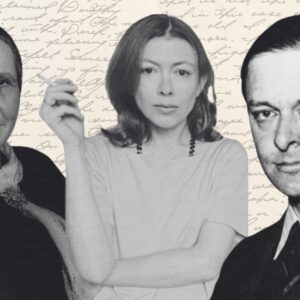
When I think of “no” I often think of “On Self-Respect,” Joan Didion’s famous essay originally published in a 1961 issue of Vogue. I first read Didion’s 1,800-word piece when I was in high school, but it has had a long-lasting impact on me. Indeed, it may be in part what inspired this book, with its skillful explication of the ways in which expectations of women deny those same women their very existences, and its admonishment of a society that values women for their “genius for accommodation” regarding their opinions and ambitions.
As Didion puts it:
We flatter ourselves by thinking this compulsion to please others an attractive trait: a gift for imaginative empathy, evidence of our willingness to give. To assign unanswered letters their proper weight, to free us from the expectations of others, to give us back to ourselves—there lies the great, the singular power of self-respect. Without it, one eventually discovers the final turn of the screw: one runs away to find oneself, and finds no one at home.
What are we to make of “no” not as a word to be avoided but one to be embraced? To celebrate its power, rather than shrink from a fear of it? To assert a reclamation? What if we dispense, once and for all, with our trepidation and add the word “no” to our rhetorical repertoire and try to fully inhabit a posture of No Thanks, or No, I Don’t Think So, or even Absolutely Fucking Not? Can we recalibrate and redefine how we think of it? Take it from a negative to a positive? How can we deploy it to decline something or deny someone? To simply walk away and never look back?
_______________________________
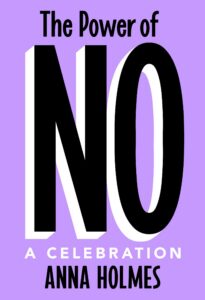
Excerpted from The Power of No: A Celebration by Anna Holmes. Copyright © 2026 by Anna Holmes. Published in the United States by Crown, an imprint of the Crown Publishing Group, a division of Penguin Random House LLC.

Anna Holmes
Anna Holmes is an award-winning writer and editor whose work has appeared in numerous publications, including The New York Times, The Atlantic, and The New Yorker. She is the author of two previous books, Hell Hath No Fury and The Book of Jezebel. She lives in Los Angeles.