When Maresciallo Tommaso Nardulli arrived on the scene at around eight, Signora Sattaflora had Betta Ansaldo covered with a white embroidered linen sheet from the dowry she had prepared over the years for the daughter she had never had. Carla Sattaflora had known Betta since she was a little girl, and it had almost felt like giving her one last gift.
Marisa Ansaldo had collapsed and someone had shouted out to call an ambulance. But right at that moment Giovanni Di Lillo, a family doctor who had retired over twenty years earlier, had happened to be passing by during his morning constitutional along the coast. The elderly doctor had taken Marisa’s pulse and ordered for her to be put in a car and taken home; there was no cure for despair. “Just leave her alone,” he had muttered as he headed back home, exhausted by all the suffering he had had to bear witness to. So Mauro and his father had helped Marisa to her feet, sat her in their car, and taken her home. They had found Signora Balestrieri on the threshold, the door open wide. Seeing her daughter in that state, babbling nonsense and barely able to stand, Letizia had goggled with the watery eyes of a sickly old lady. “What happened?” she had asked in a whisper.
Mauro and Giulio Sattaflora had exchanged a hesitant glance, fearing another stroke. Then Giulio had plucked up his courage. “Betta was in an accident, Signora Balestrieri,” he had whispered gingerly as he held his breath. “I’m so sorry.”
Against all expectations, Letizia had just clenched her jaws and tightened her lips. “Put her on the sofa, please,” she had muttered, showing them the way with her stick. Then she had seen them out with a curt thank-you while they offered to help in any way that might be required and overstressed their sympathies.
Stelvio, on the other hand, was still sitting next to his daughter, on the sand. From time to time, the bravest among the onlookers walked up to him to ask if he needed anything, if he wanted a glass of water. Stelvio always merely shook his head, a faraway look on his face.
Maresciallo Nardulli was shocked to hear that the dead girl was Stelvio Ansaldo’s daughter: over the past ten years, he and Stelvio had been playing bocce every summer. The death of a young woman was always a tragedy, of course, but having to witness a friend sit next to that white sheet was more than he felt he could bear. That morning, he was wearing his dress uniform because he was due at a ceremony in Civitavecchia later that day. Blaming the heat, he took his jacket off in irritation and handed it to his colleague to put in the car. He even took the liberty of loosening his tie, the challenging grimace on his face openly daring anyone to say anything about it.
Stepping ahead of his two subordinates, he went down to the beach, toward Stelvio and his daughter. He slowly walked around the sheet, unable to find the courage to lift it, then he crouched next to Stelvio and put an arm around his shoulders. Having failed to find anything to say, he set about the task of being a carabiniere, especially thankless at a time like that.
When his colleagues Bazzi and Faragna caught up with him, he stood up and ordered them to carry out the preliminary investigation, then he headed toward the small crowd of onlookers that were standing under the bar’s pergola, sheltering from the sun: despite it being still partly overcast, it was already getting quite hot.
“Who found her?” Maresciallo Nardulli asked.
Mauro Sattaflora, who had come back from the Ansaldos’ house, raised his hand as if he were in school.
“So, tell me,” Nardulli ordered, wiping his neck with his handkerchief.
“She was over there,” Mauro said, pointing toward the fence.
Nardulli looked toward the light blue fence, then at the sheet. “You moved her?” he asked, his voice sounding more surprised than annoyed.
“Her father . . .” Giulio Sattaflora rushed to explain.
Nardulli knitted his thick eyebrows at the top of his nose, turning toward the sea. “And how did she get all the way up to the fence?” “I don’t think she drowned, sir,” Mauro said expertly.
“What do you mean, she didn’t drown?” Half an hour earlier, back at the station, Faragna had reported that the switchboard had a woman on the line who lived right opposite Le Dune: she was screaming like a mad thing that a girl had jumped into the sea and that the body was now on the beach. The maresciallo turned around and looked at the sheet as if he was seeing it for the first time. Bazzi was holding it up with two fingers, studying the body intently.
Nardulli raised his hand to his forehead, then saw Faragna heading toward him briskly, unconcerned with the sand getting into his dress shoes. Faragna motioned to Nardulli to step to one side and spoke into his ear with circumspection. “Maresciallo, she certainly didn’t drown,” he whispered.
They exchanged a meaningful glance.
Nardulli looked at Stelvio Ansaldo again. “I’ll ring the magistrate,” he said, his face gray. “You make all these people move along. Including the father.” And, cursing under his breath, he went back up toward the road, leaving behind the most compromised crime scene he had ever seen in his life.
__________________________________
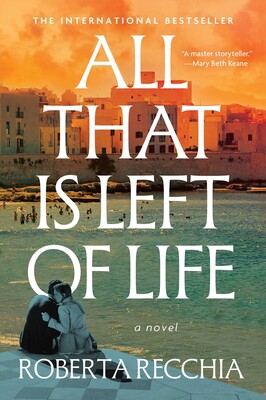
From All That Is Left of Life by Roberta Recchia. Copyright © 2024 by Roberta Recchia. English language copyright © 2025 by Antonella Lettieri. Reprinted by permission of Scribner, an Imprint of Simon & Schuster, LLC.