I devour myself in delicious painlessness.
A lake of blood clots around me. All my short life, I’ve defied biology with my flesh. Now, I defy biology with my death.
The eye fixed on me, binding me to millions—billions—of other eyes, only steels my resolve to see my sacrifice through to the end. At last, I’m not just something to belittle and laugh at; at last, I’m free to relish, savor, eat this morbid fascination right up. I used to live to consume; I used to be seen as nothing but what went into my mouth and got digested in my guts and then was expelled. What identity I had was permanently impermanent. This attention at long last is sweet revenge for so many years as an outcast. Now, I can sear their retinas in turn; now, I can brand their thoughts with the red-hot iron of my ruin. Now, at last, I can have my just deserts for their onslaught of cruelty: I will haunt their nightmares.
Forgive me for starting this story with its bodily, unpalatable origins—although doesn’t everything begin and end thus?
Everything, after all, is a story of flesh. Everything, in the end, comes down to this: our known yet inherently unknowable roots in our mothers’ wombs.
Let us begin, then, with the orgasm of living.
Who could possibly claim to have unlocked this secret?
Nine months spent there, and still a realm of utter mystery.
Still half-formed, yet all is decided there.
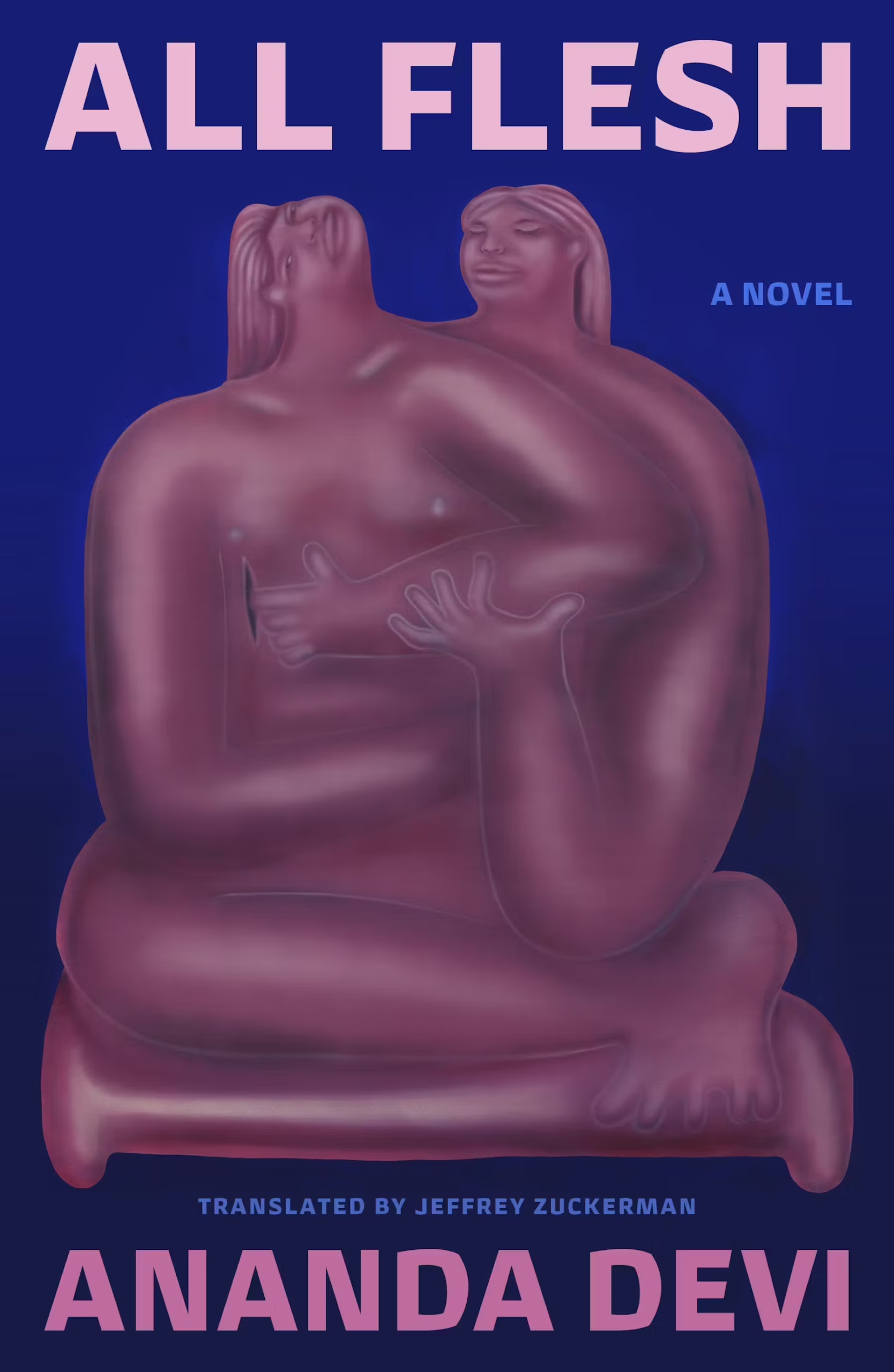
Was there really a shadow at my side for these few months, a sister? Or would she prove to be the first victim of an already-insatiable appetite?
She apparently made the ultimate sacrifice, bearing the blue mantle of saints so that I might survive. And so she was granted only the time for a breath, an ethereal stroke of my cheek, a prayer to the gods of the living, before passing away and passing along an obsession.
My mother’s womb has remained a closed book to me. What I do know is that I survived: I, the Darwinist.
While my sister, my double, my unknown, was absorbed into my tissues and my organs, and along with her went all my humanity.
Let us turn to the facts.
After precisely nine months and ten days, those ten days having stretched out as long as the nine months before, my mother gave birth to a pink elephant.
It weighed twenty-two pounds and eight ounces: hardly an excessive weight for a baby elephant; certainly a record for a baby human. When she delivered, my mother finally gave in to the shock she’d repressed all through her pregnancy, even as her slim body took on gargantuan proportions: she shrieked like a madwoman.
I was the pink elephant. My body had no trunk nor huge ears, but there was still no squaring it with the word “baby.” Some other term was needed to describe me. As my mother bawled out her lungs, the doctor and the nurses remained speechless, stunned not only by my disproportionate weight but also by my appearance: a Chinese Buddha whose eyes were unmoving, untrusting.
They were, I am told, in a rush to leave me in my mother’s arms, even though she was, physically and emotionally, struggling more than anyone else there with the reality of my utterly singular existence. I think I remember a frustratingly empty room, peopled only by the din of my hunger.
I imagine a hospital in which these echoes and shrieks reverberated, in which so many people, confronted with the unthinkable—a child too abnormal for anyone to love—simply fled. Maybe I should have been an actual elephant born of woman and made a circus freak, paraded for strangers to peer at with curiosity rather than love. I would have gone viral on the internet, where everyone, drawn to novelty, would have eagerly watched me as I grew.
I think I remember a tormented gaze, too; that must have been my mother realizing there was no going back now, no way of escaping this reality, or bypassing it, or denying it, no saying, Hold on, this isn’t my baby, there’s been a mix-up, the nurses gave me the wrong one, they all look the same, don’t they, but a mother always knows, and I know this one isn’t mine.
Actually, babies don’t all look the same: I didn’t look like any of the others. No foisting me on another mother too overwhelmed to notice. She was done for.
My cumbersome entrance was capped off by what has defined the whole human race: a fall. The day after my birth, my mother, still weak with the throbbing pain of her cesarean section and the horror of this giant baby born from her now-wrecked body, tried to lift me out of the cradle. She hadn’t considered the heft of twenty-two pounds of wriggling flesh, without the least muscle supporting any of it. She leaned down, slid her forearms beneath my swaddled body, hoisted me up. She felt her back strain as she stood back up with me in her arms. Her stitches stretched and snapped. Unable to take a step, she staggered and crashed to the ground, her body wrenching painfully to shield me from the fall. (I’ve wondered whether she might have come to regret this instinctive act of protection.)
She stayed like that awhile, a dying heifer sprawled across the greenish vinyl, while my angry, alert mouth mechanically sought her breast. She fed me, a cow felled by the enormity of her work. Her wound had reopened. The blood flowed alongside her milk. Her innards filled with acid. She sobbed, this woman who never sobbed. I was the undoing of my mother—my strong mother, my beautiful mother, my high-heeled and short-skirted mother, my American, professionally successful mother, who had refused to be cowed by anything and who had been unaware that her womanly body could hold so many traps.
I think she saw me from then on as the one whose mere
existence had sent her to rack and ruin, had thwarted her brilliant ambition to become a warrior queen. She now found herself laid horrifyingly low: greasy hair, flabby belly, night-gown hiked up over now-heavy thighs—the picture of devastation. This woman, in short, had regressed to the role of a child-bearer from that dark age when women were simply wombs, mere envelopes for vaguely desired offspring. She had reverted to a female ruled by her biological clock. Perhaps she ought to have had a hysterectomy, for her own peace of mind—but had she really had such a choice, had she made such a decision with all the cool precision of her ten-year financial projections? No, no, no. She had surrendered to her primal instinct: procreate or die.
How, then, could she have loved me?
*
In the beginning was a ravenous pink elephant laying claim to its mother’s life and body. I never stopped begging to be fed. I spent my days latched on to her breast. The one thing I had, the one claim I had.
I was born with no urge but to consume. And as I could not do so on my own, this Sisyphean task became her duty and her burden.
My poor, wan mother, wizened by her abrupt deflation, ill-prepared for such a burst of fury in her orderly existence, did try to sate me. But nothing was enough. My mouth was a gaping maw. More, more, more, the royal baby screamed, the scarlet-cheeked tyrant, the sumo-legged vanquisher.
Not an hour went by without my shrieking for her breast. The pace became hellish. As I grew, so she shrank. Dents and crevasses pockmarked her teats. She winced each time my open mouth approached, waited for the pain, tensed as she thought of her poor, swollen nipples, with their blue veins, their pale blotches, their pinkish wounds, their sticky runoff. How do cows do it? she wondered. Or, worse, how do dogs and pigs do it, with their litters, all those tiny mouths begging—is that what’s become of me? Why do I have just two teats, then?
She was convinced I was eating her alive. Maybe she wasn’t entirely wrong.
She eventually weaned me off, letting her bounty run dry so as to bottle-feed me. She mixed cereal into the formula. To tide me over between meals, she said. The doctor had officially told her not to, but he wasn’t the one who spent his days and nights feeding me. So she kept doing it, feeling giddily like a poisoner. To her dismay, my stomach took well to this new diet. She kept on adding cereal to my bottles; I kept on crying for more and growing. She had no way of knowing that her scheme would bear the seeds of its own downfall.
In the beginning was an unquestioned deity: me. Outside the hospital, people exclaimed upon seeing me in her arms or in my stroller, certain that the baby they were admiring was many months old—not mere days old. And so I was, briefly, a magnificent newborn: the empress of infants. I was dressed in lace and broderie anglaise. My cheeks reddened like spring blossoms in the air. I looked on the world as if it were my kingdom. My gurgling was so close to babbling that nobody suspected a thing.
The honeymoon proved to be short-lived. Everyone’s soft gazes soon hardened as the magnificent baby with so many rolls and love handles proved to be all unsightly flab. The weight of their disdain bore down on me, and far more so on my mother: after all, I was innocence itself, not having chosen to be born an elephant. My mother turned a deaf ear. She knew instinctively that the battle had been lost from the start and that she would not have the force to withstand my needs. I had no idea that we were enemies—yet I had already won. Perpetually interrupted nights can turn the most even-keeled women into hysterical harpies. The weeks went by; I suckled to the sound of her gnashing her teeth and hissing curses. One night, having hit her limit, she gave me a sharp pinch right when I was halfway through my bottle.
The baby I had been was momentarily puzzled: Should I express my pain with a cry, and thereby let go of the bottle with its wonderful rubbery taste? Or should I ignore it so as not to interrupt the practically aphrodisiac flow of sugary milk while my soft skin was assaulted by her nails? In the time it took me to decide, I choked, while the liquid kept on flowing down my throat. I spat up all that I’d swallowed, sobbing, hiccupping, drooling, drowning in the endless tragedy of my short life.
She slapped my back harder than she should have, but I could tell her harshness came from a fear now gripping her: the realization that the baby elephant would come to arouse such hatred that she would happily crack its skull against a wall, would gladly accept the guilt of such a crime just for that brief reprieve.
She decided to call in reinforcements. She hired a young au pair, a fairly hardy one who still could barely carry me, only for the woman to leave and not even insist on her final paycheck. Then there came a long line of nannies who couldn’t manage more than a few weeks, or even just a few days, with me.
I was perfectly good-natured, though. I think I might have been a rather calm baby had I not been so racked by hunger. But the nannies had to get up in the night at the sound of my shrieks while my parents slumbered with ear-plugs in. Each one of them eventually saw the same lure of violence my mother had, and made off before they could commit an unforgivable act. Which just goes to show how little maternal feeling counts for.
Finally, my mother found the best nanny possible: my father. And she fled.
__________________________________
From All Flesh by Ananda Devi. Published by FSG Originals, April 2026. Copyright © 2026 by Ananda Devi. All rights reserved.