This life, this sorrow. Both were imagined. It was a time when many things were quickly bought and just as soon forgotten. There was a spacious, quiet room in a little house along the water, in the harbor town of Stromness. It was early autumn. Outside the window, a sky of uncertain color drifted over the Orkney Islands, harried by immense thunderheads soaring into the heights. Soon it would be night, and once the clouds had gone, billowing curtains of green light would appear above. Stromness was a place far to the north, upon a grey sea: cold and stony and clean.
A silver grey laptop sat open on the bleached wood table. At the other end, there was a stack of Ku¯ki magazines, their corners arranged at tidy right angles to the table’s edge. The issues were printed on recycled paper, and because the house in Stromness flanked the port’s harbor, the constant wetness had slightly curled their pages.
On the magazine’s cover, illuminated by the glow of the laptop: an earthenware, umber-colored dish with three walnuts in it and a few small, almost transparent seashells. On a plate: a croissant, a bite missing. Under the table: a pair of dark green, knee-high Wellingtons. An old Swiss military bicycle was propped up against the far wall, which was of light grey stone. Its irregularities, grooves, nicks, and pockmarks heightened, rather than disturbed, the tranquillity of the space.
On the wall above the bicycle hung a framed oil painting of the sorcerer Merlin and the knight Lancelot done by the Scotsman James Archer in the late nineteenth century. Archer’s name was printed in black type on the lower crossbar of the gilt wood frame.
It was neither a particularly impressive picture, nor had it been particularly well executed by Archer. Merlin is draped in a long, light-colored cloak with a white hood over his head, obscuring his face. The dimming sun and a few gauzy clouds are daubed across the sky. Shod in sandals, Merlin strides ahead of the knight. Lancelot, noticeably weary, impassive, and preoccupied atop an equally weary black horse, follows the sorcerer, while Merlin leads him up the path into the realm of shadows, out of the frame to the left.
*
A bundle of reeds jutted from a tankard over on the windowsill, their sharp shadows rustling tenuously across the Wellingtons, then over to another pair of shoes. These now were Catalonian sandals, once tan, their heels worn in and worn down, their soles in the process of disintegration. Crumbs of leather from the sandals specked the floor just beside them, a concrete polished to only a partial sheen.
Spread over it, and there it was again, that tidy right angle: a dingy white sheep’s wool rug, greyish brown in places, not evenly bleached. In its center sat perched a one-eyed cat, gazing toward the window. The claws of her forepaws had snagged in the carpet. The animal kneaded them by turns, left and right, which produced a soft tearing sound.
In that corner of the room, beside that window in the house in Stromness overlooking the small harbor, on a sofa upholstered in threadbare sailcloth, lay Paul, asleep.
He felt as though he were floating, floating atop the crest of a long, smooth grey wave, drifting away amid a desolate slate-colored southern sea. Antarctica and its forbidden volcanic peaks were not far. Ghastly, they rose from the horizon toward which the wave carried him. It was almost a pleasant feeling, but not really.
*
One of those faded orange Penguin paperbacks had slipped from his hand in sleep and now lay beside the sofa on the rug. It was a book about aircraft recognition, published during the Second World War, that explained how to rapidly identify those Heinkels, Messerschmitts, Hurricanes, and Spitfires up above by their silhouettes. Each of the planes had a distinctive engine sound, too. And the shadow cast by each aircraft showed whether it was a Focke-Wulf or a Beaufort. Rain was a good omen. The sick were given water to drink from the seven springs. Rainwater, or the water of life, as it was known in Russia, healed all wounds, made lost limbs grow back, turned the old young again, and raised the dead up from the grave.
And then, at the horizon, where the waves’ ridges ended, there they were: those towering volcanoes blanketed in white, Mount Erebus and Mount Terror. Banners of snow whipped horizontally from their dread summits. And all of a sudden, his dream was an abomination. Paul awoke with a start. His shirt was soaked down below his collarbones, clingy and disgusting. Slept all day and woke up stupid, he thought. It was now late evening, and outside it was dark, though it never went completely dark here, in summer and in autumn.
*
Paul rose, dazed and much too slowly, felt for his glasses, went to the table, and gently touched the laptop with his index finger. The device and its screen, and the room, too, lit up. He looked out toward the rippling green of the auroras, there beyond the window, in the sky above the sea.
When he’d first moved here to the Orkneys, they had still seemed to him miraculous. He’d stared at them for hours, those squalls of solar wind, those ionic cyclones in the atmosphere, those photon storms. And now, after such a long time in Stromness, after appearing in the sky here every night, they had become mere decoration to him, an accepted, insipid part of the scenery whose magic for him had been snuffed out.
*
He switched on the light, covered his yawn, and dried the sweat from his nightmare with a kitchen towel, which he folded and draped back over the oven. Then he went to open the refrigerator, removed the cottage cheese, emptied it onto the saucer with the rest of the uneaten croissant, and set it before the cat on the white rug. He did not like cats. This one had chosen him. One morning, he had opened the front door, and there she had been, and she scampered past his feet into the house as if she now lived there.
*
Paul took a seat at the table before his laptop. He’d received two emails, aside from the usual Nigerian ones. The first seemed important and feasible to him, which is why he’d already read it three times this morning and now, after his evening nap, did so again. The other, in quite clumsy English, requested a very careful renovation of Ingmar Bergman’s house on the island of Fårö, in Sweden. Little was asked of him: a touch of fresh paint here where dry rot had appeared in the walls, replace a few chairbacks there that had gone wormy. They couldn’t pay much, not even the cost of travel. He sighed. If they wanted something from him, they really should write in proper English, not Charles Dickens nonsense such as: Please, kind sir, and: Most obediently. With the tip of a finger, he swiped the email to the bottom left, into the to-do folder.
In the first message, they wanted him to find the perfect white for the magazine Kūki. An immense dark hangar in Norway was to be painted, with hectoliters of white. He was to appear, yes, at the offices in Stavanger to discuss. Plane ticket attached, business class. And there would be a great deal of money, perhaps a hundred and fifty thousand.
The perfect white, he thought. Oh yes indeed, he was the one. Plain white, of course. Happy to oblige. Not too beige, not too eggshell, not too bluish cold like snow. Not ice-colored either. Damn. Kūki. Super. How ever did they think to pick him? How thrilling, what a fantastic honor. For many years now, he’d subscribed to that magazine printed on untreated tan-colored paper, had observed its subtle shift from highbrow modernist monthly to a mildly eccentric décor magazine that was very intentionally bringing about its own irrelevance.
Paul pored over every issue that ended up in his mailbox in Stromness. There were no online editions. Ku¯ki. He always stacked the previous six issues on his big table and the others in a corner of his bedroom, where over time they’d formed a considerable tower.
Once, at its very beginning, Kūki had visited one of the last remaining Japanese brush makers; a hermit, he still tied his hemp brushes by hand in a wooden hut amid the Hida Mountains on Honshu¯. It had always been about exclusion: the last of this, the only one of that. In that initial period, Kūki had still regarded modernist Japanese-Scandinavian reduction as necessary. Then, over the following years, came sustainability and strict reuse and ascetic renunciation, and today, finally, its photo series and articles advocated for a mild, slightly quirky anticapitalist metaphysics.
Paul recalled having been so pleased a few years earlier—when the Orkney Sourdough Bakery had been praised by the magazine in a short article, though there was a photo—to already live in this place: his little bakery, in the great Kūki. He made a point of visiting the bakery each week to buy bread, even though the selection consisted of little more than its three loaves of sourdough and a few cinnamon rolls. There was only one person who ever worked there, after all. And demand wasn’t particularly high, as people on Orkney preferred to eat presliced white bread from supermarket chains. And so, not long ago, he’d wheeled the green Swiss military bike through the front door, hopped on its uncomfortable leather saddle, and pedaled off, up the cobblestones of Alfred Street. Stromness essentially consisted only of a few lanes and grey alleyways, so he was quickly outside the village limits and on the bumpy road up to the bakery. He never wore a bike helmet. He abhorred those neon streamlined monstrosities, but why, though, hadn’t he just bought a mountain bike? This dumb Swiss clunker was so terribly heavy, and it had no gears, which really made no sense. It was like not wearing functional fleece sweaters to counter the frigid winds buffeting Orkney, and instead stubbornly and moronically insisting on sheep’s wool.
It had been awfully exhausting because the uphill, though very gradual, had still been a serious climb. Paul sweated and cursed. Maybe their sourdough bread wasn’t so very super after all. When he looked left and right as he pedaled, however, he smiled because then he realized why he lived here. Nothing but verdant grey hills, sheep, and waist-high walls of ancient stones that vanished into the vastness of the landscape. Not another soul, and everywhere the sea, on all sides, slate colored and pleasantly unwelcoming. He couldn’t recall the route to the Orkney Sourdough Bakery actually being this far. For an hour, he cycled through the drizzle.
And then there it was, the whitewashed stone house with its turfed roof, and beside it the old red telephone booth that’d been repurposed as a free bookstore—you took a book for yourself, and if you had time, you added another one. It was usually just garbage, yet recently, he had found The Brothers Lionheart by Astrid Lindgren, a lovely English first edition, but hadn’t replaced it with a new one, and for that he felt a vague guilt.
Once inside the bakery, he stood there for a long while awkwardly. The baker, read her handwritten sign beside the jute baskets, was out collecting mushrooms. Just choose the loaves you want, stick them in a brown paper bag, and transfer the money by app.
Back outside with bread in hand, he dipped into the telephone booth to scan the books: no change since last week. But wait, there was something new. A brochure on making a ceramic pistol with a 3D printer. Interesting, he thought.
He looked around to see if anyone was watching him, and he wedged the pamphlet behind his belt. Next time, he’d just bring two books from home.
If only he’d mounted a little jute basket on the handlebars of the military bike, or brought a tote bag. He had to clamp the loaf of sourdough beneath his arm, and at one point, it slipped and fell onto the road, the paper bag burst open, and he stopped to pick it up. He blew the dirt from the round of bread and wiped it off on the sleeve of his soaking jumper. So damn aggravating. At least the way back was much easier. He took his feet off the pedals, stretching them out to each side, and he smiled at how fast and effortlessly he hurtled back down into Stromness.
At home, he removed the bread from the brown sack, set it on the butcher block in the kitchen, and cut himself a slice with the extra-sharp serrated knife from Kyoto. He was tired now. Biking there really hadn’t been worth it. Still, he slathered some fermented butter over the surface of the bread and from the cabinet fetched the Blackthorn salt, collected from the salt pans in Ayrshire on the west coast of Scotland.
Blackthorn salt was filtered through something called a tower of thorns. Bearded young artisans had bought an old salt factory that hadn’t been used since the Second World War. They’d taken soothing photographs of kelp strands draped across flat stones, and posted these on Instagram, then hung blackthorn bushes in the tall wooden frame, and put the graduation tower back into operation. The salt that sprinkled out beneath the thorn tower was packaged in attractive black paper and shipped all around the world.
So he was going to Norway. He hadn’t known that Kūki was based there. Stavanger wasn’t far from him, from the Orkneys; up here, at these latitudes, everything had once been Norwegian anyhow. Even Orkney’s flag was the same as Norway’s. And people here once spoke now extinct Norn, an Old Norse language. Norn, Norn, he said aloud. Norn. He’d be glad to come to Stavanger, and he was looking forward to it, and thank you so much, he replied quickly, and he pressed send.
__________________________________
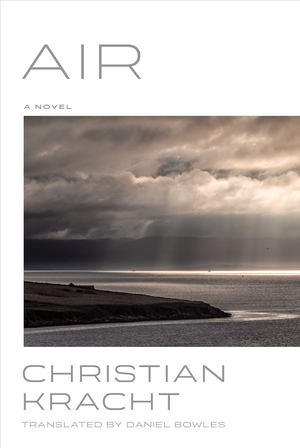
From Air by Christian Kracht, translated by Daniel Bowles. Used with permission of the publisher, Liveright. Copyright © 2025 by Christian Kracht. Translation copyright © 2026 by Daniel Bowles.