After Six Decades and Thirty Novels Jodi Picoult Was Missing One Thing: A Tattoo
“With age comes the luxury of being unapologetically yourself. A silver lining, if you will, for the silver-haired.”
I didn’t care about turning forty. When fifty rolled around, I celebrated. At 55, my neighbor took a picture of me under a matching speed limit sign and we both laughed.
Then came sixty.
Several months before my birthday I started feeling an unshakeable dread. I did not want to turn sixty. I didn’t want to read that number on a card. I didn’t want a party. I didn’t want to mark the day at all. I resented the onward march of the calendar, mulishly convinced if I ignored it, my birthday simply wouldn’t happen.
I should point out that my life is a beautifully complex, rich, lucky tapestry. My three kids are happy and healthy and married to partners who make them better versions of themselves. I am still crazy in love with my husband. I’ve got three adorable grandchildren and one more on the way. I live in a beautiful part of America. I have a thriving career as a novelist. In fact, my thirtieth novel, Hollow Bones, is being published this September. By all accounts, I have spent the last six decades building a legacy anyone would admire. And yet, I could not think about turning sixty without starting to cry.
I did not want to turn sixty. I didn’t want to read that number on a card. I didn’t want a party. I didn’t want to mark the day at all.
My therapist asked what was really bothering me. It was, I realized, the flat smack of reality in the face. At fifty I could still convince myself I had another half of my life to live. At sixty, the math wasn’t mathing. Moreover, whatever is coming next will include some version of tragedy—my parents dying, my body breaking down, other losses. Who would be eager to face any of that?
The fact that this particular birthday coincided with my thirtieth novel was bittersweet. I am about to embark on a massive book tour we are calling the “Chapters Tour”—celebrating not just my newest release but all the titles that came before it, in the same festive spirit as Taylor Swift’s Eras Tour. It feels like a milestone because it is one. I’ve spent a literal lifetime building up a body of work and amassing readers. I’m proud of my novels and humbled by the lives they’ve touched and the conversations they inspired. Recently, at BookCon, I had a throng of readers waiting to get books signed and to tell me their stories. “I used to read your books hidden behind my chemistry textbook,” said one middle-aged woman. Another told me how my books were what she shared with her mom, who’d recently passed. Dozens of up-and-coming writers whose books I consume like candy came up to me, wide-eyed. “I can’t believe I’m meeting you,” one gushed. “You’re an icon.”
At sixty, you can achieve icon status. No one gives you lifetime achievement awards when you’re twenty, after all. Thirty books is no small accomplishment, either. But as wonderful as it is to be put upon a pedestal as Someone Who Has Been In The Business Forever, it also creates a gap between you and the younger authors in the thick of the scrum. As if you’ve put in your time. As if your relevance is in the rearview mirror. As if you’re done.
Reader, I’m not done.
The more I examined the facets of my reluctance to turn sixty, the more I realized this was the crux of my problem. Physically and mentally, I am healthier than ever. I recently lost enough weight to enjoy seeing myself in a mirror instead of dreading it. I swim over a mile every day. I can do the NYT crossword puzzle without cheating. However, a sixty-year-old woman is not supposed to be in the prime of her life. According to society, to movie representations, to JD Vance, I should be finding myself a cardigan and sensible shoes, letting my hair go grey, and taking care of my grandkids—because that is my only value to society. I shouldn’t want to turn someone’s head on the street. I should be baking cookies, driving at a snail’s pace, and the only hard thing I should be sucking on is butterscotch candy. Even though I know looks are more than skin-deep, I still wanted confirmation that I could be attractive at this age, and attracted to others. Just before my birthday, I watched the Off Campus television series, a steamy saga about twenty-something college kids falling in and out of love and bed. At one point, I hit pause, wondering, Should I be enjoying this? Am I a creeper? It’s worth noticing there is a gender discrepancy between men who age and women who age. Calling someone a “silver fox” is a compliment; calling someone a “cougar” is not. We don’t bat an eye when a sixty-year-old man shows up with a thirty-year-old woman on his arm. If the situation were reversed, though, there would be a lot of side-eye. A man who faces a midlife crisis is a cliché; a woman who does so is selfish and entitled.
I am younger than a lot of my female friends, and when I confided in them that I was having a really hard time with this birthday, they offered advice. “Sixty was liberating,” Jan told me. “I have zero f***’s left to give. I say whatever is on my mind. I mean, who’s going to stop me at this point?” That’s definitely a perk, but it’s one I’ve enjoyed for many years. I have always been outspoken—in my writing, in my politics, on my social media. There is indeed a freedom in not being so young that you worry about what everyone thinks of you, or parse every comment you utter. With age comes the luxury of being unapologetically yourself. A silver lining, if you will, for the silver-haired. And yet, it didn’t make turning sixty any less devastating for me.
About a month before The Big Day, I woke up with a revelation. What if, instead of dragging my heels toward sixty, I took ownership of it? What if I marked the occasion—not as the start of a slow slide toward the end, but as an amalgamation of what has made me me, and an acknowledgment of all this body has survived and experienced and learned? I was driving in the car with my husband. “I’m thinking about getting a tattoo,” I said.
I do not have any tattoos. I’ve never wanted a tattoo. There was nothing I felt I had to commemorate on my skin permanently…until now. I told my husband my preliminary idea for a design.
My husband glanced at me. “Oh,” he said. “But what would I get?”
(This is what I mean about still being crazy in love with him. I still smile at the thought that he believed this had to be a couples activity.)
I was still road-testing the idea, but I was hesitant. Did sixty-year-olds even get tattoos? Did I think it would make me seem young and hip? Or was I hedging because my mother has made it clear my entire life that tattoos are on her Absolutely Not list? “You can’t be buried at a Jewish cemetery,” she’s always said, although I had no plans to be buried at a Jewish cemetery and in fact I am the one who owns the plot where she will be buried one day, and it is also not a Jewish cemetery. Did I realize the irony in being an almost-sixty-year-old woman worried about what her mom would think if I got a tattoo? Yes. Yes, I did.
What if, instead of dragging my heels toward sixty, I took ownership of it? What if I marked the occasion—not as the start of a slow slide toward the end, but as an amalgamation of what has made me me.
A few weeks later, I took a group of friends to New York City to celebrate one of their birthdays (66, and she was not nearly as freaked out about her birthday as I was about mine.) “I think I’m going to get a tattoo tomorrow morning,” I announced at dinner. Saying it out loud made it feel more real.
My friend Lanni, a cancer survivor with two tattoos, volunteered to be my emotional support buddy. We researched options near our hotel, combing over ratings and reviews.
The next morning, we arrived at a tattoo parlor. The artist was in a separate room, arguing over a banking transaction on the phone with some customer service agent. We looked around at the religious iconography covering all the walls; the client waiting in front of us whose long, ZZ Top-style beard brushed his beer belly. Lanni grabbed my arm and yanked me down the five flights of stairs. “Not this place,” she said.
Our second attempt was a tattoo parlor run by women. The only clients were a family of Italians arguing over which New York City design they were going to get to commemorate their visit. I showed the artist the drawing of what I wanted, and she nodded, and got to work.
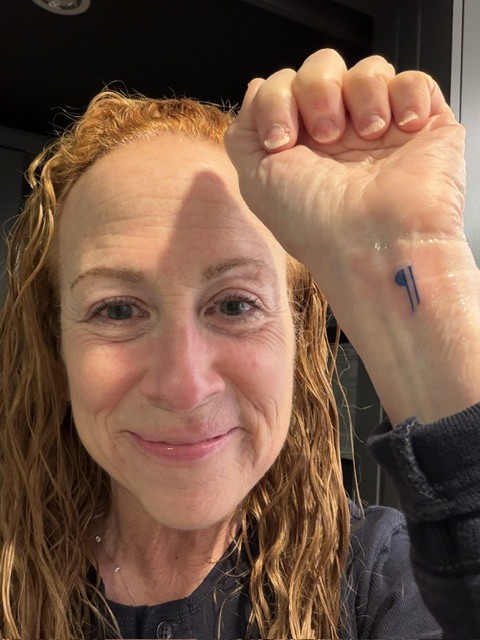
A half hour later, I left with a brand new tattoo on the inside of my left wrist. It’s about ¾” tall, cobalt blue, like the ink from a pen. It’s a pilcrow—the paragraph symbol that is used in editing.
I love it.
It’s elegant and tiny and I see it every time I sign something. To me, it means exactly what a pilcrow means when it’s inserted into a manuscript:
Same story; fresh start.
When my birthday finally arrived, I celebrated with calls from my kids and gifts that made me laugh—a hand-thrown bowl, a Little Mermaid shirt, a candle that says, “From a distance, you don’t look a day over 59!” I did not have a sea change on my actual birthday; I still wasn’t happy about turning sixty. Now, on the other side of the actual date, I’m still mildly disgruntled. But when I look down at my wrist, there’s a symbol that marks all I have accumulated and accomplished so far, and reminds me there’s more to come.
Please don’t tell my mother.
___________________________
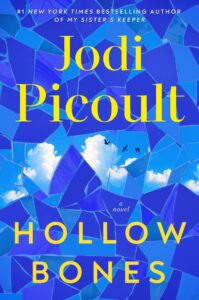
Hollow Bones by Jodi Picoult is available from Ballantine Books, an imprint of Random House, a division of Penguin Random House, LLC.

Jodi Picoult
Jodi Picoult is the #1 New York Times bestselling author of thirty novels, including By Any Other Name, Mad Honey (co-authored with Jennifer Finney Boylan), Wish You Were Here, The Book of Two Ways, A Spark of Light, Small Great Things, Leaving Time, and My Sister’s Keeper, and, with daughter Samantha van Leer, two young adult novels, Between the Lines and Off the Page. She lives in New Hampshire with her husband.