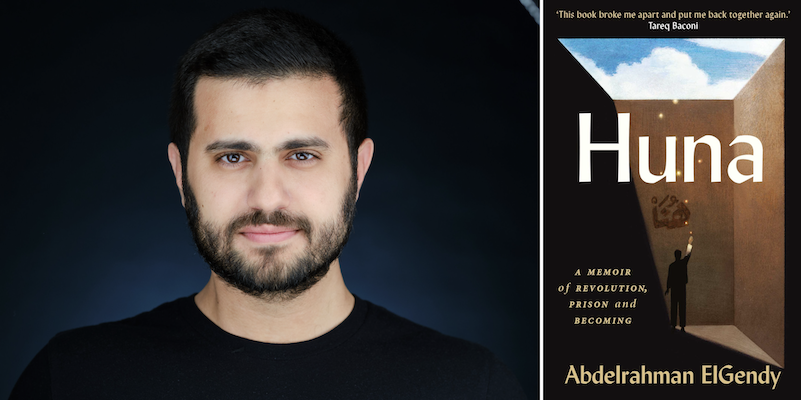
Abdelrahman ElGendy on Writing From Inside a Prison Cell
Samaa Khullar speaks to the former political prisoner and author of the memoir Huna
On his third night in detention in Cairo, crammed with sixty other prisoners into a four-by-five meter cell, Abdelrahman ElGendy heard the song for the first time. Belly full after being starved for three days, one of his cellmates began to sing “Sawfa Naqba Huna,” or “We Will Remain Here.” ElGendy was seventeen years old, goosebumps rising on his arms, not yet grasping what “here” was supposed to mean.
Huna, out this week from Hogarth, traces the six years ElGendy spent as a political prisoner in Egypt after being swept up alongside his father in a crackdown following the 2013 military coup, moving from overcrowded holding cells to the country’s most notorious prison complex, The Scorpion. We follow him as he forms lifelong friendships, studies to earn his engineering degree, and begins his writing journey—smuggling out pages in laundry bags, pages that would eventually help to form this book.
But Huna is not a book about resilience or hope—ElGendy is almost allergic to those words. It’s a book about erasure, and about how to continue to exist in a place that tries to strip you of your humanity. Its opening lines read less like memoir and more like a manifesto:
I wrote on walls; I wrote on scraps. I wrote witness in cursive letters; I wrote handles on bolted doors. I wrote around, and through, the noise, and I wrote the noise. I wrote to soothe, to numb; when the frost thawed, again, I wrote.
“You engrave yourself into the very wall designed to erase you,” he told me. “And somehow that wall built for erasure becomes your vehicle for immortality, like the dates you see on those walls, tens and tens of years back.” Structured around the ‘anbara, an Egyptian oral tradition in which one inmate calls the whole cellblock to attention from the next cell door, he positions us not as superior outside readers extending empathy, but as cellmates on equal footing.
Huna arrives on shelves as ElGendy finds himself in motion again. Forced out of the United States under the threat of potential ICE detention, he now experiences a second displacement that the book, in some ways, anticipated. I sat down with him in the days before Huna’s launch to talk about the ‘anbara, the complexities of translating a book filled with phrases that only work in Arabic, and the violence of the word “resilient.”
*
Samaa Khullar: There’s a version of this book that could have existed where you spend a lot of time explaining the Arab Spring and what happened in Egypt to a Western reader—the history, the acronyms, the timeline of the revolution. You didn’t write that book; instead you chose to take us straight into your experience as a political prisoner. What was your decision making on how you wanted to frame this book?
Abdelrahman El-Gendy: I always knew that I didn’t want this book to be “the Egypt book” or “the prison book.” I wanted it to be at least that, and I was thinking about the revolution more as an entryway into questions I was interested in, rather than the endpoint. After a certain amount of years in prison, you don’t necessarily think about politics. It’s more like: what is time? What is body? What is language? What is fate? You’re thinking about all those existential things and trying to make sense of why this happened to you and who you are now. I tried as much as possible to think about the question of erasure. What does it mean to be erased in your body, in language, in your very sense of selfhood? And then what does being look like within conditions like these? So I started reading memoirs that grapple with erasure from very different contexts.
I remember one of the memoirs I really liked was You Could Make This Place Beautiful by Maggie Smith, which is a divorce memoir—very different in terms of content, but it resonated with me because she’s interrogating what it means to be erased in a marriage, in your body, and in language and your sense of self. I found that more interesting than reading other prison memoirs.
SK: I feel like that would have been my first step—to seek out what other people have written about an experience I’m also writing about. I’m curious why you chose not to do that. Did you not want their experiences or writing styles to cloud yours, or was there a different reason?
AEG: When you read things too identical to what you’re going through, I don’t think it’s always generative. I didn’t want to write a prison memoir in that sense. When you read work while you’re writing your book, you feel inspired by certain things and how they spoke about certain experiences, and you start thinking: maybe I should also speak about that. I didn’t want to replicate what someone else was doing. The more generative thing was to think about wildly different experiences in terms of content, but ones that are aligned in terms of question and inquiry.
SK: You went to the University of Pittsburgh for your MFA. Were you there to work on this book? And what were some of those conversations like in class? Did other writers have assumptions about what this book was going to be?
AEG: This is true of MFA in general, but definitely. There’s so much that’s different when you’re not American. These are very US-centric spaces. There was a funny sort of thing that happened: I’m portraying my father in a specific way, and I feel like there’s so much peer pressure to make your parents evil in a memoir. No one told me “make your father evil,” but it just kind of felt like the questions were always: where are his flaws? I do think he’s a flawed character in the book—he’s not perfect—but he was clearly portrayed out of love. So much of the resentment in the book was actually self-directed. The guilt and all those emotions. It was this weird dynamic where I felt how I was going about portraying this experience did not necessarily align with how people expected memoir to behave in the US.
I remember a comment that said, “Maybe if you say Cairo is three times the size of New York, it would make it more relatable.” I was like, why on earth would I say that in speaking about Cairo? The US-centrism sometimes comes through in those comments, especially in MFA programs where people are sitting with the rawest, most vulnerable drafts of very personal work. And so many comments assumed familiarity with the context for everyone else. For me, it was always: tell us more, give us more context. I think that demand for constant transparency and legibility is an act of violence.
SK: Before you’re ripped away from family and friends, you describe having crushes, pushing yourself on the basketball court, begging to watch Hannah Montana. I found myself thinking about all the ways that we strip away Arab boyhood and make young men into symbols of resistance before they have the chance to grow up or even know themselves. Why did you choose to include these little details?
AEG: There’s so much about masculinity in this book, even if it’s not heavy commentary. I don’t think it’s the most traditional thing to love Hannah Montana and Taylor Swift as an Arab boy in Egypt. It’s not perceived as manly. In prison, which is a hyper-masculine space, there was this subtle thinking about masculinity. And in relation to me and Baba—so much of that inability to express affection is characteristic of son-father relationships in Arab families and has so much to do with how both of us were taught what a man should behave like. This memoir is actually me thinking through these things on the page, trying to understand what was happening in that relationship and the ways I failed to translate certain things as an act of love.
So many of these scenes were misread in workshops as me catering to an American audience. Someone would say, “I love how you included Hannah Montana here—it makes it so relatable for an American reader.” I was like, that’s just not the point. You underestimate how American cultural imperialism works. Everyone around the world has heard of Hannah Montana, and yes, it’s how American hegemony functions across the world, but that does not lessen our experiences.
SK: The handling of Arabic in this book isn’t uniform. Some words are transliterated, some are in Arabic script, and some concepts are carried entirely in English. It seems very intentional. Why did you choose this variance?
AEG: I was trying to listen more and more to my gut feeling, when I felt I wanted to contextualize or transliterate something, and when that urge came from a place of fear of being misread or cast out of a certain readership. I got better and better with each round of revision at recognizing the urge that says: this word doesn’t want to be translated, you’re just enforcing the translation to cater to the reader. So some words I felt comfortable translating—قلب خساية, “the heart of a lettuce” for example—because I wanted to give the reader an insight into this metaphor. But I was always thinking: if I was writing this book for Egyptians or people who read English in Egypt, what would I never have to explain? What would be naturally understood? And I was thinking about what it looks like for this book to be listened in on. And that comes through in the structure.
Your crushed body is not an error. It’s not an oversight. It’s a main function of the system.
The book is structured around the ‘anbara—the prison ritual where people would stand in prison cells and call out to one another through the naddara, or the opening in the cell door. One person would say “‘Anbar kollu yisma’a’!” or “Cellblock! Everyone listen!” and the whole place would stop. The ten lines of the ‘anbara poem are the ten sections of the book, all untranslated, just in Arabic. It was important to me that they’re untranslated because even if you can access the book, the whole thing is framed as something you cannot fully understand. And I put the explanation of what this poem is at the very end—and even then, I don’t explain what it means. So it’s sort of a sleight of hand. If you finish this book and received it, you realize you have been positioned as a prisoner throughout this book, as a cellmate, and not as a superior reader coming to extend empathy to a victim.
SK: When did you land on Huna, and were there other working titles?
AEG: It was actually very late in the game. It was called “We Write On Walls,” which I kind of liked but always thought of as a placeholder. Then “Huna” was part of the song I heard on my third night in detention, crammed with sixty other people in a tiny four-by-five meter cell. We hadn’t had proper food in three days; prison food was inedible. That particular night, for the first time, they allowed our families to send food through. It was so fascinating to witness how much we softened, how the mood got lighter, even though the physical conditions didn’t change at all. People started singing, and one of the songs they sang was Sawfa Naqba Huna, or “We Will Remain Here.” I was really interested in what it means when we say that. The song goes: we will remain here until the pain subsides, the melody will sweeten. So what does it mean if we don’t want to remain here physically? That’s what I was fascinated by: what is this huna, this “here,” that we’re choosing to inhabit.
One day I woke up with this revelation: that’s it. It’s perfect. It’s the song, it’s the throughline, it’s the question, it’s what we’re chasing. It’s simple, and I always wanted the title to be in Arabic, but I didn’t want it to be in Arabic just for the sake of it, I wanted it to be meaningful.
SK: Throughout the book, we find ourselves hoping that if the right official just heard your story, they’d understand you don’t belong in prison. What did it take for you to stop wanting that recognition?
AEG: Again, your instinct in prison is thinking “I don’t belong in this place” and I truly believe to this day that we don’t belong in prisons, but what I was questioning more was the instinct to think that the judicial system’s issue is only one of insufficient understanding. That if you clarify enough, if you get them to hear you out, they’ll realize this is a mistake. You gaslight yourself into thinking this is possible. And I think it’s just part of so many of our political awakenings: coming to the very difficult realization that systems of oppression are not failing to protect us. The judiciary is not failing to carry out justice: it’s part of the machinery of oppression. It’s not meant to bring about justice. It’s meant to uphold the power that is oppressing you. Your crushed body is not an error. It’s not an oversight. It’s a main function of the system.
We’re not given the privilege to be political enemies—we all have the barrel of the same gun pointed at us.
You eventually come to accept that the only possible engagement with this machinery is one of deceit and self-preservation. And I grapple with that in the book a lot, how the language of the law—not just the systems and the apparatus of the court, but the very language of law—is designed to lubricate that brutality against us to make it seem not just palatable but necessary. What does it mean to re-encounter ideas of criminality, of terrorism, of all those legal categories, once that veil has been removed?
SK: You argue that the state’s vocabulary works because it makes people sound like plausible prisoners. My mind went to Palestine, and the idea that if you’re one of the “good ones,” if you make yourself palatable, if you denounce resistance and distance yourself from the wrong people, you’ll be fine. When did you realize this was just an unwinnable game?
AEG: I was thinking of Palestine so much while writing this book. It’s the same thing in Egypt with the Muslim Brotherhood. There’s been so much pressure to discuss them in the book, which I was uninterested in. I have a very difficult and hostile relationship with them, and it’s in the book, but only in ways that serve the narrative. The boogeyman in Egypt is the Brotherhood. I think about this a lot in the book: what does it mean to be in political enmity with a certain people, but also need to stand against their oppression? Because they’ve been brutalized by the same machinery of repression. It’s a very tricky thing to do.
I didn’t want to reduce the political prisoner figure to this heroic monolith we’re often accustomed to because it’s politically useful.
You feel that saying “I’m not one of them” is throwing them under the bus, because you’re saying, by extension, that they deserve that brutality. And this is a very interesting dynamic in prison. They force all those people who probably would never have spoken to one another outside to be in the same cells, to build certain coalitions in order to survive. The ceiling is so far below our feet. The thing we’re fighting for now in Egypt is just the opportunity to hate each other freely. We’re not given the privilege to be political enemies—we all have the barrel of the same gun pointed at us. So we’re forced into coalitions we know are not going to last.
SK: You don’t explicitly mention prison abolition in the book—that phrase I mean—but I also felt you didn’t have to clarify your position on the matter. Was it a conscious choice to avoid the American conversations about prison reform or abolition?
AEG: I learned so much from American abolitionist thinkers, especially Black abolitionists, and I first encountered abolition in prison, actually, when I read Ruth Wilson Gilmore and Angela Davis and started thinking about what it means to build a world in which prisons become obsolete.
Though there is a lot that is universal about carceral systems, I think there is also a lot that is US-specific, particularly in how the ideas of surplus population and capital, land, and bureaucracy operate in ways that just do not work the same way in the Egyptian context, for example. The state is actually putting in so much money to maintain a system of oppression in order to maintain its iron grip on power.
I think our challenge is to learn from more developed abolitionist movements and build our own theory of what an Egyptian abolitionist movement can look like. I am invested in abolishing prisons in the sense of asking: What would it take to build a world in which prisons just become a thing we do not need anymore?
SK: As important as it was hearing about your comrades and loved ones in prison, it was equally important to hear about those you argued with, pitied, or even hated. You could have made it sound like you were all supporting each other, fighting towards a common enemy, but you chose to tell the truth about your anger and resentment. What was it like to put that on paper?
AEG: I was just allergic to these concepts of resilience and resistance. You have no idea how many times that language is imposed on a book like this in terms of marketing and positioning. Everyone says: people don’t want a depressing book, people want to find hope. And I’m like: this is not a book about resilience. There is not one instance in this book where I speak about hope. It explicitly speaks about hopelessness. I didn’t want to reduce the political prisoner figure to this heroic monolith we’re often accustomed to because it’s politically useful. Resilience and resistance are not bad things per se, and I do think they apply to many people in prison, but they’re often used more for the sake of the speaker than the prisoner. It’s to appease a certain guilt or helplessness. You need to believe they’re resilient and steadfast. It’s just self appeasing.
Prison is a place of survival and yes, the book is very keen on studying the ability to retain one’s tenderness in conditions that are intentional about callusing them. But it also insists on portraying the wide spectrum of emotions and the erosion that happens to one’s soul. You have to kill yourself enough in prison in order to survive it. But the trick is to kill yourself just enough to have this little bit of tenderness left. If you get too tender, you’ll get crushed, and if you lose it absolutely, then prison already won.
This is not a book that will offer you hope in the way you’re expecting it. I would like to offer something more cathartic and enduring than hope.
Sometimes it looks very ugly. Sometimes there’s a lot of hate—and not just at the jailer, at one another. People do things that are not pleasant when they’re trying to survive. Once you’re exposed to that, you’re confronted with: do you still feel the same way about these people? We don’t need to love people to think they shouldn’t be brutalized. It’s okay to dislike or even hate people and still take a principled stance against their dehumanization.
SK: I think about that even when writing about Lebanon and Iran and Palestine—how allies throw around “resilient” so quickly. What do you think people should consider before they use that word?
AEG: They should consider: for whose sake are you saying that word? More often than not, you’ll find you’re saying it for your own self-appeasing purposes. It deters us from action or makes us feel better about our helplessness. Every time you’re uttering that word and it’s not for the sake of the prisoner, I don’t think it’s very helpful in terms of political organizing. I think it’s a demobilizing word. We should just be very enraged and constantly agitated about what’s happening to them. Anything that soothes that, or gives them more-than-human capacities—that’s just unhelpful to them.
SK: You write that your pain was meaningless, do you still feel that way? Ahdaf Soueif wrote to you in prison that it was not the main event of your life, only the circumstances in which you will continue to grow. Was she right?
AEG: I have such an unsettled and agitated relationship to questions of meaning. I’ve become less concerned with thinking about what ends I’m aiming for. Thinking less about reaching those ends and more about the act of seeking itself. To me, this is the key thing I’ve arrived at up until now. This is not a book that will offer you hope in the way you’re expecting it. I would like to offer something more cathartic and enduring than hope.
I was standing in that cage, handcuffed to my father, and the prosecutor called for our execution.
Everything we’ve been witnessing, with the genocide in Gaza and Sudan and everywhere in the world, it’s just difficult to think about hope in simplistic terms. Thinking about hope in that way, it’s the same thing as resilience. It’s starting to feel like a betrayal, or just a way we appease ourselves that has stopped being helpful. I’m trying to stop thinking about meaning and hope and success in this linear, colonial way of mastery and conquering and attaining a thing.
SK: In the middle of the book, you wrote “At least this will be a poignant scene in the memoir.” How early did the process of trying to collect and remember start?
AEG: In the beginning it didn’t start as a thing to collect or remember because I didn’t want to believe I was staying in this place. The first time I ever wrote anything in prison was after the first trial hearing. I was standing in that cage, handcuffed to my father, and the prosecutor called for our execution. That was just a shocking moment: the disproportionality of what was being said about us. I was 17, and there was this weird dissonance when you hear all those things and start feeling detached from the person they’re being said about. I wanted to let it out. I grabbed a pen and paper I’d smuggled in and started writing—about my body, about what it means to have a handcuff around my hand, how my reflection looked in it. Very raw things. I released it out of prison in the laundry bag. My sister published it on Facebook and it started getting traction. And to me that was the first magical experience of knowing what it feels like for your words to be read by people you don’t know who feel touched by them and share it with you. In a place cut off from everything, where some cells you just sit looking at the same people for a year, writing was a lifeline. It got to a point where if it had landed me in solitary confinement, I couldn’t have given it up.
It was an urge of self-preservation. I needed to survive. Writing was regaining a sense of control, not over circumstances, but at least over the naming of circumstances. I was studying engineering at the time, and I was thinking about writing in the same way I tried to decipher engineering problems: how does everything that happens to me fit together?
Eventually I started thinking: maybe this whole experience could be a book. When things happened I would think about what I would write when I got back to my cell. I had a fifteen-year sentence. I had no idea if I was ever going to see the light again. But the fantasy of the book made me think of everything here as a part of a project. So when I was being beaten with batons, the protagonist of the book was being beaten by batons, not me. It was a very unhealthy coping mechanism, but in prison, if it works, you keep doing it. It has ramifications up until this point: I have a book coming out and I struggle to feel that it’s real. It feels like it’s still happening to the character in the book, not me. Some of this damage is just irreversible.
SK: Some scientists say memories are unreliable, that you’re actually only remembering the last time you remembered something. Were there moments while writing where you started to question your own memory?
AEG: It did help that I was writing so much throughout [prison]. When you write things down, you actually memorize them better. I was writing my experience in real time. That said, I have a lot of notes I cannot access, they’re all in a big duffel bag hidden in Cairo, too risky to move through an airport. This is a book not only based on my memory. So many of these people have been released from prison, I actually interviewed some of them. For the hunger strike sequence, I had extensive conversations and double-checked what I remembered with people who were there.
And my father was one of the biggest resources. He has this amazing memory for events and dates. He remembers every hour and date, and he insists on never looking at a calendar or keeping a journal. He considers it an insult to his memory. He was putting in so much time helping me remember things and it was a very interesting dynamic, speaking about these things again with him. It was his more comfortable mode of showing love: not discussing the emotional aspects of prison, but fact-checking it with me.
SK: Getting to Baba, who is one of the pillars of the book, I kept thinking about how you wished you cared about him less, because then it wouldn’t hurt so much to see him in pain. Has he read the book, and what has he said about it?
AEG: He did, eventually. If you read the book, you know there’s so much guilt because I caused the arrest of Baba. He was not a political person and had nothing to do with any of this. He was only at the protest to chaperone me, basically. Throughout prison, we struggled to communicate affection to one another. I think he just thought I hated him. I struggled to convey how I felt; it got worse, and we ended up in silence because we couldn’t speak without snapping at one another.
The prisoner’s biggest fear is to be forgotten. Prisoners just always have this phobia of the world moving on from them.
An early reader told me: “You know what I think this book is? It’s a love letter to Baba.” When he read it, I could tell he was feeling so many things. When I asked him how he felt, he just nodded and said “I understand some things much better now.” That’s it. But I knew, he poured so much time and labor fact-checking it, underlining things, giving me corrections, saying “You said 132 pardoned prisoners on that list, it was actually 200.” That was how I knew he felt love. Because he was practicing his language of love, which I’ve now learned to translate. He offers his labor very abundantly and unconditionally. This book felt like such a loving closure to a horrific experience we were forced to share together.
SK: Your cellmate from the very first night, Ayman Moussa, is at the heart of the book too. That first night you both seemed to have so much hope it would all be cleared up and you’d get out, but he’s still there. You recently wrote that you catch yourself waiting for anniversaries, writing eulogies. When did you notice that?
AEG: Everything I spoke about before—killing yourself just enough, retaining enough softness to hold and be held, finding wonder, finding the courage to love—to me, all of that is embodied in mine and Ayman’s friendship in prison. I wrote this in the book, but he kept me laughing, which kept me human. I owe so much of the softness I was able to nurse outside of prison to that relationship. And this is why leaving him behind feels like such a betrayal. It was an unspoken pact between us: everyone leaves but us. For a while that was literally true because everyone was being pardoned and released, and it was just the two of us stuck there. Prison tricks you with a sense of permanency where it feels like things will be that way forever because time is so unmoving and stagnant.
Again, Baba and Ayman are the spines of this book. And for Ayman, it’s important for people who read the book to grasp the immediacy and urgency of the story, because it’s not just a story. Ayman is still behind bars for the 13th year. He’s lost his entire twenties. At this moment, while we’re sitting here talking, he’s still rotting behind the same bars. I hate that we speak about him as though he’s dead, like he’s some kind of story we’re trying to find the wisdom in, waxing poetic, which is what we always do when we remember someone who is right there. He’s literally right across that wall from us and we’re not doing anything material to get him out. He’s not resilient—he just wants to get the fuck out of prison. He doesn’t care about any of that. He wants to be free. So I just want people to finish this book and feel as viscerally enraged as I am that he is not free and he should be.
Now whenever I send him a letter, I try not to offer him hope. I’m just trying to offer him slivers of the life that has been stolen from him. I tell him about concerts and singers and jokes, what I’m reading. He tells me what he’s reading, and the new cellmates he met last month. We just try not to make prison the main event. Any attempt at providing hope feels like bullshit at this point. I don’t have hope, he doesn’t have hope. I’m just more concerned with: how are we trying to hold and be held?
SK: I was struck towards the end when you mentioned that you were 22 when you met a fellow political prisoner. You mention it in passing but as a reader I was shocked that we had already been with you for five years, that you had already lost your late teens and early twenties behind bars. And I started to wonder: did you ever think about those on the outside who must have forgotten the political prisoners? Did you feel any resentment?
AEG: I mean there’s a whole throughline in the book that speaks about forgetting all the time, but it is such a huge thing throughout prison. The prisoner’s biggest fear is to be forgotten. Prisoners just always have this phobia of the world moving on from them. And even when people are speaking about political prisoners, it’s almost always the fresher ones, so people from 2013 are not talked about as much as people who got arrested last month or last week—Egypt is never in shortage.
People reconcile themselves with the fact that this is a sad thing, but it’s just a thing now. Like, you’re in prison, we’re not, and that’s the way things are. We were always thinking: how in the world is everything moving forward? How is time not stopping for this? How am I in a cage with a locked door? And I’ve been here for five, six, seven years. Someone like Ayman, 13 years. How is everything not pausing?
It feels very different if you’re a political prisoner while there’s a revolution than it is now, when your incarceration serves nothing. There’s nothing but the years you’re losing in your life and no one cares about that. There’s no monuments erected in your name. No one is even remembering you. It gets to a point where your family is tortured by the fact that this is part of their routine now. It’s hard to go about life normally and encounter all those people in the world who are not waiting for the next prison visit next week like you. The idea of you being in prison is now just a thing that people don’t question, they don’t think about your release in the same way anymore.
We thought about it all the time, and part of my writing from prison was trying to unsettle that. I’m forcing people to remember me somehow or to keep the conversation going. I don’t want to be erased completely.
SK: Does your heart still soften at the thought of Cairo today, or does it make you angry?
AEG: It’s more a sense of melancholy. I write about this in the book: Cairo, Al-Qahira, the vanquisher. We grow up being told Cairo vanquishes our enemies, and you assume the enemies are the bad people coming to invade. Then you grow up and learn that it’s actually you, because you’re the one being vanquished again and again. I’m sad that I probably won’t get to see it again. I’m trying to accept that this is going to be the case. I do feel like the ideal relationship with Cairo for me would be a long-distance relationship—go hang out for a month every year and then leave.
I left the US for the same reason I can’t go back to Cairo. I vowed that once I left prison, I could not be in a place where I was unable to say and write the things I wanted. In Cairo, so much has been erased—the revolutionary memories we had there, which we now have to pretend didn’t happen and which we cannot speak to each other about. It’s a very Orwellian reality. And I just can’t afford to live that way anymore.
There’s a quote I keep returning to by Arwa Saleh, writing in 1995 about a very different moment in Egyptian history, but it feels like it was written about the January 25th revolution:
Perhaps the naivete of this dream now brings a smile—maybe more to those of our generation than to anyone else—but I find it far harsher, the hand dealt to the generations who never got to know such abundance. It is for this reason that I wrote of our stillborn dream, for it was not entirely a mirage, as so many of us are now tempted to call it in order to diminish our past. A kind of revenge, I suppose, against the arrogance we once harbored. It was history as well, leaving behind real fragments, and it is strange that we should squander them merely because we were defeated with such humiliating ease.
That quote is exactly how I feel about the revolution. We are always inclined to belittle what we did and how naive we were and how stupid, because we were defeated with such humiliating ease that we find it difficult to recall. So we squander everything. But I would rather have experienced this, and felt all the terrible and crushing things, than have no experience of such abundance at all.
_________________________________
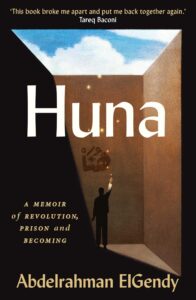
Huna: A Memoir of Revolution, Prison, and Becoming by Abdelrahman ElGendy is available from Hogarth

Samaa Khullar
Samaa Khullar is a Palestinian-Indian writer and investigative journalist based in New York City.