A Necessary History of the Oddest Letter: W
Danny Bate on the Linguistic History of Our Alphabet
“The letter W is a child of the fall of Rome. In the fifth century CE, the western half of the Roman Empire disintegrated into a patchwork of new kingdoms and new rulers. The reasons behind this collapse of imperial power are complex, but a large role was played by various peoples who had formerly lived outside its borders. The Romans might have looked down on these migrants as ‘barbarians’, but they also increasingly came to rely on them for military support. They were foederati—peoples bound by treaty to fight Rome’s enemies in return for land and food. It was only with the help of the foederati (a Latin word related to English federation) that the Romans were able to see off the threat of Attila the Hun in 451. Yet the more power these regional leaders had, the less authority the emperor and the central state could wield. This culminated in the overthrowing of the last emperor in the west in 476.
Language would have been a part of the divide between Roman and barbarian. By the fourth and fifth centuries, the western empire had become overwhelmingly Latin-speaking. By contrast, the newcomers spoke their own languages, perhaps with a passing knowledge of Latin too. From what we can tell, a great many of these migrants spoke Germanic languages. One of these incoming tongues was the ancestor of the language you are reading right now, English, which arrived in the remains of Roman Britain during this era. Germanic-speaking elites could now be found from southern Spain to the coasts of the North Sea. These new rulers were keen to sell themselves as legitimate successors to the emperors, and there was considerable continuity during this turbulent period.
By keeping up appearances and styling themselves as good Romans, they could dampen the jealousy of the old aristocracy and gain popular support. The new kings did not insist that scribes ought to write official documents in their own Germanic tongue, but eagerly adopted the more prestigious Latin language. This worked fine most of the time, but might occasionally hit a snag. Latin-writing lands were now ruled by men whose names contained un-Latin sounds. A new king might want his scribes to draw up a charter for some great display of generosity, but how were the scribes to spell that king’s name?
One of the troublesome sounds for writers was /w/. This is the common consonant in English water and want, and it would have been present in kingly Germanic names like Clovis, Vitiges and Odoacer. The trouble was, the Latin alphabet now had no letter for this sound.
Nonetheless, W established itself as a standard way to spell the Germanic sound /w/, including in Latin texts produced in England.
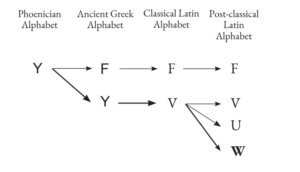
In ancient times, you would’ve heard the sound /w/ all around the Mediterranean Sea. Both Latin and Ancient Greek once used the sound, and both the Romans and the Greeks had letters to spell it. This was a sound that they, just like English, had inherited as part of their common Indo-European ancestry. Yet, as we saw in Chapters F and U, it was now foreign to them. In Greek, the consonant and its letter Ϝ had faded away, while in Latin, V had come to stand for the fricative /v/ instead.91 Time and time again, we find the ancient sound /w/ being lost or altered across the Indo-European family of languages. It would later happen in Continental Germanic languages too; in German today, W stands for /v/. The English consonant /w/ is actually a rare survivor, rescued from potential change by its migration to the island of Britain.
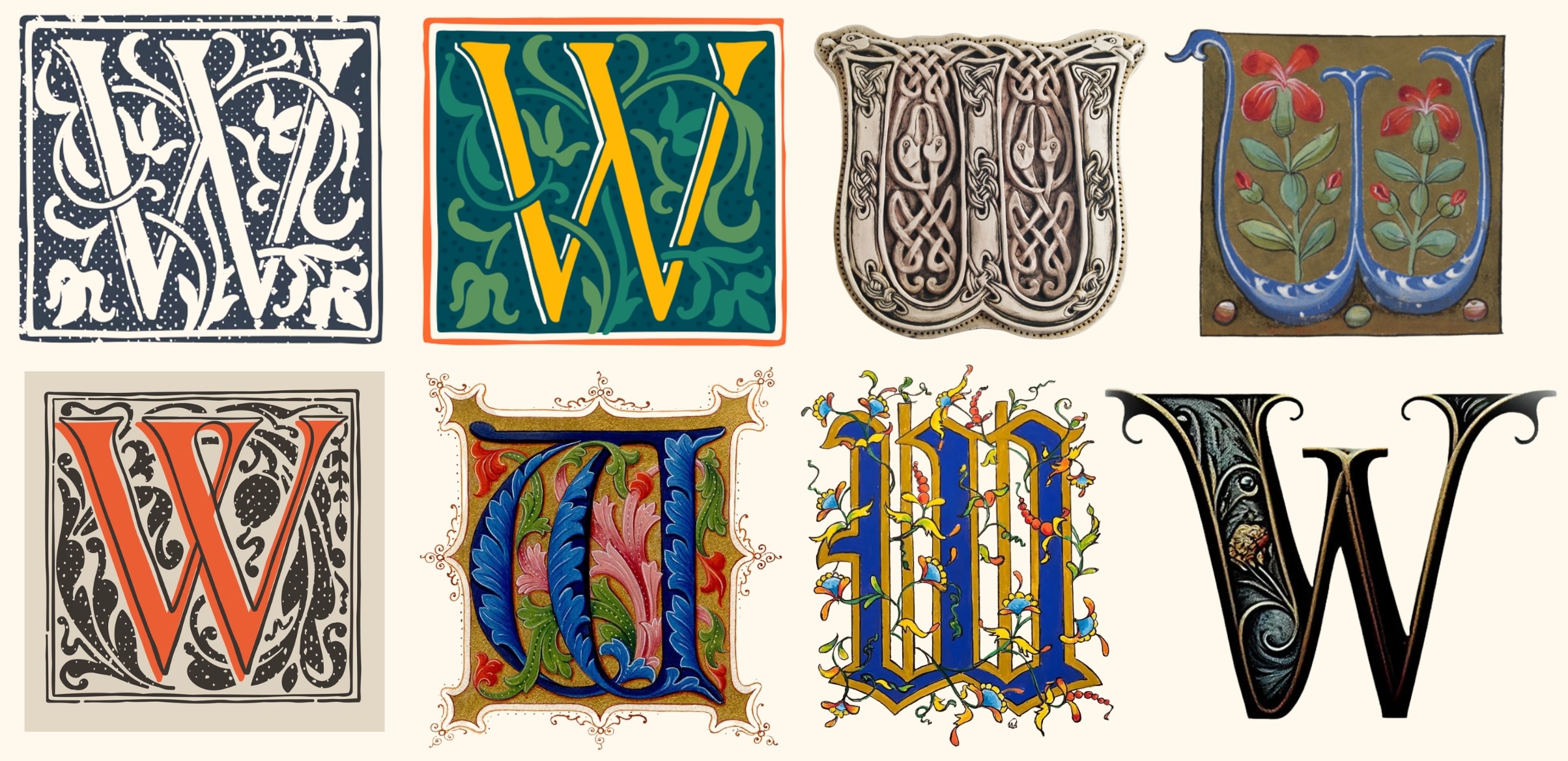
Out of the meeting of languages and writing in the new post-classical world, a letter was born to spell the alien /w/. From the sixth century onwards, likely starting in the powerful kingdom of Francia, innovative scribes doubled U. Within Latin texts, we find Germanically-named individuals like the abbot UUandeberctus and King UUaldemarus. The two letters were increasingly written as -one, and at least by the 11th century, they had fused into the letter W as we know it. Note that this was long before the split of V and U into two separate letters, hence some modern disagreement over their offspring’s name. In the English alphabet, it’s called double U. For the French, it’s double vé.
From its origins in Francia, W was exported to nearby lands that also needed it. W appears in early English texts, although not without competition. One alternative, seen in Cædmon’s Hymn in Chapter U, was a single U. Scribes would switch to one U when the following vowel was an /u/. This would avoid awkward-looking sequences of three Us in a row.
This dislike of ‘triple U’ in medieval texts is in fact still active in English spelling today. In the later Middle Ages, scribes would swap a U for an O if it came after W. This was done for the sake of clarity when reading. Even when words had a short /u/ vowel, spellings like wulf, wud and wunder would have been too confusing in the era of manuscript writing, what with its rows of upright quill strokes. This avoidance tactic can explain the modern mismatch between sounds and spelling in wolf, wood and wonder. Nonetheless, W established itself as a standard way to spell the Germanic sound /w/, including in Latin texts produced in England.
Nonetheless, W established itself as a standard way to spell the Germanic sound /w/, including in Latin texts produced in England.For example, the Life of Saint Æthelwold is a tenth-century biography that narrates the holy life of an English bishop. Being based in southern England, its Latin language is crammed full of English place-names containing the sound /w/, like Winchester, Worcester and Wallingford. The saint’s own name is spelled Aðeluuoldus.
Yet, during the same pre-Norman period, a specifically English written culture was also emerging alongside Latin. Its writers clearly had a sense that this was a separate language from Latin, and therefore could have its own spelling practices. While writing in Latin ought to use only Latin letters, they felt that they had more freedom when spelling Old English. Just as they had done with the letter Þ, English writers looked for an alternative to a lengthy W or an ambiguous single U. They reached into the world of runes, and employed Ƿ.
Instead, W has been brought in to tell the reader that the OW in town is a greatly shifted diphthong, no longer a single long vowel as it had once been.
Known as wynn, the letter Ƿ is extremely common in our Old English sources. See on p.301 how it appears twice in the first line in our only surviving copy of the poem Beowulf, in the words hƿæt ‘what’ and ƿe ‘we’.
It was standard spelling in the Wessex tradition, which would have written two and word as tƿa and ƿord. Examples of Ƿ outside the parchment pages of manuscripts show that the letter enjoyed popular use for centuries. A decorated dagger, found in Kent and dated to the ninth or tenth century, informs its viewers:
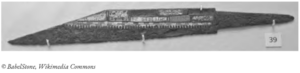
Biorhtelm me ƿorte ‘Biorhtelm wrought me’
S[i]gebereht me ah ‘S[i]gebereht owns me’
Yet, as you might have noticed, wynn is no longer a part of the English alphabet. It did survive the Norman Conquest, but gradually fizzled out during the Middle English era. It faced considerable opposition from the spelling of French and Latin, which had continued to use W since the sixth century. The pressure to match them meant that it was by W that Ƿ was eventually replaced.
Ever since the reapplication of W to English, the language has put the letter to a great many uses. Some instances of W are more recent in origin. Some even developed out of an original G.
In Old English, the letter G stood for one of a couple of similar sounds, depending on where in the word it came. In the middle of a word, a G represented a velar and fricative sound that was like a weaker /g/. During the Middle English period, this sound shifted into /w/, which also has a velar quality as a sound. This is how an Old English word like fugol ‘bird’ has become fowl, or how the sagu tool is now a saw. The Norse concept of lǫg, the facts of life laid down by fate or society, is behind English law.
These changes of G to W reflect a changed consonant, but elsewhere in spelling, W is used to tell us something about a vowel. It is especially common in words that have undergone the Great Vowel Shift, like town, cow and owl. These go back to tun, cu and ule in Old English, none of which had a G. Instead, W has been brought in to tell the reader that the OW in town is a greatly shifted diphthong, no longer a single long vowel as it had once been.
OW shares this role with OU. The second option for the same vowel appears instead in words like hour, shout and found. There has been a half-hearted rule in English spelling to use OW at the end of a word or syllable, and OU everywhere else. This rule would explain why we don’t write ‘nou’, ‘eyebrou’ and ‘allou’, but rather now, eyebrow and allow. At the end of a word like now, there is an audible /w/ sound, especially if the next word begins with a vowel (e.g. now I think …). However, this rule hasn’t been rigorously applied; we ought to write ‘broun’ and ‘croun’, not brown and crown.
Both OU and OW had good reasons to become the standard spelling for this post-shift vowel, but English failed to make a firm decision in favour of one or the other. It has even exploited the optionality to distinguish different words with a common origin. We spell flower with OW, while we use OU for the best quality or the ‘flower’ of ground grain—that is, flour.
Before we can leave W, there’s a mischievous effect of the letter to be acknowledged.
Consider three words: as, has and was. The third word, I think you will agree, does not rhyme with the previous two, despite their common spelling. Likewise, consider: and, hand and wand. The same lack of rhyme occurs, as it does in the trio arm, harm and warm. Notice the odd one out in ash, bash, cash, dash, gash and wash. If we also compare fan with swan, far with war, or fat with what, then their common denominator becomes clear: there’s something disruptive about the letter W.
To understand this effect, we have to concentrate on a particular quality that sounds in our languages can have. Vowels have featured often in this book, especially with regard to how far forwards, backwards, high or low our tongue is when we pronounce them. These features of tongue position are accompanied by the additional factor of lip rounding—whether or not we purse our lips at the same time.
The key thing to note here is that the consonant /w/ is pronounced with the lips and the back of the tongue. In the case of was, wand, wash and the rest, what has happened is that the /w/ rounded the following vowel, and also dragged it backwards in the mouth. The consonant has shared its rounded lips with the formerly unrounded vowel that comes immediately after it.
Consequently, in many varieties of English today, was, wand and ward have rounded vowels, while unrounded vowels can still be heard in their W-less counterparts, has, hand and hard. The cot-caught merger in North American English (see Chapter O) may be shifting and unrounding the particular vowel in the W-words, but nonetheless, hand still doesn’t rhyme with wand. The fact that this is an effect of adjacent sounds explains why the same changes and divergent vowels have also occurred in quality and quartz. They are not spelled with a W, but they still contain the influential consonant. Quartz doesn’t rhyme with parts, but rather shorts.
We still spell wash and warm as if they rhyme with ash and arm, because until fairly recently, they did. Their rounding is quite modern. It may have started sometime in the 15th century, but for the following four centuries, it remained limited to certain words and contexts. The first instances of W-rounding were likely in very common and unstressed words, like was. When said frequently and quickly, it’s more efficient to progress from a rounded-lipped consonant to a rounded vowel, than to switch off that rounding between the two. The effect was probably not present in the English of Chaucer, nor standard in the later speech of Shakespeare, on the basis of the words that these poets think are rhymes. In his sonnets, Shakespeare pairs was with glass, and warmed with disarmed.
Then were not summer’s distillation left,
A liquid prisoner pent in walls of glass,
Beauty’s effect with beauty were bereft,
Nor it, nor no remembrance what it was.
–Shakespeare, Sonnet 5
The fairest votary took up that fire
Which many legions of true hearts had warmed;
And so the general of hot desire
Was, sleeping, by a virgin hand disarmed.
–Shakespeare, Sonnet 154
Even Lord Byron, composing his narrative poem Childe Harold’s Pilgrimage in the early 19th century, rhymes three words that together sound awkward today.
I stood in Venice, on the Bridge of Sighs,
A palace and a prison on each hand:
I saw from out the wave her structures rise
As from the stroke of the enchanter’s wand:
A thousand years their cloudy wings expand …
–Lord Byron, Childe Harold’s Pilgrimage, Canto IV
Yet again, we have an instance of a reasonable change in sounds, and spellings that have not caught up. We could of course start to write wond instead of wand, or wor instead of war, or even woz for was. Maybe we will one day. For the moment at least, English readers and writers know to be cautious around the English letter W.” (297–306)
__________________________________

This article has been adapted from Why Q Needs U (Blink/Bonnier, U.S. June 2, 2026) by Danny Bate. It is provided courtesy of the publisher.

Danny Bate
Danny Bate is a linguist, writer, broadcaster and podcaster who is fascinated by the study of historical languages and etymology. He took his BA and MPhil degrees from the University of York and the University of Cambridge respectively, and his PhD in linguistics from the University of Edinburgh. He can be found online at dannybate.com, on social media @DannyBate4 and @dannybate.bsky.social and at his podcast A Language I Love is....