








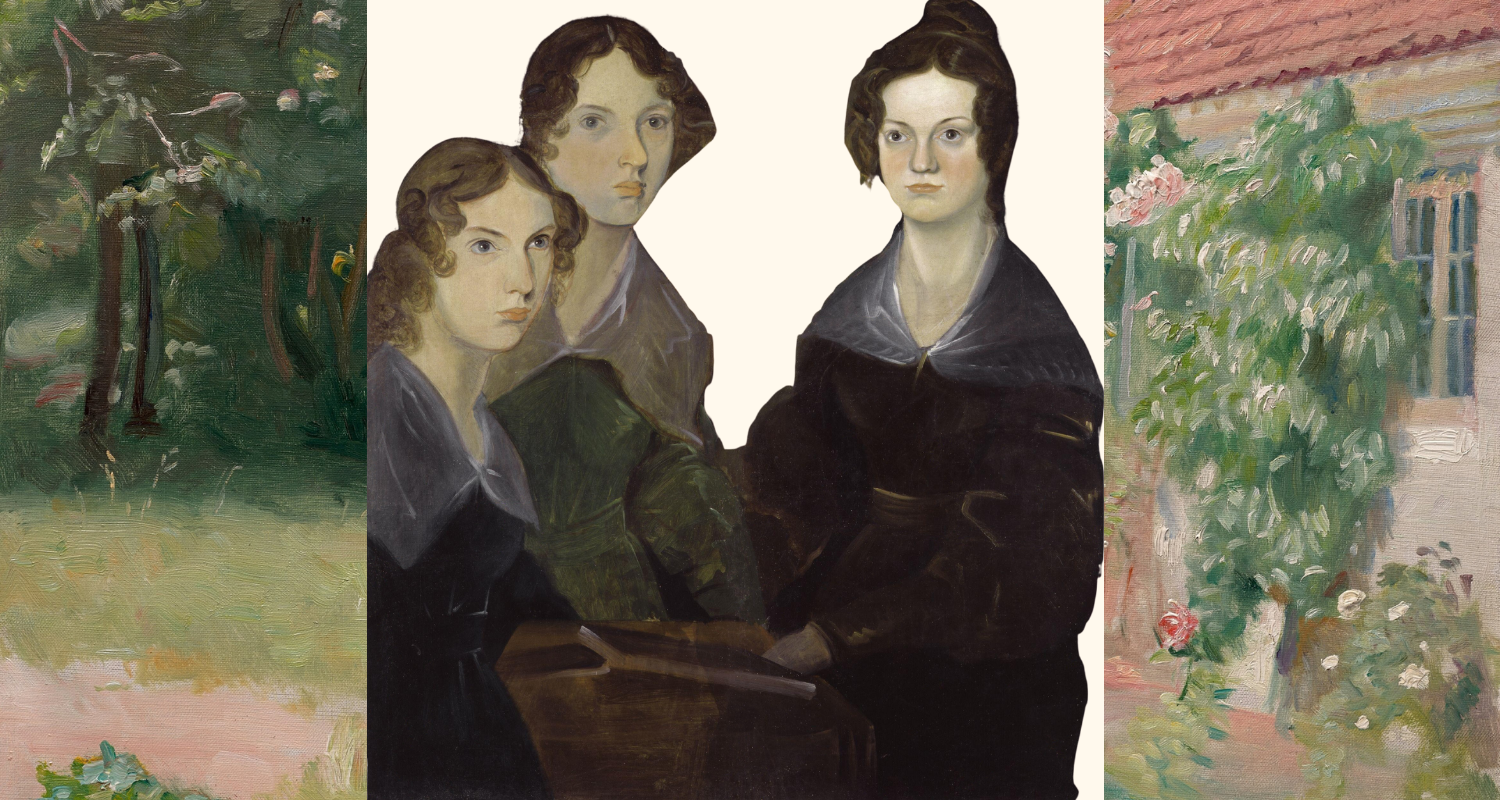
A Field-Guide to the Brontës’ Literary Universe
Amy M. King Explores the Landscapes and Botany That Shaped the Sisters’ Novels
In late May of 2022, the COVID pandemic was not completely over, but many countries, including the United Kingdom, starting lifting restrictions on travel. And so, after a transatlantic flight and a LNER train, in what felt like a state of liberation, I found myself in Yorkshire in late May, striding across the high moors and exulting in the lowland valley’s late spring blooms of bluebells, cowslips, and fields of bright yellow meadow buttercups. Although there is always an element of cosplay in visiting preserved landscapes (and the Yorkshire Dales and North York Moors National Parks are particularly welcome versions of them), the force of the spring bloom that May shook my carefully tended irony, and I simply marveled at the late spring eruption.
I thought of the spring blooms at Lowood in Jane Eyre, and more generally of the novels of the Brontë sisters, who had lived in the West Riding of Yorkshire and whose novels had accompanied me from my pre-teen years through graduate school and on to a professional life in the academy as a Victorianist. What was clear to me in that post-COVID spring was that the landscape in which the Brontës lived shaped their experience of the natural world and lent specificity to their narratives. A specificity that demanded what I thought of as a kind of field-guide to the novels—what the Victorians called a “flora,” and which in the book excerpted here, I call a botany.
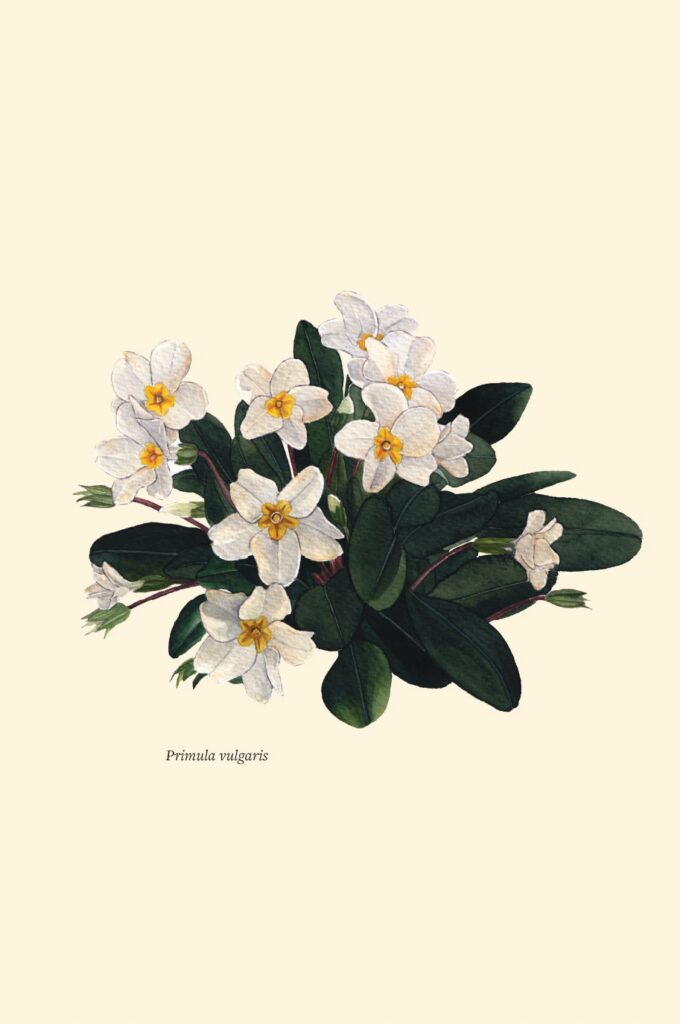 Illustration by Tugce Okay.
From Lucasta Miller’s compelling The Brontë Myth (2001) I was aware that the Brontës had been subject to a process of mythologizing that Charlotte herself initiated and which began in earnest after all of the sisters’ deaths. In a famously florid description of the Brontë parsonage, Elizabeth Gaskell in her Life of Charlotte Brontë (1857) described it as
a place where neither flowers nor vegetables would flourish…where the snow lay long and late on the moors, stretching bleakly and barely…and where often, on autumn or winter nights, the four winds of heaven seemed to meet and merge and rage together.
Gaskell’s biography gave rise to the persistent conflation of the Brontës with the moors as a metonym for bleakness—and the sense that nothing flourished in that inhospitable place, least of all love, where Charlotte, Emily, and Anne Brontë famously lived most of their short tuberculosis-ridden lives. That served a particular kind of narrative, but it will come as no surprise to those who know the moorland habitat that plants of many kinds grow there. And anyone who has read the novels and poetry of the famous sisters knows that the common names of plants are often invoked, and sometimes even anchor a telling scene.
The landscape in which the Brontës lived shaped their experience of the natural world and lent specificity to their narratives.
We can surmise, for instance, from the novels that the Brontë sisters knew the wild primrose—Primula vulgaris, pictured above/at left—and we know that Charlotte painted a watercolor of the primrose (alongside other adept if dutiful renditions of violets, roses, and morning glories). Late in Emily Brontë’s Wuthering Heights, Catherine Linton sidles up to Hareton and teases him by “sticking primroses in his plate of porridge.” It’s a comic turn away from the dead-on seriousness of the references to primroses that follows the first-Catherine’s death in childbirth—the day after Catherine Earnshaw’s funeral, the weather turns foul, silencing the larks, blackening the early spring leaves, and burying “the primroses and crocuses” under “wintry drifts.”
Anne Brontë’s Agnes Grey, which was originally published in a three-volume edition with Wuthering Heights in 1847, also references (as Anne wrote) “that familiar flower,” but hers is strikingly different from Emily’s. Agnes Grey centers an early scene of courtship between Agnes and Mr. Weston, who—seeking to comfort the affronted governess—gathers from “high up between the twisted roots of an oak, three lovely primroses.” The novel signals Agnes’ virtue and ideal mind through her more rational appreciation of nature, as she turns away from a scene of flirtation to “botanise and entomologise amongst the green banks.”
To be clear: that the three authors knew the primrose did not indicate a particularly deep or specialized knowledge of the natural world. In 1597 the English herbalist John Gerard had described and drew several primroses for The Herball; or Generall Historie of Plants. But if you haven’t yourself seen a wild primrose lately, it doesn’t much help when reading Wuthering Heights or Agnes Grey to know that the wild primrose was, as Anne Pratt, the nineteenth-century author of The Language of Flowers says, “so common a flower as to need no description.”
As the literary critic and philosopher Elaine Scarry has compellingly written, flowers are the most “imaginable” of objects because they are the most beautiful. But if you don’t know this so-called common flower, your imagining of it tends to short-circuit. The botanical illustration of Primula vulgaris brings us closer to the primrose’s pale-yellow bell-shaped flowers, its bright green leaves that are often evocatively described as tongue shaped. And although a keystroke can bring up an array of photographs of the common flower, we are living through a time when nature seems increasingly distant and endangered, even as it has never seemed more visually accessible. Despite a dizzying capacity to search up images and books about plants, many of us are increasingly alienated from the knowledge of the natural world that was common in the Victorian period.
Perhaps it takes a field of meadow buttercups, and a hillside dotted with bluebells leading up beyond the tree line to a bleak moor, to remind us that we need to work to imagine flowers. And in so doing, to better understand the classic novels whose force often depends upon them.
*
Fir
Pinus Sylvestris
Other names: Scots pine, Scotch pine
The so-called “fir” is a central botanical image in Wuthering Heights—but it is a confusing one, which we will explore here. Lockwood arrives to an uncertain welcome at the Heights, and this is his description of the place that gives the novel its name:
Wuthering Heights is the name of Mr. Heathcliff’s dwelling. “Wuthering” being a significant provincial adjective, descriptive of the atmospheric tumult to which its station is exposed in stormy weather. Pure, bracing ventilation they must have up there at all times, indeed: one may guess the power of the north wind blowing over the edge, by the excessive slant of a few stunted firs at the end of the house; and by a range of gaunt thorns all stretching their limbs one way, as if craving alms of the sun. (Vol. I, Ch. 1)
These “few stunted firs,” along with the “gaunt thorns,” mark out the area around the house; one imagines that in this upland heathland these are the only trees around. The growth formation of the firs as well as thorn trees convey the difficult atmospheric conditions of the moor. The term “thorn tree,” as we will see in the chapter on Shirley, is the shortened appellation for the hawthorn, which appears in all the Brontes’ novels. However, the term “firs” for the stunted and slanted trees that mark out the end of the Heights needs some explanation.
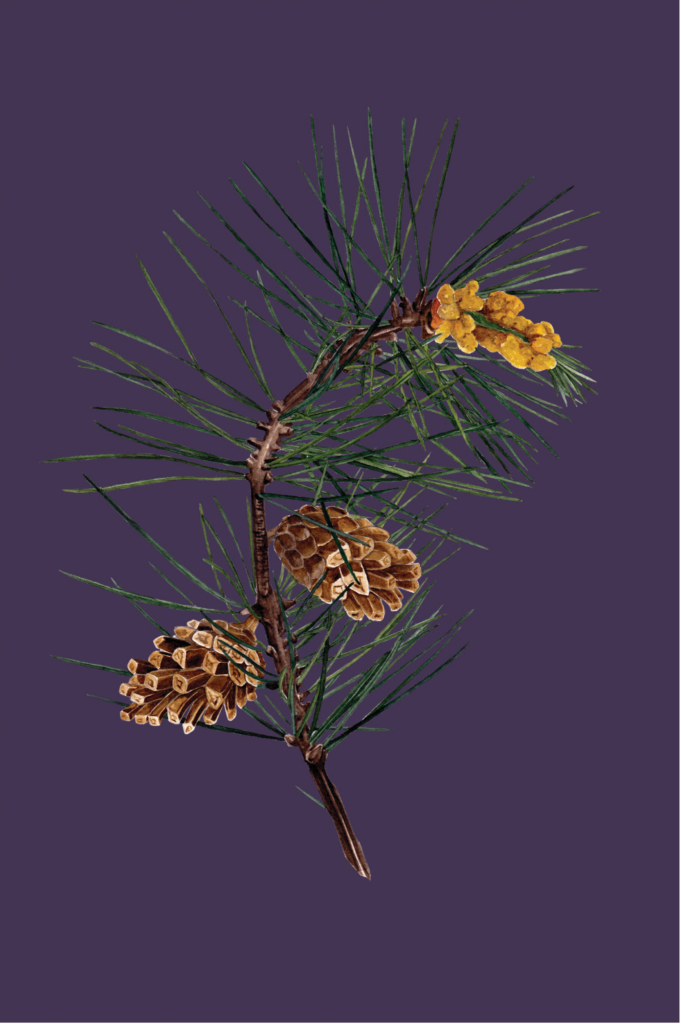 Illustration by Tugce Okay.
The United Kingdom has only three native conifer species: the yew, juniper, and the Scots pine. The Douglas fir (Pseudotsuga menziesiz) was a species of fir that became popular after it was introduced to England in the 1820s, but it is unlikely that Emily, who was so careful with her plant references and who studied natural-historical subjects, would have placed that relatively new species in the ancient homestead of Wuthering Heights.
We do know that both Emily and Charlotte Bronte drew a true fir on an outing as students in Belgium in August 1842. Emily’s drawing is a close study of the tree itself. How then are we to understand her use of the term “fir” for what is more likely to be Pinus sylvestris, or Scots pine? One answer comes from knowing Anne Bronte’s novel, The Tenant of Wildfell Hall, where the local farmer Gilbert Markham knowledgeably describes the trees that surround Wildfell, the “loftiest eminence in our neighbourhood, where, as you ascend, the hedges, as well as trees, become scanty and stunted.” He goes on to name those trees as “larches and Scotch fir-trees, or isolated black thorns” (Ch. 2). Lockwood may not have known the difference between a pine and a fir, but Gilbert Markham certainly does, even if the term “Scotch fir-trees” is an odd amalgamation of “Scots pine” and “fir.”
Until Carl Linnaeus described the Pinus genus in 1753, what we now know as Pinus sylvestris was commonly called “Scots fir” or simply “fir.” Clearly the colloquial use of the term “fir” or “Scotch fir-tree” in the Brontes’ novels is used to denote the native Pinus sylvestris, and that usage reflects the persistence of the older term “fir” beyond the time when “pine” became standard for the genus Pinus. The name “fir” stuck, as evident in Bronte’s use of it in Wuthering Heights.
Scots Pine, Pinus sylvestris
The Scots pine is an iconic native conifer that is found in notable stands in North Yorkshire, though it is most associated with Scotland, as Pinus sylvestris is its national tree. P. sylvestris is the United Kingdom’s only true native pine species. The term “fir” used by Emily Bronte may have derived from the Old English fyr (often spelledjyr or fir), meaning fire. Certainly, the color of the bark of the Scots pine—which is distinctively fiery orange-red—is suggestive of this element. This conifer—a group of evergreen trees that reproduce via cones rather than flowers—has blue-green needles and produces small egg-shaped seed cones that are 2-3 inches (5-7.5 centimeters) long. Scots pines can grow upward of n5 feet (34 meters) tall. This helps us understand the adjective “stunted” in relation to “firs” in the novel, for the growth pattern of those particular Scots pines were impacted by the strong “wuthering” weather.
Traditionally Scots pine was planted around farms as a windbreak, which correlates with the description of the trees in Wuthering Heights, as well as in The Tenant of Wildfell Hall: the “superannuated mansion of the Elizabeth era … shielded from the war of wind and weather by a group of Scotch firs, themselves half blighted by storms, and looking as gloomy as the Hall itself” (Ch. 2).
The Fir-tree in Wuthering Heights
When Lockwood spends the night in the oak-closet, he falls asleep and has extraordinary dreams that include a scene in a chapel where there is loud banging on the pulpit. When he wakes he rationalizes that the loudness of the dream with its banging was caused by a sound outside the window:
And what was it that had suggested the tremendous tumult? What had played Jabez’s part in the row Merely the branch of a fir-tree that touched my lattice as the blast wailed by, and rattled its dry cones against the panes! (Vol. I, Ch. 3)
Later in the night he wakes again, since he has heard “the fir bough repeat its teasing sound”; when Lockwood tries to open the window to silence the noise, he violently knocks his “knuckles through the glass,” and tries to seize the “importunate branch” of the fir tree. But it is not the fir-tree bough rapping at the window, as Lockwood narrates:
my fingers closed on the fingers of a little, ice-cold hand! The intense horror of nightmare came over me: I tried to draw back my arm, but the hand clung to it, and a most melancholy voice sobbed, “Let me in—let me in!” “Who are you?” I asked, struggling, meanwhile, to disengage myself. “Catherine Linton,” it replied, shiveringly (why did I think of Linton? I had read Earnshaw twenty times for Linton) “I’m come home: I’d lost my way on the moor!” (Vol. I, Ch. 3)
The cones and bough of the “fir-tree”—that is, Pinus sylvestris—inspire the novel’s most gothic scene. Lockwood goes on to scrape the little hand against the broken glass to free himself, and his screams raise the house. The question of what can survive on this wuthering moor—besides the Scots pine evoked in this scene—is extended beyond plants to the possibility of the supernatural.
______________________________
From A Brontë Botany: Flora in the Classic Novels of the Brontë Sisters by Amy M. King, illustrated by Tugce Okay. Copyright © 2026. Available from Andrews McMeel Publishing.

Amy M. King
Amy M. King is Professor of English at St John’s University. She specializes in Victorian literature and has published widely in the field of the nineteenth-century novel, including the acclaimed Bloom: The Botanical Vernacular in the English Novel and The Divine In the Commonplace. She is a contributor to The Cambridge Companion to George Eliot and The Oxford Companion to Victorian Literary Culture, and has written essays for journals such as Victorian Studies, NOVEL, Victorian Review, Common Knowledge, and BRANCH.