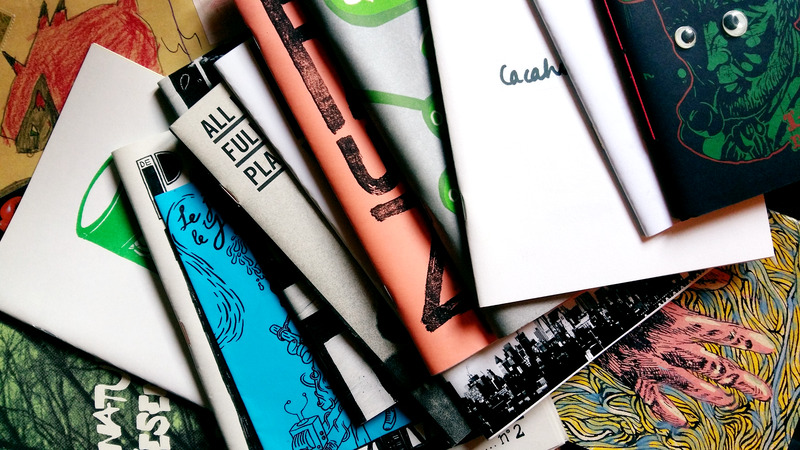
A DIY Literary Education: How Zines Taught Me To Be a Novelist
Jeff Miller: “Possibly the greatest lesson I got from the zine is that writing is about community.”
The small secretary desk where I write is tucked into a corner of my bedroom. I spent hundreds of mornings here, shaping and reshaping the manuscript of my novel, Temporary Palaces, while a few feet away my partner and our beagle—both late sleepers—snoozed contentedly.
Our house is small, but it’s not cramped. There are places I could work alone. In the spare room or at the dining room table. But when we moved into our house, I carried my desk out of the moving cube and up the stairs, instinctively placing it in the corner of our bedroom.
My earliest experiences as a writer took place at a desk in my suburban bedroom, as a teenage zinester. It was there that I scribbled tiny stories, edited them, copy-and-pasted layouts, and after a trip to the copy shop, collated and stapled the latest issue of my zine Ghost Pine. In so doing I learned the rudiments of being a writer.
From zines I got the permission to love my place in the world, and that the way to show love is to pay attention.
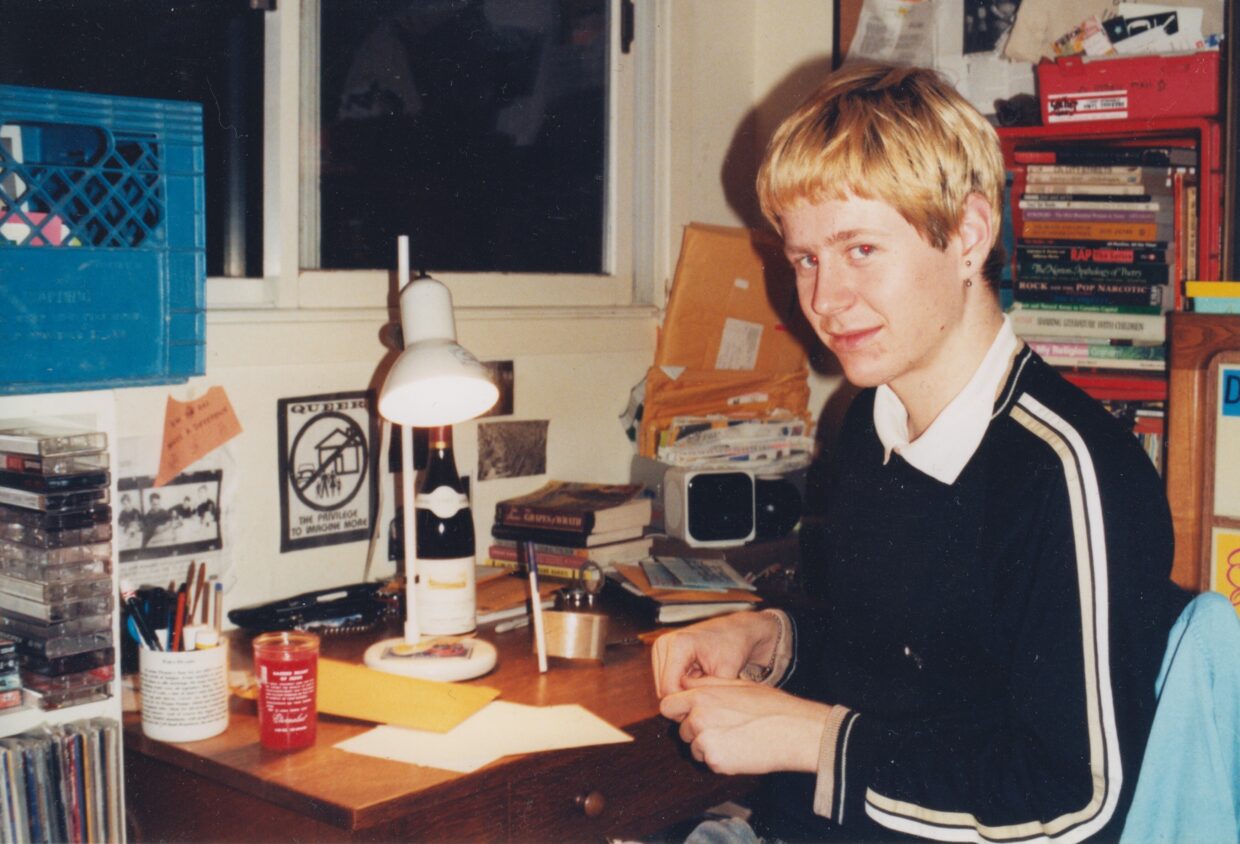
I recently unearthed a photo of this first “office,” circa 1997. With bleach-blonde hair I sit surrounded by my analog universe of cassette tapes, a mug full of pens and glue sticks, stacks of books, a tape gun, outgoing mail, and a box full of received letters. Printed photographs are tacked to the cork board. My turntable is out of the shot, but a few records from my collection are visible in the bottom left-hand corner. These were my tools.
When I was actively making a zine, the desk surface would be invisible under a detritus of notebooks, markers, photocopied pages, computer print outs, and remnants of cut-out paper in various sizes.
*
By the nineties, punk zines had been around long enough to be taken for granted. Music zines often had the same format, columns from semi-famous punks, interviews with up-and-coming bands, record reviews, and, always shunted to the back, zine reviews. I read these religiously, but the zines that really excited me were called “personal zines” or “perzines” in those reviews.
Hand- or type-written, each one had a distinctive style, but they were all created by a punk honestly (or with some exaggeration) showing readers what their life felt like from the inside. It wasn’t pure confession. Like in any genre, there were tropes: drinking coffee; traveling by thumb, bus, tour van, or boxcar; feeling alienated by late capitalism and trying to survive outside “the system”; reflections on how to build community, and overthrow patriarchy.
But beyond these well-worn themes some stories were simply about an average day. Writing with a bruised heart on their sleeve, a jaded seen-it-all attitude similar to a Jawbreaker song, nevertheless a cautious optimism usually shone through.
Reading those zines gave me the courage to jot down observations of my own world, which—as a teenager—was pretty small. I wrote about my suburban neighborhood, my grandparents who lived nearby, illicitly climbing the service ladder of the grocery store, my high school.
No matter the power of inspiration and the thrill of writing in my notebook, I also knew that whatever energy the writing had, there were failings of grammar, and for a long time, an embarrassing uncertainty about the provinces of there, their, and they’re.
Even when the language improved, the machines I relied on often humbled me. Photocopiers failed me in countless ways, and when the blade of my paper cutter dulled it began tearing pages rather than neatly dividing them in two. When my zine ballooned to over one hundred pages, my stapler refused to bind them, only leaving teeth marks on the cover. This is the minutiae that drives all zinesters mad. But as writers, it’s limitations like these that inspire us to grow and improve.
*
Novels are not zines, of course. Their sprawl and unruliness, their capacity to be anything. Unlike the roughness of a zine, their high polish initially made it difficult for me to take them apart and see how they worked inside. And yet even after I had learned the rudiments of scene and story design, character, point of view, and setting, I found myself returning to many of the lessons I learned as a teenage zinester as I wrote and revised Temporary Palaces.
First among these was observation. Noticing the small details of the world around me, writing them up. In a zine that is enough. One of my favorite pieces to write as a teenager was about the bus I took from the suburbs to buy records and see punk shows downtown. I describe some of the sights, a business that sold bricks covered the façade of their building in a patchwork of all the bricks they sold. Next to it was one of the vast open spaces where the city of Ottawa carted and dumped the snow removed from city streets—a vast mountain range of gray-white that survived into the heat of early summer.
My love for my corner of the world wasn’t innate, it had to be learned. I cribbed the idea from a zine called Dangerfox whose author described their commute from Oakland to San Francisco on BART. Maybe my travels didn’t have the grandeur of traversing one of the world’s most impressive bodies of water, but it doesn’t matter. From zines I got the permission to love my place in the world, and that the way to show love is to pay attention.
Through the practice of narrating my real life I somehow, like many zinesters before me, found a way into fiction.
These observations of city life aren’t enough to carry a novel. But as I wrote Temporary Palaces I let my characters see the world around them, and in that way, allow us to see them. When Ben sees that everything has been torn down on the block around his old punk house to prepare for new development, or the dive bar his band used to play in has been turned into a swanky cocktail lounge, he is experiencing his own personal history becoming uprooted. These urban signifiers reflect his own need for change.
I also drew on my own experience of narrativizing my real life. Temporary Palaces collects small moments of action. I gave my characters my own experiences, from washing dishes in a restaurant dishpit to flailing around screaming on stage. In one moment, Alex stands halfway across the bridge at Metro Mont-Royal with her friend, waiting to see whose train will arrive first. In another, she finds her way into an abandoned house. I’ve done all these things, and giving these movements to my characters as they surf the bigger waves of their life was a way of rooting the book in what I know is true.
Possibly the greatest lesson I got from the zine is that writing is about community. The individual zines I loved were the singular expression of a writer, but also part of a tradition. Maybe a bit like a folk song. I was inspired to try to be as epic as I’m Johnny and I Don’t Give a Fuck, as honest as Doris, as funny as SCAM, as beautifully designed as In Abandon, as artful as Tyger Voyage. And because zines were as much a scene as they were art, letters came in the mail with every single issue I ordered. And then I reciprocated, sending the latest issue of my zine back with a letter. In this way I corresponded with all my favorite writers for years, until I finally travelled to visit them in their cities. And then wrote about these travels in my zine.
Each zine was part of this larger project, a communal push to create a scrappy literary scene of our own. To build a space with our own rules of reciprocity, care, and enthusiasm. This experience, of writing for an audience of a few hundred people fostered in me a love of writing for its own sake.
Through the practice of narrating my real life I somehow, like many zinesters before me, found a way into fiction. My debut novel explores an underground world like the one I grew up in from another perspective. But it doesn’t have to be one or the other. Last summer, after the edits of Temporary Palaces were in, I collected up some notebook musings from the last few years, typed them up, and made a new issue of Ghost Pine for the first time in 14 years. Having something in my pocket that I can give to people feels amazing. I mailed out dozens of them. Spending afternoons stuffing envelopes, doing the same thing I did at 16 and 22 and 28 and 34, was a reminder of the strength and importance of subcultural communities. It’s that world I wanted to represent and honor in Temporary Palaces.
__________________________________
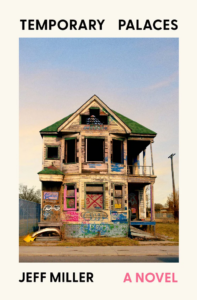
Temporary Palaces by Jeff Miller is available from House of Anansi Press.

Jeff Miller
Jeff Miller is the author of the award-winning creative nonfiction collection Ghost Pine: All Stories True. His stories have appeared in several anthologies, and he frequently publishes criticism. Jeff holds an MFA from the University of British Columbia and lives in Nova Scotia.