Forgotten Landmines: 7 New Poetry Collections to Read This August
Craig Morgan Teicher Recommends Your Poetry TBR This Month
“You see, one can live without having survived,” writes Carolyn Forché. That sounds grim, and indeed it is, but it also points to one of the qualities that makes contemporary poetry so remarkable: an inexhaustible resolve to see what is actually there. From Antonella Anedda’s panoramic and microcosmic view of European history to Theo LeGro’s posthumous chronicle of terminal illness, these poets are determined to transcend time and bear witness to the urgent horrors of our era as well as to the extraordinary beauty that war, hatred, and fear keep failing to stamp out. These poets urge us to dare to see the world with the same vivid courage.
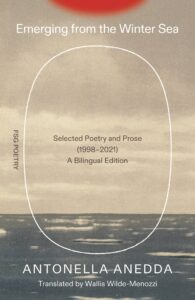
Antonella Anedda, trans. by Wallis Wilde-Menozzi, Emerging from the Winter Sea
(FSG)
This bilingual edition, the first career-spanning US selection from this major Italian poet, introduces Anedda’s quiet yet severe poetry to a wider audience. Her far-reaching vision—which spans European history and the webs of its empires—extends from the intimacy of the body, of the home and its “mild objects linked/ to an abandonment outside us/ but still within us.” Home may be peaceful, but at the same time “flames envelop latrines, metal roofs,/ the Oleanders burn sand up to the sky/ and further to the east, other blazes, terror, people in swarms./ Are they escaping? She doesn’t know.” This slippery logic and sense of simultaneity pervades the seemingly gentle textures of these poems. Something menacing is always lurking in the undercurrents beneath the words. And yet, even as she works to give voice to the unspeakable, to notice what’s beneath noticing, Anedda asserts that “each of us tells the story differently.”
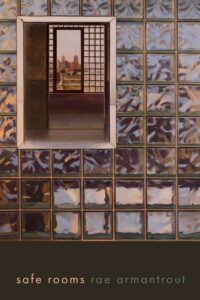
Rae Armantrout, Safe Rooms
(Wesleyan)
Pulitzer and NBCC Award winner Rae Armantrout seems to have understood, long before the age of doomscrolling, that we live by grabbing scraps of language and attaching our own meaning to them. Her short, staccato poems, often set in numbered sections, draw words and ideas from many sources, especially news and advertising, making Armantrout something of a reporter. In Safe Rooms, she also draws on autobiographical material: her grandmother, she writes, “enjoyed watching pro-wrestlers on television. Her favorite was Gorgeous George.” There is also plenty of Armantrout’s usual jump-cutting, her gaping juxtapositions that snap bridges between utterly unlike things: “‘Celtic Sea Salt.’// Touch here/ to make this your avatar.” And sometimes she’ll come out with an image so startling it stops one’s breath: “A tree is writing/ stick music/ in equivalent phrases/ of various lengths,/ each ending/ in a nib.” As always, her poems offer “A fresh take on anxiety/ and disrepair.”
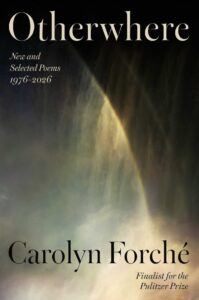
Carolyn Forché, Otherwhere: New and Selected Poems 1976-2026
(Scribner)
Forché, like Adrienne Rich, has always positioned her poems at the precise intersection of the personal and the political, bearing public witness to injustice by checking her own pulse and then looking up and out with fierce attention and an ear for the layered music of suffering and hope. This first career-spanning collection follows Forché’s travels, “threaded with the extremity of the rupture of twentieth-century Europe” and of North and South America, especially El Salvador, where the poet worked as an activist and embedded with resistance fighters in the years before the Civil War (as narrated in her extraordinary 2019 memoir What You Have Heard Is True). Surveying historical and present-day war zones and disaster sites, Forché describes those who “lie down in the fields and leave behind/ the corpses of angels.” The most recent poems report from the ongoing war in Gaza, where “A boy dreams of meat and chocolate. Another collects what he thinks are the bones of his brother.” This is an essential body of late-Twentieth and early-Twenty-First Century poetry; humanity is brutal and craven, these poems show again and again, and sometimes heroic. We must, Forché warns, “Go toward the light always.”
Dorothea Lasky, Mother
(Wave)
In what may be her best book, Lasky excavates the word “mother,” which becomes a mirror for the self and a porthole with an intensified view of the world. Lasky takes despair and hopelessness as prerequisites, channeling Anne Sexton’s freewheeling associative style. These poems generate their own momentum as they tumble down the page: “I’ll be the demonic mother/ Who reminds you all not to forget/ Exactly who you are/ And when they come for you/ When they come for your throat/ And steal the best parts of you/ I am the mother who will fight them/ I am the mother who won’t give up/ Until I’ve fought them to the ground” Our mothers won’t save us, these poems insist, because we have to become them in order to have to save ourselves.
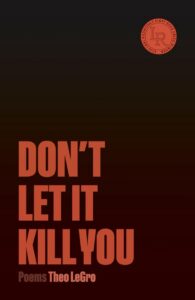
Theo LeGro, Don’t Let It Kill You
(Persea)
In this arresting posthumous debut, Theo LeGro calls the heart a “forgotten landmine”; indeed it explodes throughout these pages. Few people take the opportunity to plan their funeral in art, as LeGro does in “Dress Sexy At My Funeral”: “make sure/ there’s an after party…stay/ all night/ stay/ a little longer.” It’s in that afterlife that the reader meets this startling poet, who passed away earlier this year. These poems take in the ragged contours of a too-brief and almost too full life: sex and desire, the trials of closing the distance between two people, a father’s death, a mother’s coldness: “You’d been slicing fruit/ for me. I’m still afraid of your hands, even now.” Most significantly, LeGro maps their course through their losing battle with cancer. LeGro’s voice is breathtakingly accessible—one shouldn’t be able to be this straightforward and candid while facing death so directly. LeGro meets despair with a kind of compassionate sarcasm and an astonishing resolve. This book simply doesn’t turn away from the darkness closing in, because there is nowhere else to look. In poems, LeGro sees in that dark: “Sometimes when I listen to a song I love, I panic. I remember/ the day will come when I can never listen to a song again,// no matter how bad I need to.”
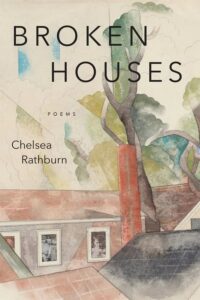
Chelsea Rathburn, Broken Houses
(LSU)
Rathburn, the poet laureate of Georgia, is, among other things, a formalist. This book, which meditates in various ways on the fragile idea of home, is full of subtly rhymed sonnets, though there is more free verse here than in her previous collections. Where there isn’t form, there is a kind of formality and reserve, and a penchant for elegant description, that recall the poems of Elizabeth Bishop: “what I mean to say/ is there’s a gradual unfolding,/ everything golden and green: sunlight/ …/ parking spots glittering like gifts.” But what makes these poems so beguiling is the way they set up that formality in order to gently knock it down with quiet playfulness. Her poems tour the houses of her ragged family of origin and their sordid forbears (“My parents left out the foster home, the worst// of the beatings, the floor of the garage/ where my father slept beside the dogs”), and, decades later, the house where Rathburn and her husband raise their daughter during the pandemic with “less certainty, watching hotspots and trends.” Rathburn tells what it’s like to live now, to have a family now, when so much cuts against hope. I’m grateful to know what it’s like.
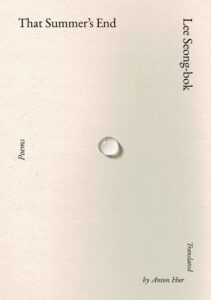
Lee Seong-bok, That Summer’s End
(Knopf)
I sort of gobbled up this gorgeous first English translation of South Korean poet Lee Seong-bok’s 1994 collection. In Anton Hur’s lucid and spare renderings, these poems addressed to things, concepts, and to unnamed beloveds manage to be haunting and comforting at once—there’s no way to describe them without resorting to opposites: “This world holds the dirtiest gutters people ever lived in and the neatest trees no human hand touches.” Seuong-bok’s poems are delicious and confusing—delicious because confusing and vaguely melancholy. Instead of hope, each of these brief encounters—often with nature, in poems and sequences with titles like “Forest” and “Low Song”—ends with a surprised tanacity, a realism that suddenly acknowledges that the world is simultaneously disappointing and transcendent. The many love poems here seem designed to keep longing at bay: “we have never met and/ therefore cannot part,” writes Seuong-bok in “Near You 2.” Even the darkest moments are rendered with a koan-like matter-of-factness, depicting stark landscapes where, for instance, “birds flock by as they cover this place with graves.” Seemingly set everywhere and nowhere, these poems invite each passerby into a space of exquisite solitude.

Craig Morgan Teicher
Craig Morgan Teicher is the author, most recently, of the poetry collection August, September, October. He has won the Lenore Marshall Poetry Prize and has been awarded a Guggenheim Fellowship. He works as Director of Special Projects for the Bennington Writing Seminars. He teaches at Bennington and NYU.