







5 Book Reviews You Need to Read This Week
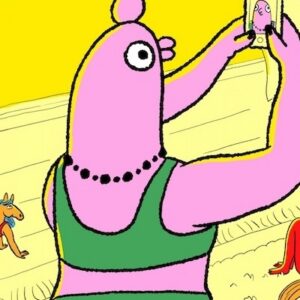
"Sometimes Hanawalt’s perspective veers into the horrifying, and the transition from Richard Scarry to Extremely Scary can be shocking."
Our grab bag of gorgeous reviews this week includes Sam Thielman on Lisa Hanawalt’s I Can’t Stop Thinking About Horses and Sex, B. D. McClay on Chad Harbach’s The Brightness, Meghan O’Gieblyn’s on Claire-Louise Bennett’s Kiss Kiss, Bye-Bye, James Wood on Meghan O’Gieblyn’s Will and Attention, and Jac Jemc on K Ming Chang’s Needlemouth.
Brought to you by Book Marks, Lit Hub’s home for book reviews.
*
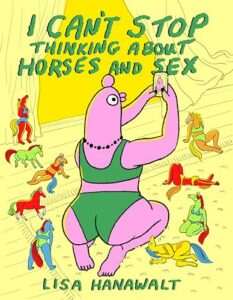
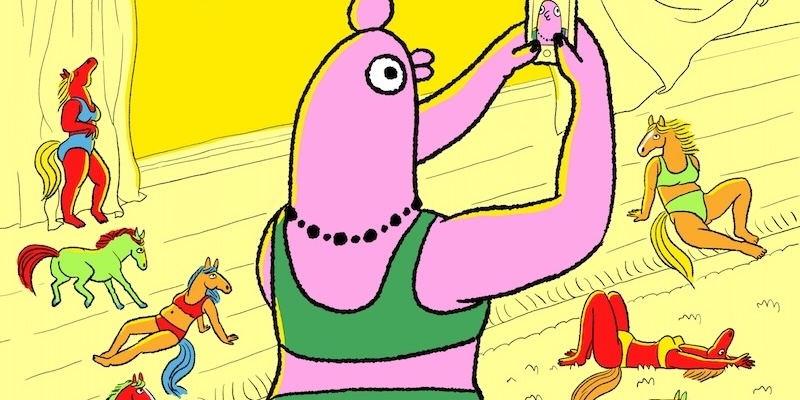
“Bodies—human, equine and beyond—fascinate Hanawalt, who dares us to imagine what it would be like to find increasingly ridiculous things sexy. I probably laughed hardest at the eroticized version of the PBS host Mister Rogers (he takes off more than just his loafers and cardigan), but the reader is spoiled for good gags.
Sometimes Hanawalt’s perspective veers into the horrifying, and the transition from Richard Scarry to Extremely Scary can be shocking. She imagines letting a guy take off not her clothes but her skin and muscles; he’s only satisfied when he saws apart her femur. Her self-depictions alternate between a pink bird, a green, Muppety monster and (briefly, literally) a butt hole.
Hanawalt’s jokey vignettes and colorful animal drawings belie a very serious narrative precision. Horses and Sex is not a book of short stories, but ‘memoir’ feels too narrow to encompass its long sections of text and silent pages of loose sketches punctuated by striking, Hockney-esque paintings and beautifully composed photographs. She is telling a story, but not the story her earnest cartoon avatar says she’s telling; in fact, the author’s depictions of events often contradict her character’s assessments of them.
…
“If these problems aren’t new, it’s a relief to read them in such vivid, contemporary and occasionally gory detail, and not as a preamble to some overbroad philosophical treatise. Hanawalt uses her considerable gifts to describe parts of herself she might prefer to obscure or hide. And yet her openness and authenticity feel carefully calibrated: Lisa cheerfully tells the reader that most of her relationship with Adam is ‘none of your business.’
Whatever lessons Lisa learns about sexual liberation and its discontents she learns from Juniper, who is going through it too, and is just as frail and emotionally volatile as the author. But whereas Lisa’s endless introspection—the I Can’t Stop Thinking part of the book’s title—often brings her to tears, Juni has avoided self-knowledge altogether. She isn’t crying. She’s just a little horse.”
–Sam Thielman on Lisa Hanawalt’s I Can’t Stop Thinking About Horses and Sex (The New York Times Book Review)
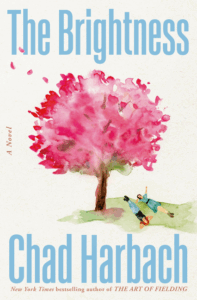
“Throughout The Brightness, characters dismiss ambitious realist novels, whether historical or contemporary in concern, as ‘not exactly the news about how we live’ or as bland, ‘mashed-potato realism.’ The middlebrow realist is a master technician, a superb replicator of experience, but neither more nor less than this. These statements—coming as they do in the pages of a large, enjoyable novel that could be called quasi-historical and even accused of having a ‘whole boring “plot” ‘—begin to suggest a preoccupation with whether such novels are worth anyone’s time. The existence of the book says yes; the characters within it say maybe.
…
“The fictional models Harbach cites, both within the text (such as Wharton’s story ‘The Pelican’) and in interviews (such as Anna Karenina), are attentive to social judgments and situations. They are about just and unjust ostracism, the delicacy of one’s reputation, who gets away with things and who doesn’t. They understand that human relationships and human interiority both exist within a world, and this world constrains not only what people do but what they can even regard as possible. Harbach is a gifted observer of undergraduates, their pathos and their comedy, but his Westish is a gentle and perhaps too-good-natured institution, where even the jocks are nerds. This means that the larger social dynamics created by rape—even the prospect of rape—in small, intimate communities go unconsidered. There is no one genuinely malicious at Westish, and thus none of the moral compromises one finds at an actual college: the friends who take sides, which usually means picking the person who’s less trouble; the real but unspoken feeling that sexual assault may be an inevitable part of freewheeling social life; the surreal experience of being in a class about Tess of the d’Urbervilles with someone you know to have hurt other people. The singular strangeness of studying at a small college is striving not to know what you know about somebody else, for the sake of higher learning, or at least for the peace of the classroom. These kinds of forces, which explain why students behave in the self-warping ways that they do, are missing, as is the sense that people are ever constrained by something beyond their own quirks of personality or individual delusions.
…
“The accusation levelled within The Brightness against novels that are stuck in the past, whether formally or through their subject matter, is that they are ‘not exactly bringing the news.’ The proper response to this complaint is that novels do not bring the news; the news brings the news. This is as true of art that is experimental and political as of art that is old-fashioned … An artist is always becoming an artist, the same way Pella and Irma will always be becoming Pella and Irma. All works of art are addressed in part to people they cannot know, with problems they cannot understand. To prove that an old-fashioned book can be excellent, it isn’t necessary to dramatize arguments about the form. You need only a prose style, an interest in people, and a sense of society. In art as in sports, the best defense is a good offense.”
–B. D. McClay on Chad Harbach’s The Brightness (The New Yorker)
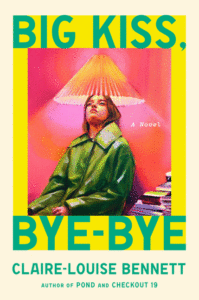
“One senses that any given text in Big Kiss, Bye-Bye (and perhaps even the text of the novel itself) is more important structurally and formally than it is on its face. There’s something compulsive and dreamlike about the novel’s language, which is often deliberately redundant. Scenes and anecdotes recur across the novel—the memory of a former lover who spills coffee all over the bedcovers; her most recent encounter in a cemetery with Robert Turner, the philosophy teacher—but fail to become clearer through repetition. At times, the prose recalls not so much Bernhard or Gertrude Stein but a certain type of buggy LLM output known as repetition degeneration (sometimes called the ‘repeat curse’), in which the model gets stuck in self-reinforcing loops.
…
“In a 2016 interview with The Paris Review Bennett, whose novels capture the experience of consciousness more acutely than practically any other contemporary fiction, expressed skepticism about identifying too closely with her own mental activity. So much of what happens in the mind is repetitive, she said: ‘Habit creeps into thought and cuts off other more generative possibilities. Patterns, connections, associations, they occur quite naturally, don’t they?’ If the recurrent scenes and images are occasionally frustrating, it’s because they reproduce, with a fidelity that is nearly intolerable, the well-worn circuits of the mind’s engine. Writing can be a way out of this circularity: to put something down on paper is to transform the endless mental churn into a narrative that is linear and progressive. But Bennett is working within a strain of modernism that eschews order and clarity in favor of capturing the perpetually unfinished business of thinking, which is constantly undermining, undoing, and subverting its own conclusions. She has said that she agrees with Samuel Beckett’s assertion that the task of the artist is to ‘find a form that accommodates the mess,’ an arguably self-defeating endeavor given that the very act of writing makes the fluidity of thought final and static.
…
“There are moments when the novel seems to be documenting the end of a love affair with language, a wistful and ambivalent good-bye to a medium that can no longer enchant in the way it once did. We live in a world that is entirely saturated with writing—with emails, text messages, the great ocean of language on the Internet, the inexhaustible machine-generated text that appears on the screen faster than the eye can consume it. The notion that we are moving into a postliterate era is not unrelated to this sense of overabundance. When the written word is cheap and widely available, it becomes harder than ever to see it as meaningful, like a currency that is devalued by inflation.
…
“It’s easy to dismiss Bennett’s novels as language games that are formally clever but too conceptual to be enjoyed in any immediate, visceral sense. But after any extended immersion in her books, one feels bored with the plodding linearity of other novels, with their dutiful backstory and studied beats of narrative ‘reflection,’ and is eager to return to that raw consciousness of Bennett’s narrators, who circle their subjects restlessly in the hope of stumbling on the unexpected. The signature tic of Bennett’s writing is a phrase, often following an observation, ‘Yes, that’s right.’ It’s an expression that points backwards, to what was already said, but which has the effect of making the text feel spontaneously alive, as though the narrator were discovering what she is trying to say in the act of writing it, a perpetual becoming.”
–Meghan O’Gieblyn’s on Claire-Louise Bennett’s Kiss Kiss, Bye-Bye (The New York Review of Books)
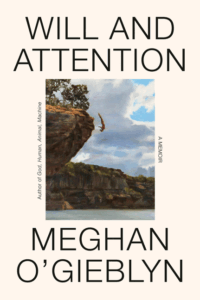
“‘God does not and cannot exist,’ Iris Murdoch once wrote, ‘but what led us to conceive of him does exist, and is constantly experienced and pictured.’ You could hang that sentence—epigraph, baleful blessing—over Meghan O’Gieblyn’s memoir, Will and Attention. In some ways, it resembles a conventional addiction memoir: an alcoholic in her twenties, O’Gieblyn got sober, flourished for more than a decade as an essayist and critic, and then started drinking again during the pandemic. She vividly recounts her year of secrecy and collapse, followed by rescue and restoration. The fractions of fall and rise are in order: the book’s existence attests to the recovery. But Will and Attention is more complex and surprising than its form suggests. An anguished engagement with theological and philosophical texts, above all the writings of Simone Weil, it is closer to an unfinished spiritual diary than to the familiar sort of sculpted redemption story … Perhaps her book is really a memoir of her addiction to God. More anguishing, to a God who does not and cannot exist.”
…
“If O’Gieblyn’s self-diagnosis is right, the collapse of will that led to her loss of faith is awkwardly close to a collapse of will that might lead to her return to faith. A failure of will is not quite a surrender of will; a voluntary submission might be seen as some noble version of willing, a willing away of will. Nevertheless, we seem to be in a strange twilight realm in which religious success may resemble secular failure.
…
“One fascination of this brave book—brave in its disclosures but more so in its demands, its spiritual rigor, and its ardent intellectualism—lies in watching the eloquent, intelligent sufferer steadily entrapping herself. I don’t mean the obvious entrapment by her twin poisons, alcohol and institutional religion. I mean something more fundamental and less fathomable: her theology of alcoholism. The association of intoxication with religious ecstasy has a long history; its terrible force here comes from O’Gieblyn’s sense that the substance that has ruined her life also grants the surrender she was unable to achieve through worship.
…
“A tormenting syllogism seems to grip the author: she longs to encounter God; to do so, she must escape her will; to escape her will, she must drink. Therefore she drinks. Or she drank: this beautifully sober book describes her release from that prison. But her tradition does appear to have bequeathed her a powerful suspicion of the will. As she concedes, Christianity has reasons to denigrate human will, making it the source of disobedience and an explanation for much of the world’s evil. Salvation comes instead through God’s grace, the unearned gift that saves us from ourselves. Assigning responsibility for evil to human will also helps to absolve God. Yet understanding this religious inheritance, as O’Gieblyn so lucidly does, offers little assurance that one can escape its hold.”
–James Wood on Meghan O’Gieblyn’s Will and Attention (The New Yorker)
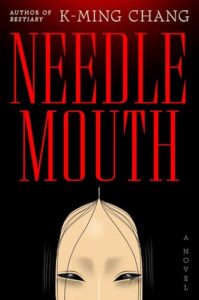
“At once a densely symbolic fairy tale and a harrowing family drama, what follows is a fever dream in which the distinctions among world building, hallucination and metaphor are easily, perhaps deliberately confused. A philosophical allegory in the vein of Hermann Hesse’s Siddhartha or Kafka’s The Metamorphosis, Needlemouth asks the reader to keep one eye always on the larger metaphysical questions, making it difficult to ever get truly lost in the story.
‘All lineages follow the father,’ Needlemouth tells Cindy in one of many dialogues throughout the novel that show the depth of Chang’s preoccupation with these themes: ‘But we have made another kind of line. A line that strings me to you, wound to wound.’ Unfortunately, the novel’s action and backstory never fully illuminate the source of those wounds.
Readers of Chang’s previous work…will find all her hallmarks present here: the powerful, complicated bonds among maternal figures and young women; an unflinching use of abject imagery and grotesque sensory detail; a troubling of the boundary between the animal and the human; and a layering of past and future events onto the present action, suggesting the circularity and simultaneity of time.
The nightmarish worlds the cousins must pass through on their quest to find and murder Needlemouth’s father are filled with excrement, viscera and bodily effluence; but still every sentence is a pleasure to read, even—or perhaps especially—the most disgusting ones. Chang challenges us not to avert our gaze from the filth of living, her language making our experience of the book a somatic journey in itself.
The novel arrives at several stunning moments that force characters to reckon with the traditions they’ve been raised in and the promises they’ve made, to Needlemouth and to themselves. Blood lust transforms. Rebellion reorients. And in the end we’re asked to consider if the desires for destruction and for care might, in fact, be one and the same.”
–Jac Jemc on K Ming Chang’s Needlemouth (The New York Times Book Review)

Book Marks
Visit Book Marks, Lit Hub's home for book reviews, at https://bookmarks.reviews/ or on social media at @bookmarksreads.