10 Literary Science Fiction and Fantasy Novels That Offer Hope for the Future
Chloe Benjamin Recommends Ted Chiang, Susanna Clarke, Mohsin Hamid, and More
During graduate school, I finished the novel that found me an agent—but when my agent submitted it to publishers, all twenty of them turned the manuscript down. Truthfully, it was closer to a collection of loosely-linked short stories, and the feedback from editors was consistent: Pretty sentences. But nothing really happens.
This is not to impugn books in which little happens! I love those books, which is why I tried to write one. As a teenager, I revered realist literary fiction, stories whose epiphanies emerged from quiet, interpersonal moments—stories that needed no pyrotechnics to move me as a reader. I wanted to write like that, and to be taken seriously in the way of those writers. I feared allegations of sentimentality, avoided melodrama, and wrote characters so faint that even my agent once delicately suggested that a protagonist “get a hobby.”
Of course, I was devastated when my novel-in-stories died on submission. After I recovered, though, I saw the truth of the feedback. Many writers do a beautiful job with subtle fiction. I just wasn’t one of them. I thought, too, of the books that shaped my brain as a young reader, like A Wrinkle of Time and His Dark Materials: epic science fiction and fantasy that introduced me to other worlds while also paying close attention to prose and character. What if I tried to write a book like that?
My first two novels are ultimately realist, though each has a speculative element. The Anatomy of Dreams follows two dream researchers working beneath a charismatic but ethically-questionable professor. In The Immortalists, four siblings visit a fortuneteller who claims to be able to tell anyone their date of death. But Under Story, in which a divorced couple discover a time-bending parallel universe, is the first time I committed fully to genre fiction.
I felt intimidated. To write about our world well is challenging enough; to write well about an imaginary world is a different, riddle-strewn gauntlet. There were so many issues to brainstorm, so many problems to solve and reversals to think through. By the end of the day, I was often so mentally exhausted that I struggled to think of words. But the process was thrilling, too. I wrote the first draft over five years, immersing myself in its worldbuilding, crosshatching real science with invented elements. I wanted to be meticulous enough that readers could give themselves permission to believe—to do a magic trick so airtight that it would feel real even to me.
But I didn’t want the worldbuilding to overshadow the heart of the novel: the story of a single couple’s grief and healing, their under story. In many ways, it’s the story of my healing from years of chronic pain, though there isn’t a migraine in the book. Still, Under Story is about the devastation of a life that breaks down and the miracle of the life that blooms from those ashes. It is a tribute to the fact that existence is always both/and, not either/or: pain and pleasure, loss and love.
In early interviews, I’ve been asked whether I received any pushback from my publisher about the cross-genre nature of the novel. I’m glad to be able to say that I haven’t. In the past, genre titles and authors were often shunted into discrete lanes—but I have the sense that this changing. Perhaps it has to do with the success of films like Christopher Nolan’s Inception or TV like Zal Batmanglij and Brit Marling’s The OA, both of which are high-concept and beautifully-executed. Or maybe it relates to the fact that the real world feels increasingly surreal, even genre-bending itself. Our political system vacillates between absurdism and horror. Developments in AI drag us, willingly or unwillingly, into a technological landscape that often feels like science fiction. (I am among the unwilling; I refuse to believe that my life would be better if I’d just outsource my mind.) In this context, science fiction and fantasy offer a mirror as well as a line of hope. Perhaps it isn’t too late to change our trajectory—and perhaps alternate visions of the world, and of the future, can give us ideas.
Below are some of the literary-leaning science fiction and fantasy titles that inspired me along the way.
*
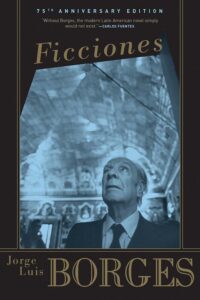
Jorge Luis Borges, Ficciones
These fantastical stories have elements of many different genres, from the magical realism with which Borges is often associated to detective narratives. Borges is rigorously imaginative: I love the almost lawyerly intensity with which he argues his inventions, as though daring us not to believe him. In “Tlön, Uqbar, Orbis Tertius,” he lays out an “undocumented country” with a blend of intellectual intensity and sheer playfulness, from that country’s language (“There is no word corresponding to the noun moon, but there is a verb to moon or to moondle”) and views on literature (“The concept of plagiarism does not exist; it has been established that all books are the work of one single writer, who is timeless and anonymous”) to its phenomenon of hrönir (“secondary” versions of lost objects that spring into being “a little larger than the originals”) and theories about time: one school of thought “declares that the whole of time has already happened and that our life is a vague memory of dim reflection, doubtless false and fragmented, of an irrevocable process. Another school has it that the history of the universe, which contains the history of our lives and the most tenuous details of them, is the handwriting produced buy a minor god in order to communicate with a demon.” How can you not be alternately enlightened and delighted?
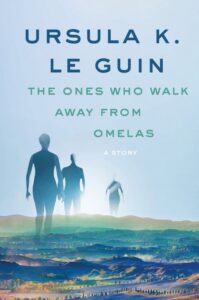
Ursula K. LeGuin, “The Ones Who Walk Away from Omelas”
I don’t know that a perfect novel exists (they are simply too big, too inherently textured), but I do believe that a perfect short story is possible, because “The Ones Who Walk Away from Omelas” is one of them. At five pages, it is astoundingly economical and metaphorically genius: a fable about capitalism, to my mind, though you can read it in so many ways.
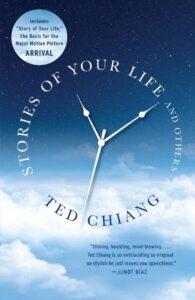
Ted Chiang, Stories of Your Life and Others
Ted Chiang’s short stories feel like thought experiments, each considered with exceptional meticulousness and integrity. They are scientifically engaged but not dry, morally curious but not pedantic. The titular novella at the heart of this collection (“Story of Your Life”) is one of my favorite pieces of writing… ever. As someone who is fascinated by aliens but continually frustrated by how often alien narratives end in war or violence, I was captivated by the way that Chiang braids time and language while imagining a new species. I still think of this piece as the gold standard when it comes to soulful science fiction.
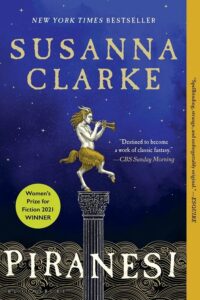
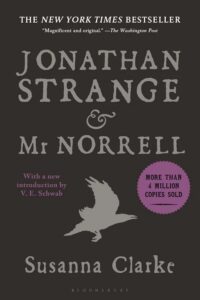
Susanna Clarke, Piranesi and Jonathan Strange & Mr. Norrell
There is something I need to confess. The first time I started Jonathan Strange & Mr. Norrell, I stopped after seventy-five pages. Despite the fact that it had been emphatically recommend by friends who know my taste—and despite the fact that I loved the writing—I lost speed during a section on naval magic and feared that the rest of the book would have more military content than tends to hold my interest. Years later, though—after I fell in love with Piranesi, Clarke’s second novel—I knew that I had to give Strange & Norrell another chance. I can hardly stomach the thought of what I would have missed otherwise. This is a top-five-favorite novel for me; it is almost nine hundred pages, and I would have gladly read twice as many. Strange and Norrell is part political and academic satire, part sincere expression of belief in magic and mystery and art. It’s also technically dazzling, even risky (Jonathan Strange, not only a major but a titular character, is introduced after 200 pages—in a footnote), full of heart, and very funny.
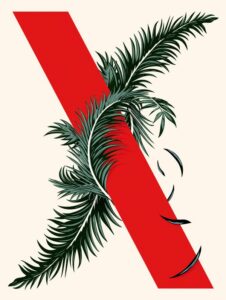
Jeff VanderMeer, The Southern Reach Series
Vandermeer’s eerie series has been described as “eco-horror” and “cli-fi,” relatively new terms that reflect how current these books feel, despite their fantastical elements. They document investigations into the fictional Area X, a portion of American coastline where nature is behaving strangely. To say anything else would be to spoil the wild ride of this series, which is outrageously inventive, often trippy, and genuinely fresh. I’ve never read anything like it.
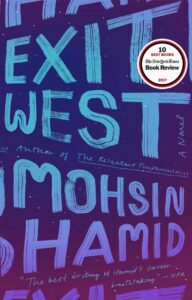
Mohsin Hamid, Exit West
Exit West imagines the refugee crisis with a powerful magical realist twist. Saeed and Nadia live in an unnamed country tormented by civil war—and meanwhile, there are rumors of mysterious doors, portals that lead to other places. The fusing of realist horror with a fantastical device allows for a kind of prismatic re-seeing in the way of a parable. At the same time, Hamid employs a lightness of touch, and moments of humor, even when his characters are enduring the unendurable. Grief is always with these characters, but they have not allowed it to rob them of the capacity for other emotional experiences. When I finished Exit West, I thought of a famous line by Samuel Beckett—“I can’t go on, I’ll go on”—and how true it feels to human being.
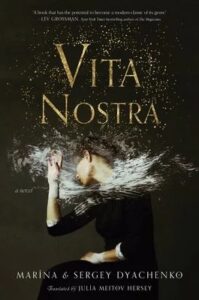
Marina and Sergey Dyachenko, translated by Julia Meitov Hersey, Vita Nostra
My friend Brittany Cavallaro gives me some of the best book recommendations, because she knows that what I crave most is immersion. Reading Vita Nostra—written by a Ukrainian couple and set in Russia—means being immersed in a metaphysical magic school: rain and streetlights and clanking radiators, enigmatic professors and strange gold coins, overnight trains, the smell of damp leaves, mortal danger, and the kind of mind-bending that reminds you how little we know of reality after all. The novel follows teenager Sasha Samokhina’s matriculation at the Institute of Special Technologies. The Institute’s professors teach something utterly mystifying: for years, neither Sasha nor her classmates can figure out exactly what it is. While reading Vita Nostra, I felt like a fellow student at the Institute, studying their materials, experiencing my own metamorphosis. The full reveal is as satisfying as any fantasy concept I’ve encountered.
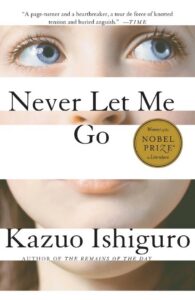
Kazuo Ishiguro, Never Let Me Go
My first novel, The Anatomy of Dreams, was inspired by this one. I was so arrested by Kathy’s voice—that sense of trouble under calm water, nostalgia pressured by melancholy—that some light turned on in my brain. I’ll be the first to say that Ishiguro did it better: Never Let Me Go explores issues of science, ethics, and creativity to heartbreaking effect. Ishiguro often blends literary and genre elements, from the off-kilter fantasy of THE BURIED GIANT to the noirish WHEN WE WERE ORPHANS. Indeed, the way he plays with memory makes it seem like a not-quite-realist genre of its own, wavy at the edges and unnervingly malleable.
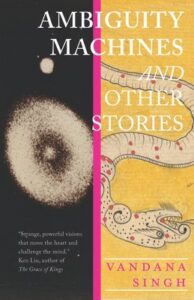
Vandana Singh, Ambiguity Machines and Other Stories
Singh, also a physicist (!), was born in New Delhi, and in many of her stories, Indian myths and landscapes fuse with otherworldly ones. There is also a distinctly environmental lens that reminds me of Robin Wall Kimmerer: in one story, a newly-invented energy grid is based on fungal networks. Another story imagines a planet whose beings relate through the concept of kinship. Each story contains a novel’s worth of plot and character, and the prose is gorgeous—lush but precise, musical and surprising. For some reason, despite how deeply reading makes me feel, I rarely cry while doing it; but one of these short stories made me weep on the beach at a family vacation. Yet I find hope in them, too. “Requiem,” the final story in Ambiguity Machines, follows an anti-corporate uprising in which animals partner with humans. Singh’s collection reminds me that there is hope to be found in collectivity, and that imagination is as powerful a tool as any.
__________________________________
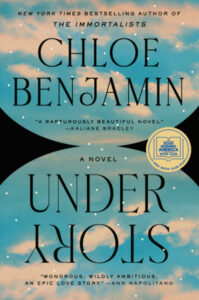
Under Story by Chloe Benjamin is available from Putnam.
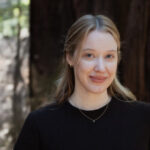
Chloe Benjamin
Chloe Benjamin is the author of The Immortalists, a New York Times bestseller, and The Anatomy of Dreams. A Barnes & Noble Discover Great New Writers selection, LibraryReads favorite, and #1 Indie Next pick, The Immortalists was named a best book of 2018 by NPR, The Washington Post, Entertainment Weekly, and others. The Anatomy of Dreams received the Edna Ferber Fiction Book Award and was longlisted for the 2014 Center for Fiction First Novel Prize. Originally from San Francisco, CA, Chloe is a graduate of Vassar College and the M.F.A. in fiction at the University of Wisconsin. Her work has been translated into over thirty languages. She lives with her husband in the San Francisco Bay Area.