The Double-Sided Sword of Deception: How Lying Can Help—and Hurt—Us
Leslie John on the Role Bluffing and Secrecy Plays in Our Interactions With Others
In his 1970s campus novel Changing Places, David Lodge introduced readers to a literary parlor game called Humiliation. The name of this game is also its object. Players—in this case, professors of literature—attempt to outdo one another by naming a classic work they’ve never read (but assume others have), scoring a point for every person who has read it. In doing so, Humiliation inverts the rules that govern these lit scholars’ professional lives, where the goal is to have mastered the entire literary canon, or at least give that impression. Suddenly the most humiliating gap in their reading repertoire is the winning ticket. Stepping back, we can also see that Humiliation creates an ingenious double bind. Players win by losing and lose by winning. The urge to “win” collides with the fear of being thought uncultured, leaving the professors caught in a deliciously awkward double bind.
At first, Howard Ringbaum, Lodge’s most obnoxiously pedantic and competitive character, is so focused on professional prizes like prestige and promotion that he is unable to enter the spirit of the game. Instead, he resorts to humblebragging, naming an obscure eighteenth-century book. His strategy is clear: Rather than risk real vulnerability, he picked a book so niche it was more likely to make his colleagues feel underread than to actually score him points.
Sulking after losing the first round, Ringbaum sat out the second round. During the third, his killer instinct shifted focus. He “slammed his fist on the table, jutted his jaw about six feet over the table and said: ‘Hamlet!’ ” With this one showstopping admission—Hamlet, possibly the most canonical text of Western literature next to the Bible—Ringbaum wins the game. And loses his job: The English Department “dared not give tenure to a man who publicly admitted to not having read Hamlet.”
Our decisions to conceal aren’t purely gut reactions. They’re the product of powerful cultural conditioning.
As comic and absurd as it is, this classic scene from Changing Places reminds us of the real risks of revealing—and why English professors would understandably be wise to keep notable gaps in their knowledge secret. (I sure kept my limited business experience under wraps on the first day I taught MBAs at Harvard Business School.) Letting others have privileged knowledge about us gives them power.
What Are Your Thirteen Secrets?
Michael Slepian, a professor of leadership at Columbia University, specializes in the study of secrecy. Early in his career, he set out to understand a very intriguing question—just how many secrets we typically keep, along with what kinds of things we choose to hide. He and his colleagues Jinseok Chun and Malia Mason developed the Common Secrets Questionnaire, one of the most comprehensive tools for studying secrecy. They built the questionnaire by first asking one thousand people to anonymously describe a secret they were holding. They distilled those responses into thirty-eight categories, including sexual behavior, infidelity, lying, self-harm, drug use, poor work performance, unpopular or taboo beliefs and preferences, and ambitions.
Since then, Slepian, Chun, and Mason have administered the full questionnaire to thousands of people from all walks of life. They have found that at any given moment people keep, on average, thirteen secrets. The most common secrets, perhaps unsurprisingly, are about our romantic lives. For instance, many of us keep secret what turns us on and who we are attracted to. We keep all sorts of other secrets, too. We don’t tell our friends that we disapprove of their significant others. We’re ashamed to tell them when we’re struggling with our finances or fighting with our partners. Other secrets are more about personal preferences and social pressure, such as liking something considered “lowbrow” (such as reality TV or gossip magazines, both of which I enjoy) or disliking something we’re “supposed” to enjoy. We keep loads of secrets in the workplace, too, like our political opinions and mental health struggles. Secret keeping is such a natural impulse that we often turn to it largely by default, with little deliberation.
A few years into my academic career, some faculty at UC Berkeley invited me out to give a talk, which was a thinly veiled job interview. Needless to say, I was on my best behavior. But a challenge emerged. Two of the most respected professors—an academic power couple—invited me to their home for dinner. I was flattered and excited. When we sat down at the table, my heart sank. The first dish they served was steak tartare. Raw beef, no matter how well seasoned, no matter how swanky the cut, is not my jam; nor is any raw animal matter, for that matter. And in the home of these illustrious professors, I was ashamed about that. I feared they would consider me unsophisticated for not liking the dish.
It’s at these tough junctures in life that I turn to Mr. Bean for inspiration. In a flash I recalled one of my favorite sketches, in which he unwittingly orders steak tartare at a fancy restaurant. After the waiter lifts a silver cloche from the plate laid before him with a flourish, the aghast Mr. Bean frantically finds places to hide the offending beef away. He hollows out a dinner roll and crams some in; he drops a big dollop onto the table and plops the side plate onto it; he squishes the remainder into the flower vase just before the waiter returns to ask if everything is all right.
I couldn’t, of course, do the same. But, like Mr. Bean, I concealed my revulsion. Pretending to be very excited at the special dish, I took as many bites as I could, emitting the requisite coos, while trying desperately to suppress my gag reflex.
Why didn’t I just apologize and tell my hosts I don’t like steak tartare? Surely they would have understood. They probably would have even apologized themselves for serving something I didn’t like, and maybe offered me something else instead. But in that moment, in that situation, the stakes seemed incredibly high. I didn’t want to come across as unrefined. I was trying my darnedest to fit the mold of “esteemed academic,” especially because, being young and female, the deck was stacked against me. I thought that required acting worldly and sophisticated by liking high-class fare.
We often act impulsively when keeping secrets or turning what might be understandable disclosures into secrets. I did this myself when I put on my raw carnivore act. But our decisions to conceal aren’t purely gut reactions. They’re the product of powerful cultural conditioning. From a very early age, we are taught that we should carefully manage how we present ourselves to others. This ongoing “performance” was the focus of one of the most influential social scientists of the twentieth century. And it sheds light on why we withhold information and wrap ourselves in secrets.
All the World’s a Stage
Meet Erving. He’s a bit of an enigma. His friends called him “bright but strange.” His full name is Erving Manuel Goffman, and he’s best known for his book The Presentation of Self in Everyday Life. In it, he introduced the core idea that much of human behavior is performative, enacted on the “front stage,” where we carefully control what we say and do to manipulate others’ impressions of us. It’s only when we’re backstage—when no one else is watching—that we are truly ourselves, he conjectured.
Goffman honed these ideas as a doctoral student on the remote Shetland Islands of Scotland. Day after day, he watched how people seemed to withhold their true feelings. A mother sent her son off to sea “without kissing him and with very little show of emotion” though he’d be gone for years. A housewife burned her finger on a hot pot and “very little emotional expression [was] allowed to escape.” Even in the small frustrations of daily life, concealment was the rule. And on the whole, Goffman approved.
That stance makes sense when you consider Goffman’s background. Born in 1922 to a Jewish Ukrainian family in Canada, he avoided the Holocaust but not antisemitism. In 1939, Canada itself had turned away a ship of Jewish refugees, many of whom later perished in death camps. For someone raised in a lower-middle-class, stigmatized community, holding back seemed quite sensible.
It was from this vantage point that Goffman saw the world. By all accounts, he lived the restraint he studied. He banned recordings of his lectures, avoided photos, gave only two interviews, and even sealed his archives before his death. Stories abound of his stoicism. At his famously grueling PhD defense, legend has it a bead of sweat slid down his brow, and he didn’t even flinch.
In short, Goffman saw careful self-preservation as armor: protection against embarrassment, rejection, and worse. He joined a long tradition—from ancient proverbs to modern psychology—arguing that sometimes, silence is a strength.
But self-protection isn’t only about staying quiet. Sometimes we go on offense, bluffing to manage how we’re seen. We say we couldn’t care less that someone insulted or embarrassed us, when in fact we’re steaming mad. We claim we didn’t really want a job we weren’t hired for, when in fact we’re devastated. We also bluff sometimes because we think we’ll make a better impression on others. If we’re stepping into a new leadership role, we might put on a great show of being super confident, when in fact we’re feeling anxiety about how well we’ll do the job. On a first date, we might work fervently to come across as a lighthearted extravert when really we’re a serious-minded, brooding introvert.
This bluffing of ours was fascinating to the brilliant mathematician and polymath John von Neumann, widely credited as the founder of the field of game theory. Whereas Goffman’s interest in self-presentation was rooted in his childhood experiences, a large source of inspiration for von Neumann was his poker-playing habit (though rumor has it he was not a very good player). “Real life consists of bluffing, of little tactics of deception, of asking yourself what is the other man going to think I mean to do,” wrote von Neumann. He was so taken with the notion that life is like a game of poker that he conducted in‑depth analyses of the best poker strategies. He sought to work out a detailed game plan for when and how we should conceal and bluff in life.
Game theory helps us navigate strategic decisions—especially when the stakes are high, outcomes are uncertain, and success depends on predicting what others will do.
Sometimes bluffing goes beyond saving face. We hide things that feel safer to keep inside, but that silence can put us at real risk.
When it comes to our everyday interactions with others, we do sometimes approach them as though we’re game theorists. We strategize about what to share and why, even if we don’t always realize we’re doing it. We’re uncertain how others will react or whether they might use our disclosures against us. Will they think less of us? Will they be offended and shun us? Might they use the information to humiliate us? We’re inclined to engage in this gamesmanship because we’re quite good at bluffing and concealing.
And sometimes bluffing goes beyond saving face. We hide things that feel safer to keep inside, but that silence can put us at real risk.
Consider a shocking study that estimated about 80 percent of Americans have lied about health issues to their doctors—the very people who have taken an oath to care for them! This is often because we feel shame about our condition or behavior, such as drinking or smoking, and we shudder at the thought of being judged by someone we hold in high esteem. Those feelings are valid, but failing to overcome them can be life-threatening.
American Academy of Family Physicians president Dr. John Cullen recalled a time when he was literally about to cut open a patient to take out their appendix, but he had a hunch that something was not quite right. Apparently, symptoms of drug abuse (specifically, methamphetamines) can resemble those of appendicitis. Fortunately for the patient, Dr. Cullen gave it one final chance: “We’re about to cut you open here. Are you sure you don’t want to tell me anything else?” The patient fessed up, and the surgery was halted.
Another surgeon recounted a case of a woman who started to bleed uncontrollably midway through surgery. Prior to surgery, she had affirmed that she wasn’t taking any medications. The nurse rushed to the waiting room to ask the woman’s mother whether she was taking anything. Again, the answer was nothing. Finally, the surgeon asked, imploring the mother to be honest. The mom finally revealed that her daughter was taking weight loss supplements but had been too ashamed to say so. The surgeon ran back in, and a life was saved.
Not all concealment and life-or-death. Sometimes it’s just about saving face—but even then, the costs can be real. Have you ever experienced a variation on the Humiliation game that I opened this chapter with? Situations in which revealing your greatest weakness could enable an immediate win—and also threaten a long-term loss? I have, more than once. I suspect most of us have. One memorable example for me took place when I was a doctoral student, at a conference party that went late into the night. I found myself sitting on the floor in a circle with a few hugely influential behavioral economists and several other senior academics in my field, none of whom had known of my existence beforehand. Somehow we got onto the topic of embarrassing stories. Everyone took their turn, à la Humiliation, mostly admitting to an array of not‑so‑embarrassing things while cleverly using the opportunity to work in some humblebraggy professional reveals—like finding a typo in the abstract of the article they had just published in a fancy journal (the horror!). I, like Howard Ringbaum, turned out to be the showstopper when I shared my most (actually) embarrassing story.
I was acting in a German play in college, Der Besuch der alten Dame (The Visit of the Old Lady) by playwright Friedrich Dürrenmatt. I played the strict schoolteacher who lets loose and gets very drunk in one scene. Well, I got super into it. The audience roared with laughter. I couldn’t contain myself and also started laughing. Uncontrollably. So much so that I peed myself, onstage. In front of five hundred people. Worse, I was wearing a dress with thin pantyhose. Fearing the crowd could see the trickle of pee, which felt like a waterfall, I panicked and started to splash and dump the bottle of “vodka” (actually water) everywhere onstage. Until this moment, apart from that conference party, I’ve only told a couple of close friends about this. My family was in the audience, and we have never spoken of it. I don’t know whether I successfully covered it up. (Recently, my mom gave me a photo from the play that she had found. I could be reading into things, but I swear I saw a wry smile cross her face. So maybe the jig is up? Well, it most certainly is now!)
As I wrapped up the story, I glanced around the circle. People were howling. But as the laughter ebbed, I felt a flicker of panic. Had I just gone full overshare in front of the very people whose respect I hoped to earn? Was this a career-torpedoing disclosure dressed up as comic relief?
The next morning, I had the biggest disclosure hangover of all time, the emotional equivalent of having drunk a bottle of cheap wine. Sure, I had been a hit—mine was definitely the funniest story of the night. But at what cost? How could I have been so stupid? It was like I had been on a stage and humiliated myself all over again.
Clearly, in the performance of life, I was one of the bad poker players.
__________________________________
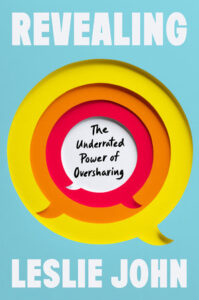
From Revealing: The Underrated Power of Oversharing by Leslie John. Published on February 24, 2026 by Riverhead Books, an imprint of Penguin Publishing Group, a division of Penguin Random House LLC. Copyright © 2026 by Leslie John.

Leslie John
Leslie John is the James E. Burke Professor of Business Administration at the Harvard Business School. Her award-winning research appears in top academic journals and media including The New York Times, The Wall Street Journal, and The Economist. A Canadian-born internationally trained ballet dancer, she now calls Boston home.