Read an Original Review of All the King’s Men on Its 80th Anniversary
“Magnificently vital reading, a book so charged with dramatic tension it almost crackles with blue sparks.”
Perhaps you’ve recently been feeling a call to reread Robert Penn Warren’s Pulitzer Prize-winning novel, All the King’s Men. It could be because our world is a disturbing mirror to that dystopian tale of populism. It could be because we have our very own Willie Stark in the president’s seat and seemingly countless Jack Burdens surrounding him.
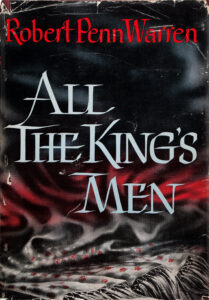
Or possibly, it’s because somewhere in your subconscious, you knew it was the 80th anniversary of that epic political novel, that gorgeously-written and darkly sobering tale of the way a man’s morals can dissolve in the face of power and greed. To celebrate the anniversary, below is the original (mixed) New York Times review by Orville Prescott, the Times book reviewer for 24 years.
*
Soon now we shall go out of the house and go into the convulsion of the world, out of history into history and the awful responsibility of Time.
“An exciting new novel is published today. It isn’t a great novel or a completely finished work of art. It is as bumpy and uneven as a corduroy road, somewhat irresolute and confused in its approach to vital problems and not always convincing. Nevertheless, Robert Penn Warren’s All the King’s Men is magnificently vital reading, a book so charged with dramatic tension it almost crackles with blue sparks, a book so drenched with fierce emotion, narrative pace and poetic imagery that its stature as a ‘readin’ book,’ as some of its characters would call it, dwarfs that of most current publications. Here, my lords and ladies, is no book to curl up with in a hammock, but a book to read until 3 o’clock in the morning, a book to read on trains and subways, while waiting for street cars and appointments, while riding elevators or elephants.
…
Warren toys with the questions, but does not answer it. Through the eyes of his narrator, a corrupt and cynical newspaper man enrolled in the dictator’s service, he sees Huey’s career without illusions as to his personal faults … Mr. Warren has not chosen to recognize Huey as the personification of an American variety of fascism.
This does not mean that All the King’s Men does not consider issues. But Jack Burden, the reporter turned official blackmailer for the Boss, is an inadequate medium for their consideration. Although learned in history, Jack is so cheaply cynical that he is entirely bogged down in a morass of relativity where ends justify means and good and bad are meaningless words. In the end, after contemplating the superior behavior of several others, Jack concludes that loyalty and courage really are virtues, after all. But the reform comes too late and is not persuasive.
…
The two themes are woven together adroitly so that they cross, and recross, with flashbacks in time, with interpolated stories almost completely independent in themselves, with episodes of thundering melodrama. Willie Stark as a man and a politician is superbly well realized. Jack tells his story with a cynical humor, a raw vitality and an awed wonder that are immense. He is equally skillful in suggesting the futility of the old tradition when confronted with men like Willie, and, in poetic passages of pure atmosphere, rushing highways at night, old towns on the Gulf, the noisome aggregate of crawling, subhuman life around the great man.”
–The New York Times, August 19, 1946

Book Marks
Visit Book Marks, Lit Hub's home for book reviews, at https://bookmarks.reviews/ or on social media at @bookmarksreads.