An Angel Watching Over Me: On Exile, Estrangement and Placelessness in Paris
Timothy Taylor Remembers His Mother's Journey From Europe to the Americas, and Those Who Helped Her Along the Way
1.
The International Refugee Organization (IRO) put the three women up in Paris. My eighteen-year-old mother, Ursula; her sister, Traute; and my grandmother, Gertrud. It was supposed to be a one-night layover, just long enough for them to get their entry visas stamped at the Ecuadorian embassy, then transit fifteen hours by train to Genoa, where the SS Marco Polo was waiting to make the crossing to Guayaquil, at which point they’d finally be reunited with my grandfather after eight years of anxious separation.
This was 1948. It would be almost sixty years later that my mother would tell me the fullest version of the story, not long after her cancer diagnosis. I’d just been in Paris myself. In fact, I’d been there three times that year, on a lucky streak I was too naive to appreciate at the time. I’d taken the most recent trip in connection with a documentary film a friend of mine was making about Mavis Gallant, for which I’d done the interviews. Mavis and Iate dinner at Le Dôme and Wadja in Montparnasse. She never really answered any of my writing questions, though at the end of one evening, she told me I reminded her of her ex-husband, Johnny. She was holding my arm tightly as we stepped around puddles toward a taxi in Boulevard Raspail. She was eighty-three that year.
Do you know what I told Johnny just after we were married? Mavis said, looking up at me. I said to him: You’re so tall, I’ll never need a horse!
The next morning my friend and I had an argument in Charles de Gaulle Airport because we got bumped to a later flight and I was in a mounting panic about my mother and becoming completely unreasonable.
I got back to Vancouver and took another flight the next morning to see her in Edmonton. Of course she would hardly say a word about how she felt, just kept turning the conversation back to me and my wife and young son, my work, and my latest trip to the City of Light. Those were the circumstances under which my mother surprised me with one additional detail about her long-ago time in Paris. No, she’d never met Mavis Gallant, who arrived two years after my mother was there, moving on different currents, flowing with a different tide. But that summer of 1948, my mother had met an angel.
“An angel?” I asked. This was new.
“Our angel,” my mother said. “I can’t be sure anyone else saw him. But we did. We three.”
Perhaps she thought that as a writer, I’d look beyond the edges of the particular detail: outside the white border of the photograph and into the shadowy backrooms of the world beyond what’s captured by the lens.
She was wrapped in a blanket in her favorite chair. My father was running the skid steer outside, clearing the snow, leaving dirty white mounds to either side of the driveway that led from the house out to the range road. The light had a wintry grain, with flecks of color suspended in it. I watched her in that light, her body failing her in front of my eyes.
But she was smiling, remembering, her gaze drifting to the window and out across the fields beyond, crop stubble rolling to the distant tree line.
I’d eventually compare notes on the angel story with my sister. Shelagh had been told something similar, only that the man they met that summer was like an angel. That wasn’t how my mother phrased it when we spoke. She said angel. Our angel. Perhaps she thought that as a writer, I’d look beyond the edges of the particular detail: outside the white border of the photograph and into the shadowy backrooms of the world beyond what’s captured by the lens, the film, the print, the frame, the memory.
2.
The IRO put them up near Place Pigalle, which was sketchy back then, not camp like it is now. Postwar Pigalle, down Boulevard de Clichy, around Place Blanche, you watched your step. Especially women, with all those drunken servicemen rolling through, packs of them, fights spilling out of the cafés, catcalls and spitting in the streets.
Madame Delisle was their host. She ran the hotel where they were billeted a block north of the boulevard. She took one look at Gertrud with her two teenage daughters and pulled my grandmother aside. It was urgent. You watch these two! There are men in Pigalle who would take them. You understand?
“So Madame Delisle was your angel?”
No, no. Delisle was fiery and wonderful, but the angel came later.
They arrived on a hot July Saturday, and the streets were teeming. The plan was to walk to the Ecuadorian embassy, on Avenue de Messine, west into the Eighth Arrondissement, just south of the gate into Parc Monceau.
Delisle rushed them out the door, tapping her wristwatch. Hurry, hurry!
Delisle knew something Gertrud and her daughters didn’t yet. There were millions of people on the move in Europe at the time, rivers of humanity trying to find their way back home or to temporary new homes or to loved ones with whom they’d figure out where home was, if there was any home left at all. Soon afterwards, Mavis would be up in Montparnasse watching the same chaotic flow, writing the first of the stories that would make her one of the century’s great chroniclers of exile and its varieties. Delisle had seen enough to know that these currents were overwhelming, even dangerous at times. So she gave my grandmother and her daughters those few words of urgent advice, took their luggage brusquely, then shooed them out the door.
They hurried westward through the shimmering streets of the neighborhood of Saint-Georges. They were nearly run over by a man on a bicycle crossing Rue Ballu. Traute broke the heel of her shoe on a curb near the Liège Métro station. They were jostled by men carrying heavy crates, cursed out by a man selling a pair of old boots, and viewed with suspicion by seemingly everyone else. When they finally stumbled out of a side street and into Place de l’Europe, Ursula could see that her mother’s upper lip was beaded with sweat and trembling. Cars and trucks piled into the roundabout, horns blaring. Pedestrians surged in all directions along the sidewalks. Below them, clattering on a dozen parallel tracks, the trains were coming and going, arriving and departing, thundering underground. My mother felt grit on her skin and the fumes gagged her. Traute, white and shivering, clung to Gertrud. As they tried to cross the road from one branch of the roundabout to another, they lost all sense of direction in the dizzying flow, and with the briefest break in the traffic, they lurched together into the street, crossing over not to the west side of the circle, as they’d planned, but across the lanes of traffic and up onto the central island. There they stood, marooned among crushed shrubbery and wilting flowers as heavy trucks and buses roared past seemingly inches away.
For a moment, it seemed to my mother as if they’d entered the thudding chambers of the city’s very heart, all things rushing past them, a cyclone of humanity trying to get home. Traute burst into tears, and Gertrud looked faint from the heat, ready to slump, to surrender. And that’s when their angel first appeared.
“In the form of a man, to be clear,” my mother told me.
“No wings? No halo?”
“Exactly, no,” my mother said.
He stood on the far side of the circle, right between Rue de Vienne and Rue de Madrid, where they’d been trying to go. Handsome, a bit older. Ursula noted his regal bearing as he stood there, watching them with curiosity and concern. She inhaled sharply because the man simply stepped off the curb, walking directly into the roundabout, and advanced calmly toward them as traffic slowed then stopped entirely in a rank of cars and trucks, no horns sounding at all.
Grey suit, crisp white shirt, with a gold wristwatch visible at the cuff. The angel wore a trim charcoal Borsalino with a tiny bouquet of songbird feathers and a scarlet paisley scarf that rippled in the breeze.
And then he was there with them, taking Gertrud by the arm. Traute took his other arm as their angel led the three of them back across the road, and Ursula watched the scene unfold as if it were a kind of bewildering theatre for them alone, all those cars and pedestrians seeming to freeze in waiting—one moment, two moments—before they all crashed into motion again behind them, clamoring back to their full torrent like the walls of the Red Sea surging shut behind Moses and the Israelites.
“Woah,” I said.
“I know,” my mother said. “Then he walked us the rest of the way to the embassy.”
By which point they were sticky with the effort of walking across those hot paving stones and through exhaust fumes. Only their angel was as unruffled as before, not a pleat out of place.
“And then what?” I asked. “Did he disappear? Poof!”
Not quite. First they had to discover that the Ecuadorian embassy was closed on July 24. “Simón Bolívar Day,” my mother said. “Of course, by the Monday when they were open, we’d missed our boat!”
“But your angel,” I said.
“Oh, he was lovely.” He walked them all the way back across town, navigating the spokes, arcs, and roundabouts of Paris. Across the railway tracks again, Gertrud walking next to him, Ursula and her sister trailing behind. Up Rue de Saint-Pétersbourg. Past the towering neo-Gothic facade of Église Saint André-de-l’Europe, where they could hear the organ being played and where their angel took them inside to listen. Ursula stared up from the gloomy nave at the enormous mahogany machine booming from the balcony and, rising from it, those shining, impossible banks of pipes that reached into the arches above.
My mother sighed remembering, a faint smile painting her lips. Back to the boulevard and around Place de Clichy, with its statue of Marshal Moncey. Some enormous battle to defend Paris against the Russians had been fought there, my mother told me. There was a warrior goddess carved into the pedestal, weeping for all those slain.
3.
“Can I make you something to eat?” I asked her. “An egg?” And she nodded, so while she continued to speak, I began pulling things out of the fridge and finding the right pot, running some water. Outside I could hear the whine of the skid steer hydraulics as my dad cleared snow from the area where they parked the cars.
The delay on the visas meant waiting three months for the SS Marco Polo to return to Genoa, then ready itself for the next crossing. All told, that meant the women were stranded in Paris through the summer to November.
“You must have been disappointed,” I said.
“I was not,” my mother said. “I didn’t want to leave.”
“Didn’t you want to see Opa?”
Her father, Felix, had been waiting for them in Ecuador since 1940. He’d been writing his thoughts down all that time, which I’d learn only later, when his journals and letters were given to me. I know now that he was lonely; he was living for the day his family got off that boat in the Port of Guayaquil. And of course I know my mother would have missed him terribly. She’d said so. Only, at eighteen, she could acknowledge she wanted the calamity of war behind her. To Ursula, that felt easier to achieve by Felix returning to postwar Europe, not all of them traipsing across the Atlantic to a place she had trouble finding in an atlas when she’d first heard the name.
I was watching her as the water boiled. When I was eighteen, I still had Porsche posters on my bedroom wall and slept nightly with my English bulldog, Max. My mother was being asked to start her life over again. So they missed their boat, and she was glad for the reprieve, even if they were nearly broke, even if they were on a very small IRO stipend and the hotel had bugs. If you woke at night to go to the bathroom, you’d see them marching up and down the walls. Not cockroaches. Some kind of carpet beetle, with the odd centipede joining the parade.
“Soft or hard boiled?” I asked her, and she said soft. I set the timer and returned to the counter to listen. I could see her mind drifting back.
“There was a swimming pool over near Stalingrad station. Piscine Château-Landon. We liked to go there.”
The pool wasn’t free, so they’d save a bit of their IRO money daily. Then on Fridays they’d treat themselves. In August, when the city was quieter but the air grew heavy and hot, they even went twice a week sometimes, skipping the metro and walking. Gertrud and the girls would make their way eastward, then south between the stained sandstone buildings to the pool. Sometimes there would be groups of young men along the sidewalks by the entrance to the pool, playing a game with coins thrown against a wall. Gertrud would keep the girls close, one on either side. They’d step into the street to pass these groups of men, who followed them with their eyes, exchanging comments in French. Low whistles, clicking sounds. Hé, les belles!
On one particular muggy day, there had been only a few young men loitering outside before their swim. But when they emerged later—hair carefully dried, lipstick reapplied as always since even the suggestion that they’d recently been in bathing suits seemed to agitate the men further—there seemed to be quite a lot more of them, some kind of coin-tossing tournament going on along the sidewalk of the Rue de Château-Landon across from the pool. Much cheering and jeering. Except from one small group, who spied the women coming out of the pool and seemed to fix on them with special focus. Five or six men in dark trousers, with untucked shirts and loose jackets, hands in their pockets, shouldering off the wall and cutting slowly across the street, angling into the women’s path.
Gertrud and her daughters walked in tight formation. The men sauntered, staring. These were signs the women could easily read as the air cooled and their hearts sped. Ursula felt a numbness in her legs as they made their way, step by step, as the young men assumed a position against the wall ahead of them in the street, gesturing and talking, eyes glinting, white teeth flashing. Belles! Belles! One man now, with a wide smile, leaning close as they approached, speaking, it seemed, to my mother directly: Hé, mademoiselle…t’es pas d’ici, hein.
Gertrud’s arm went rigid against Ursula, whose step had faltered, whose breathing had gone deep and fast. Not from around here. It wasn’t curiosity. The words were insinuating, territorial, postwar code from a man to anyone not scanning as local. Were the stranger also a woman, the insinuation carried an added note of warning.
“And that’s when we saw him again. Our angel was right there on the sidewalk, just past the young men. We were so surprised. So intensely relieved. And they saw him too, immediately. They saw us looking and followed our gaze.”
Their angel approached with an easy and neutral expression on his face. When he closed the distance, he made a sharp gesture to the young men, two fingers angled toward the street. He said some words Ursula could not hear, not angry words, but directive. And with those words and that gesture, the young men shifted suddenly in posture, in attitude. They seemed to waver, lose definition somehow, then dissolve off the wall and disappear back into the street.
Grey suit, crisp white shirt, gold wristwatch just visible. Borsalino with its spray of feathers. My friends, my friends. How fortunate I am to see you again. And he shook each of their hands in turn, taking them with both his own hands, which were smooth and cool and, on Ursula’s palm at least, left the barest trace scent of talc.
Then he took them for coffee and a pastry he called flan pâtissier. Nobody said a word about the men on the street or the war or what it meant to be an exile, a refugee, placeless. None of them dwelt on what it meant to have lost, to be lost. They just sipped their coffee and marveled at the flan, with its delicate custard and buttery crust. After that, their angel bought them souvenir scarves from a shop nearby, as if he anticipated this would be the last time he saw them. My mother’s had a scarlet border surrounding scenes from the city, Les Halles, Les Invalides, the Luxor Obelisk, the windmills of Montmartre, and near the centre, a coat of arms of some kind, which my mother couldn’t identify, but which I did years later, long after she described it to me that afternoon I made her an egg. Long after the cancer killed her and we all got much older, the grief not really fading away but becoming something else entirely, brighter and more penetrating with time.
It was a seal, I learned, only recently: the antique seal of the water merchants of Paris, who had drifted here themselves, to the city that now flourished around Ursula in all its terrible splendor.
4.
She ate the egg I made her that day. No salt, no pepper, she said. Her stomach was already turning on her. Then she sat for a moment. She said thank you, very quietly. I saw that her eyes were full of tears. And then she threw the egg up into her lap.
“I’m sorry. I’m sorry. I’m sorry.”
So the time comes for leaving, eventually, always. We fly or we sail. We cross a distance and soar through the atmosphere. The formations of night rise ahead. The jeweler’s black velvet is spread across the land and the ocean. We see the sparkling gemstone cities, the shimmering pearl of coastal lights. Over the prairie there would be lightning that evening, dropping in shattering bolts from swollen purple clouds. Rain would come in sheets across the farmhouse roof as she lay dying.
My father would roll up onto an elbow in bed, lean over her. Ursula?
We had wind in our hair, all of us. My wife and I were forty-three years old that year; our son was a toddler. I’d dressed him in clothes I brought home from a shop in Montparnasse, little overalls and a sweater with a big B on the front. My mother had smiled at the pictures, her eyes brimming.
In the taxi, Mavis had asked: You know Joseph Roth? And when I said I’d read The Legend of the Holy Drinker, she gripped my arm and looked up at me in mock alarm. She said: You are the red-haired Jew!
And the world tipped over as we spoke. The world rotated, and I could see ahead around the curve of it. I could see Ursula on the cresting swell, wondering what was to become of her as the land dropped away behind the SS Marco Polo, as the Atlantic became an enormous night system of its own textures and codes, the cabin rolling. Ursula on the deck in the darkness, the wake phosphorescent green, everything behind her, all of Europe, dissolving.
She was clear of the locks by then, through the channel, out of the canal. She was across the abyss without fear. With wings, with loyal mind, Ursula slipped free.
Ursula? My father would say that night. Dear God, Ursula. Wake up.
He came a final time, Ursula’s angel. It was the day after the fireworks at Versailles that they’d saved four weeks to afford, at which Ursula had cringed and covered her eyes. She’d pressed her face to her mother’s chest, every cracking starburst bringing back explosions in the air over Münster, the burnt-out shell of their house in Friedrichstrasse. That famous summer, at the fireworks in Versailles, every streaking green flame shook a sheet of light across the crowd sitting on blankets on the lawns. And Ursula tried to block them out, but the lights still flashed inside her eyelids. Sheets of flame, crumbling brick, a spiraling murmuration of cinders.
The next day, Gertrud walked her daughters thirty minutes down to Les Halles, where you could lose yourself in the ranks of produce and cheese shops and butchers, where you could gaze at the offerings even if you had no kitchen in which to prepare them or money with which to buy them. Beef cheeks and tongues, Frenched racks of lamb, glistening hams, poulet de Bresse, and rabbits still with their heads, round eyes blinkless under long lashes frozen in the ice.
Did the tumult follow them? Did they somehow draw it to themselves? Ursula wondered about this at the time and then later over the years.
They heard a rumble first. Then they heard the sound of stomping feet. And then the market was transformed. Somewhere a hand was raised, a whistle was blown, and all at once the butchers were out of their stalls, assembling in the aisles. There was shouting. There was a sudden flourishing of knives, blades flashing in the market lights. From all directions at once, the butchers were crushing toward the exits, holding their boning knives and cleavers aloft. One butcher joined the march with the longest carving fork Ursula had ever seen, twin tines glittering sharp overhead. They came all at once, the air clamoring, rushing, with Ursula and her mother and sister trapped in the middle once again.
“It was a labour strike,” she told me on the farm that day. “They weren’t after us, of course. But we were still terrified. Two hundred butchers out for a protest march and waving their knives about.”
I imagined I could see them. In the inky night, above the Rockies, heading home, I closed my eyes, and perhaps that’s how our final connection was made, in sleep, in her dreams. I saw those flashing knives and knew them by their names: the grande couteau de cuisine, the couperet, the tapering tranchelard. We looked on those butchers together, my mother and I. We looked on those gleaming, murderous blades.
It was the perfect moment for him to make his final appearance, their Borsalino angel, in his enduring cloak of silent calm. He slipped through that crowd of butchers as if they weren’t even there. A hand to guide Gertrud and a gesture for the girls to follow, which they did. They followed their angel faithfully and returned exactly the way he’d come, directly through that crowd of chanting men in their blood-stained aprons. As the dream unspooled, Ursula followed him to Genoa and up the gangplank of the ship that would transport her to the life she hadn’t wanted and she could not then think to predict.
She followed him even as his image faded. To Curaçao, where the air was perfumed with dama di anochi blossoms and the night was navy blue. To Barranquilla, where rickety shacks spidered up the shoulder of the hill. My flight was bending earthward across the Garibaldi Highlands, cutting the rocky shoreline over Lighthouse Park, just as she entered the Panama Canal, in bright sunshine now, shielding her eyes to see that great machinery of passage and the men who worked the Gatun and Pedro Miguel locks, scaling ladders, heaving ropes, ratcheting enormous winches of chain. Los canaleros, the men were called. They guided you through. They eased your passage on toward the other side.
Wheels down. A shriek of rubber and a puff of smoke as our transitions occurred, the Miraflores locks slipping astern, Panama City now lying low to the south, the Isla Puná, Guayaquil, and a new life just over the horizon ahead.
Oh, my dearest Ursula, my father said. Oh, my dearest love.
But she was clear of the locks by then, through the channel, out of the canal. She was across the abyss without fear. With wings, with loyal mind, Ursula slipped free.
5.
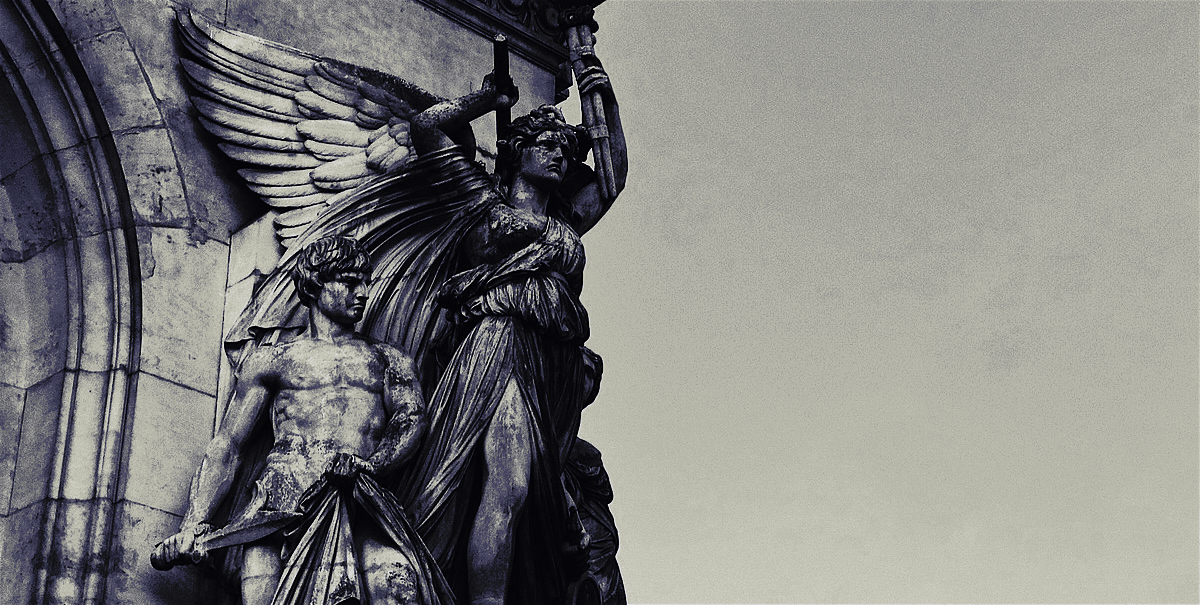
There were always angels in Paris, and there are angels in Paris still. They’re in gold on top of the Paris opera house. There’s one in white marble in Square Samuel Rousseau opposite Saint Clotilde church, wings protectively covering the composer César Franck. You’ll find the Angel of Death himself over in the Third Arrondissement, frescoed on the wall of an inner courtyard off Rue des Archives, presiding over a sundial that was perhaps a prisoner’s last sight before the blade of the guillotine fell.
I retrace my own steps now, slowly. I try to see outside the white border of the photograph and into those shadowy backrooms. I’m not sure I can do it. A writer is never quite sure.
But I am sure of this: Mavis stayed and Ursula left, and it didn’t much change their respective exile. Mavis remains in Paris, lying now in the Peron family crypt in Montmartre Cemetery, a guest of this city even in death. Ursula moved on, across the ocean, around the world. She lived in Ecuador, Venezuela, and Brooklyn Heights, had five kids and became my mother, officially stateless the entire time.
I eat at Wadja as I’m prone to do. I remember how Mavis read the nightly specials for me, translating pavé de biche as “Bambi.” I walk down from where Ursula and Gertrud and Traute stayed in Pigalle, from where they looked up to see the Montmartre windmills. Down through Saint-Georges, past where the embassy was, past the swimming pool where they encountered those men who were perhaps exactly the sort of men Delisle had warned them about at the beginning of that hot summer of 1948. Those who might take you.
Past those places. Keep going. Down past Rue La Fayette. Past Rue du Croissant. And in Place Theodor Herzl I find her. It is a her unmistakably, in her flowing, pleated gown and tassel earrings, her wings spread and pressed against the cornice of the building’s upper floors. She stands five storys above the intersection still, with a leaf raised in her left hand. Ready to direct and protect, both from the men and from the swirling chaos that might otherwise harm you.
Seen, I suspect, by hardly a passing soul.
__________________________________

“The Borsalino Angel” by Timothy Taylor appears in the latest issue of Brick: A Literary Journal.

Timothy Taylor
Timothy Taylor is a Vancouver-based novelist, journalist, and creative writing professor. His eight books include the novels Stanley Park, The Blue Light Project, and The Rise and Fall of Magic Wolf. His memoir Exile Diaries is forthcoming from HarperCollins Canada.